
What Is Medical Billing?
Medical billing is the process of converting healthcare services into insurance claims so healthcare providers can receive payment. It includes verifying patient information, preparing and submitting claims, tracking claim status, resolving denials, posting payments, and following up until the account is fully processed. Medical billing plays a vital role in connecting patient care with the healthcare revenue cycle.

Goals of Medical Billing
Medical billing is designed to ensure that healthcare providers receive accurate reimbursement while maintaining compliance and delivering a smooth financial experience for patients.
Submit Accurate Claims
Reduce billing errors by creating complete and accurate insurance claims.
Receive Timely Payments
Help providers receive reimbursement as quickly as possible.
Minimize Claim Denials
Identify potential billing issues before claims are submitted.
Maintain Compliance
Follow payer guidelines and organizational billing policies.
Improve Revenue Cycle Performance
Support consistent cash flow by managing claims efficiently.
How Medical Billing Works
Medical billing is a continuous workflow that begins before the patient receives treatment and ends only after every payment and patient responsibility has been completed.
Patient Schedules Appointment
↓
Patient Registration
↓
Insurance Verification
↓
Patient Receives Medical Services
↓
Provider Documents the Visit
↓
Medical Coding
↓
Charge Entry
↓
Claim Submission
↓
Insurance Reviews the Claim
↓
Payment Posted
↓
AR Follow-up (If Needed)
↓
Patient Pays Remaining Balance
↓
Account Closed
Key Departments in Medical Billing
Medical billing is a team effort. Each department plays a specific role in moving a patient’s account from registration to final payment.
Front Desk / Patient Registration
Registers patients and collects demographic and insurance information.
Insurance Verification
Verifies eligibility, benefits, and authorization requirements before the visit.
Medical Coding
Assigns diagnosis and procedure codes based on provider documentation.
Medical Billing
Creates and submits insurance claims.
Payment Posting
Records insurance payments, adjustments, and patient payments.
Accounts Receivable (AR)
Follows up on unpaid, denied, and underpaid claims.
Denial Management
Investigates denial reasons, corrects billing issues, and submits appeals or corrected claims when appropriate.
Essential Medical Billing Terms
| Term | Simple Definition |
|---|---|
| Medical Claim | A request for payment submitted to an insurance company. |
| Clean Claim | A claim submitted without errors or missing information. |
| Clearinghouse | A company that checks electronic claims before sending them to insurance companies. |
| Claim Rejection | A claim returned before processing because of missing or invalid information. |
| Claim Denial | A processed claim that is not paid by the insurance company. |
| Payment Posting | Recording insurance payments and adjustments in the billing system. |
| Accounts Receivable (AR) | Outstanding money owed to the healthcare provider. |
| Appeal | A request asking an insurance company to review a denied claim again. |
| Write-off | An approved adjustment that removes part or all of a balance. |
| Patient Responsibility | The amount the patient must pay after insurance processing. |
Medical Billing Process
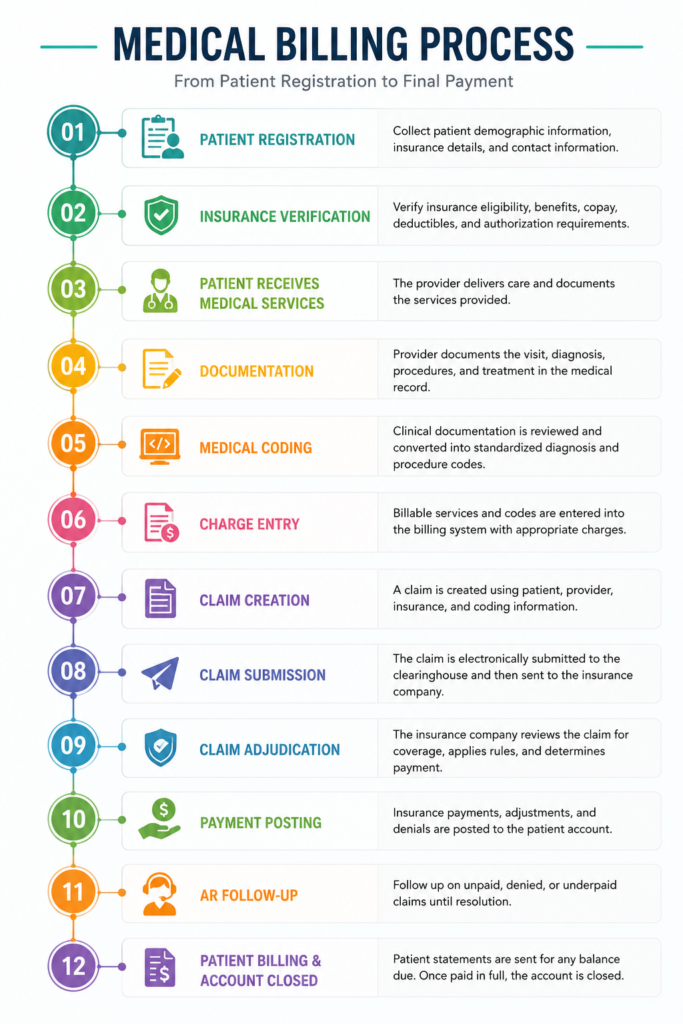
Patient Journey Through Medical Billing
Every patient visit follows a structured financial process. Understanding this journey helps beginners see how healthcare services become insurance claims and how providers ultimately receive payment.
1. Patient Schedules an Appointment
2. Patient Registration
3. Insurance Eligibility Verification
4. Patient Receives Medical Services
5. Provider Documents the Visit
6. Medical Coder Assigns Codes
7. Medical Biller Creates the Claim
8. Claim Submitted to Insurance
9. Insurance Processes the Claim
10. Payment Posted
11. AR Follow-up (if required)
12. Patient Pays Remaining Balance
Keep Learning
Now that you understand how medical billing works, the next step is to learn how every department works together to manage the complete financial lifecycle of a patient account.
In the next module, you’ll explore Revenue Cycle Management (RCM) and discover how patient registration, coding, billing, payment posting, and accounts receivable all work together to support healthcare organizations.
Questions, answered
Have questions about the US healthcare system? Find clear, beginner-friendly answers to some of the most common questions to strengthen your understanding before moving on to the next module.
What is medical billing?
Medical billing is the process of preparing, submitting, tracking, and managing insurance claims so healthcare providers receive payment for the services they provide.
Is medical billing difficult to learn?
Medical billing may seem complex at first, but understanding the workflow step by step makes it much easier. With regular practice and real-world examples, beginners can build confidence quickly.
What is the difference between medical billing and medical coding?
Medical coding converts clinical documentation into standardized codes. Medical billing uses those codes to create claims, submit them to insurance companies, and manage the payment process.
Why do insurance companies deny claims?
Claims may be denied because of missing information, coding errors, eligibility issues, authorization requirements, or payer-specific billing rules. Identifying the cause and taking the correct follow-up action is an important part of medical billing.
What should I learn after medical billing?
After understanding medical billing, the next step is to learn Revenue Cycle Management (RCM). RCM explains how every department works together from patient registration through final payment, giving you a complete picture of the healthcare revenue process.