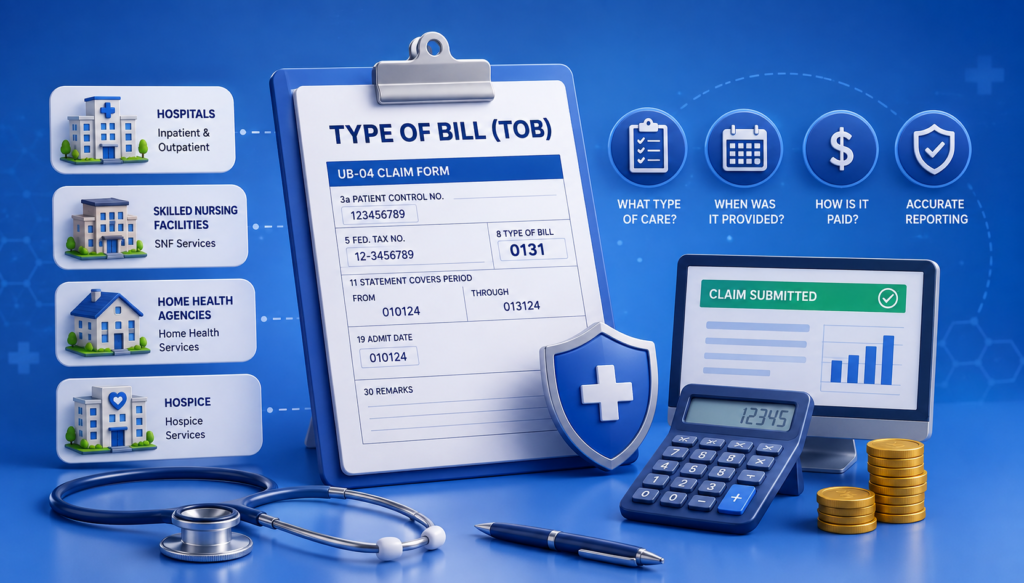
What Is a Type of Bill (TOB)?
A Type of Bill (TOB) is a standardized three-digit code reported on the UB-04 (CMS-1450) claim form that identifies the institutional healthcare facility submitting the claim, the classification of services provided, and the billing frequency. Insurance companies use TOB codes to correctly process institutional claims, apply reimbursement rules, and distinguish between original claims, corrected claims, interim bills, and final bills.

Goals of Type of Bill (TOB)
Type of Bill codes provide insurance companies with standardized information about institutional claims, helping ensure accurate claim processing, reimbursement, and billing compliance.
Identify the Healthcare Facility
Specify the type of institutional provider submitting the claim, such as a hospital, skilled nursing facility, hospice, or home health agency.
Classify Healthcare Services
Identify the type of services being billed, including inpatient, outpatient, laboratory, or other institutional services.
Indicate Claim Frequency
Show whether the claim is an original bill, interim bill, corrected claim, replacement claim, or final claim.
Improve Claim Accuracy
Ensure institutional claims are submitted with the correct billing information to reduce errors and payment delays.
Support Insurance Reimbursement
Help insurance companies correctly process institutional claims and determine reimbursement.
How Type of Bill (TOB) Works
When an institutional healthcare provider delivers services to a patient, the facility billing team prepares a UB-04 (CMS-1450) claim. Before submitting the claim, the appropriate Type of Bill (TOB) code is selected based on the facility type, the classification of services provided, and the claim frequency. The TOB code is reported along with Revenue Codes, ICD-10-CM diagnosis codes, CPT®/HCPCS codes (when applicable), and other billing information. The insurance company uses the TOB code to identify the claim type, apply reimbursement policies, and process payment.
Patient Receives Facility Services
↓
Provider Documents Services
↓
Medical Coder Assigns Diagnosis & Procedure Codes
↓
Facility Billing Team Reviews Documentation
↓
Select Appropriate Type of Bill (TOB)
↓
Assign Revenue Codes
↓
Prepare UB-04 (CMS-1450) Claim
↓
Submit Claim to Insurance
↓
Insurance Reviews Claim
↓
Claim Closed
Common Type of Bill (TOB) Codes
Type of Bill codes identify the healthcare facility, service classification, and claim frequency. Below are some commonly used TOB codes in institutional medical billing.
111
Hospital Inpatient – Admit Through Discharge
113
Hospital Inpatient – Interim Continuing Claim
114
Hospital Inpatient – Interim Last Claim
117
Hospital Inpatient – Replacement Claim
131
Hospital Outpatient – Original Claim
137
Hospital Outpatient – Replacement Claim
211
Skilled Nursing Facility (SNF) – Inpatient
321
Home Health Agency – Original Claim
711
Rural Health Clinic – Original Claim
851
Critical Access Hospital (CAH) – Outpatient
Note: TOB codes vary depending on the facility type and payer requirements. Medical billers should always verify payer-specific billing guidelines before claim submission.
Essential Type of Bill (TOB) Terms
| Term | Simple Definition |
|---|---|
| Type of Bill (TOB) | A three-digit code that identifies the facility type, bill classification, and claim frequency. |
| UB-04 (CMS-1450) | The institutional claim form used by hospitals and other healthcare facilities. |
| Facility Type | Identifies the type of healthcare provider submitting the claim. |
| Bill Classification | Indicates whether the claim is inpatient, outpatient, or another institutional service. |
| Claim Frequency | Shows whether the claim is original, interim, replacement, or void. |
| Revenue Code | A four-digit code identifying the hospital department or service category. |
| Institutional Claim | A claim submitted by a healthcare facility using the UB-04 claim form. |
| Replacement Claim | A corrected claim submitted to replace a previously processed claim. |
| Void Claim | A claim submitted to cancel a previously processed claim. |
| Interim Claim | A partial claim submitted before the patient’s treatment is completed. |
Type of Bill (TOB) Billing Process
Understanding the TOB billing process helps institutional billers submit accurate UB-04 claims, reduce claim denials, and ensure timely reimbursement.
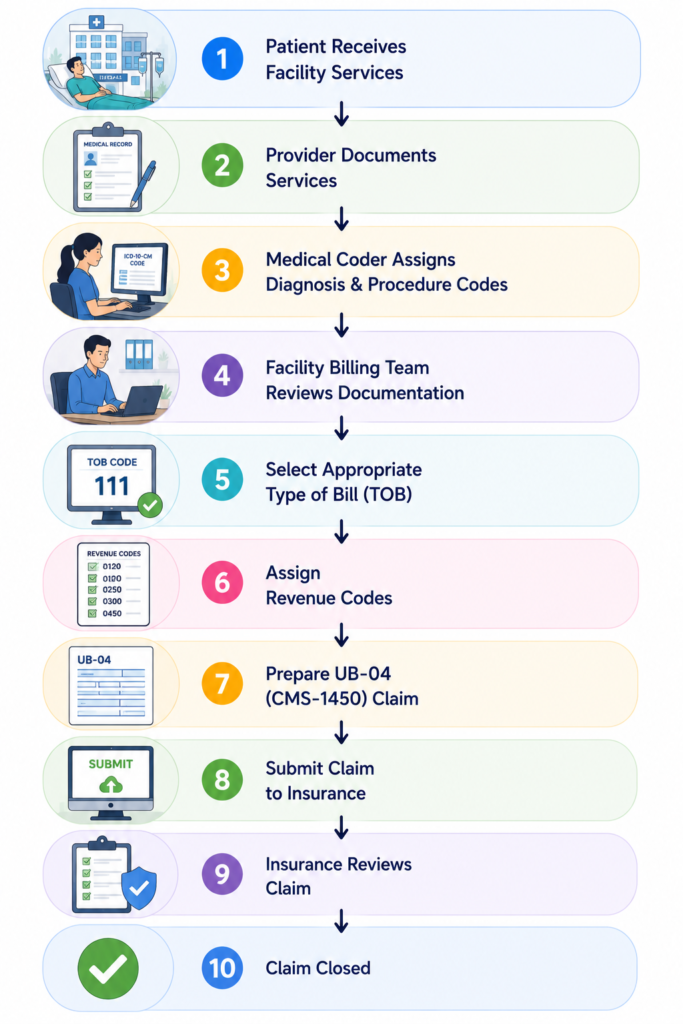
Patient Journey and Type of Bill (TOB)
When a patient receives care at a hospital or another institutional healthcare facility, the services provided are documented and coded before a claim is submitted. The facility billing team assigns the appropriate Type of Bill (TOB) code based on the facility type, service classification, and claim frequency. The completed UB-04 claim is then sent to the insurance company for review and reimbursement.
1. Patient Receives Facility Services
2. Provider Documents the Services
3. Medical Coder Assigns Diagnosis and Procedure Codes
4. Facility Billing Team Reviews Documentation
5. Appropriate Type of Bill (TOB) Code is Selected
6. Revenue Codes are Assigned
7. UB-04 (CMS-1450) Claim is Prepared
8. Claim is Submitted to Insurance
9. Insurance Reviews the Claim
10. Claim is Closed
Keep Learning
Congratulations! You now understand the fundamentals of Type of Bill (TOB), including its structure, components, billing process, and role in institutional medical billing. Correct TOB coding helps insurance companies accurately identify facility claims, process payments, and reduce billing errors.
In the next module, you’ll learn about Claim Submission, including how medical claims are prepared, transmitted to insurance companies, common submission methods, clearinghouses, and best practices for submitting clean claims.
Questions, answered
Have questions about the US healthcare system? Find clear, beginner-friendly answers to some of the most common questions to strengthen your understanding before moving on to the next module.
What is a Type of Bill (TOB)?
A Type of Bill (TOB) is a standardized three-digit code used on the UB-04 (CMS-1450) claim form to identify the healthcare facility, bill classification, and claim frequency.
Where are TOB codes used?
TOB codes are used only on institutional claims submitted using the UB-04 (CMS-1450) claim form by hospitals, skilled nursing facilities, home health agencies, hospices, and other institutional providers.
What information does a TOB code provide?
A TOB code identifies:
The facility type
The classification of services
The claim frequency (original, interim, replacement, or void)
Is a TOB code required on CMS-1500 claims?
No. TOB codes are not used on CMS-1500 professional claims. They are only used on UB-04 institutional claims.
Can an incorrect TOB code cause claim denials?
Yes. Selecting the wrong TOB code can result in claim rejections, payment delays, reimbursement errors, or claim denials because the insurance company may process the claim under the wrong billing category.