
What Are Revenue Codes?
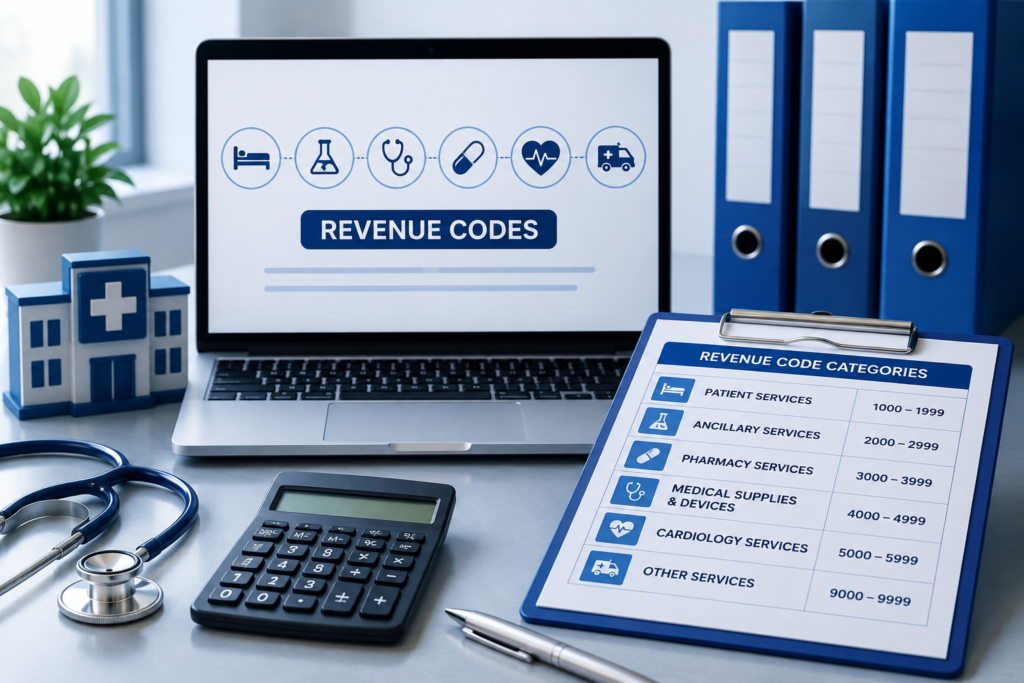
Revenue codes are standardized four-digit codes used on the UB-04 (CMS-1450) claim form to identify the department, accommodation, or service category that provided care to a patient. They are used for institutional (facility) billing, while professional claims submitted on the CMS-1500 form do not use revenue codes.
Goals of Revenue Codes
Revenue codes help healthcare facilities accurately identify the department or service category responsible for patient care. They support proper claim processing, reimbursement, and compliance with payer requirements.
Identify the Service Department
Specify the hospital department or cost center that provided the service.
Support Institutional Billing
Provide the information required to submit accurate UB-04 facility claims.
Improve Claim Accuracy
Ensure facility charges are reported correctly to reduce billing errors.
Prevent Claim Denials
Use the appropriate revenue code to avoid claim rejections and reimbursement delays.
Support Accurate Reimbursement
Help insurance companies correctly process and reimburse institutional claims.
How Revenue Codes Work
Revenue codes are assigned by healthcare facilities when institutional services are provided to a patient. Each revenue code identifies the hospital department or service category responsible for the charge. The facility billing team enters the revenue code on the UB-04 (CMS-1450) claim form, along with the appropriate CPT®/HCPCS procedure codes (when required), diagnosis codes, and charge amounts. The insurance company reviews the claim and processes reimbursement based on the reported services and the patient’s benefits.
Patient Receives Facility Service
↓
Hospital Department Provides Care
↓
Revenue Code Assigned
↓
CPT®/HCPCS Code Assigned (If Required)
↓
ICD-10-CM Diagnosis Codes Assigned
↓
UB-04 Claim Prepared
↓
Claim Submitted to Insurance
↓
Insurance Reviews Facility Claim
↓
Payment Processed
↓
Claim Closed
Common Categories of Revenue Codes
Revenue codes are grouped into categories based on the type of department, accommodation, or healthcare service provided. Understanding these categories helps medical billing professionals accurately report facility charges on institutional claims.
Room and Board
Used to report inpatient accommodations such as private rooms, semi-private rooms, intensive care units (ICU), and other hospital stays.
Emergency Department
Identifies services provided in the hospital emergency department.
Operating Room
Used for facility charges related to surgical procedures performed in the operating room.
Recovery Room
Reports services provided during post-operative recovery following surgery.
Laboratory Services
Used for clinical laboratory testing performed by the healthcare facility.
Radiology and Imaging
Includes X-rays, CT scans, MRI, ultrasound, nuclear medicine, and other diagnostic imaging services.
Pharmacy
Reports medications supplied and administered by the healthcare facility.
Physical, Occupational, and Speech Therapy
Used for rehabilitation services provided by licensed therapists.
Observation Services
Reports facility charges when a patient is placed under observation before admission or discharge.
Other Ancillary Services
Includes respiratory therapy, dialysis, cardiac services, outpatient clinics, infusion services, and many other hospital departments.
Essential Revenue Code Terms
| Term | Simple Definition |
|---|---|
| Revenue Code | A four-digit code used on the UB-04 claim to identify the department or service category providing care. |
| UB-04 (CMS-1450) | The institutional claim form used by hospitals and other healthcare facilities. |
| Institutional Claim | A claim submitted by a healthcare facility for facility charges. |
| Facility Charge | Charges billed by a hospital or institutional provider for services and resources provided. |
| Department | The hospital area responsible for providing the service, such as laboratory or radiology. |
| Accommodation | Hospital room or inpatient stay category reported with revenue codes. |
| Ancillary Service | Additional healthcare services such as laboratory, pharmacy, imaging, or therapy. |
| CPT®/HCPCS Code | Procedure code that describes the specific medical service performed. |
| ICD-10-CM Code | Diagnosis code explaining the patient’s medical condition. |
| Cost Center | A hospital department used for billing and financial reporting purposes. |
Revenue Code Process
Understanding the revenue code process helps medical billing professionals correctly report facility services, improve claim accuracy, and support timely reimbursement for institutional providers.
Patient Journey and Revenue Codes
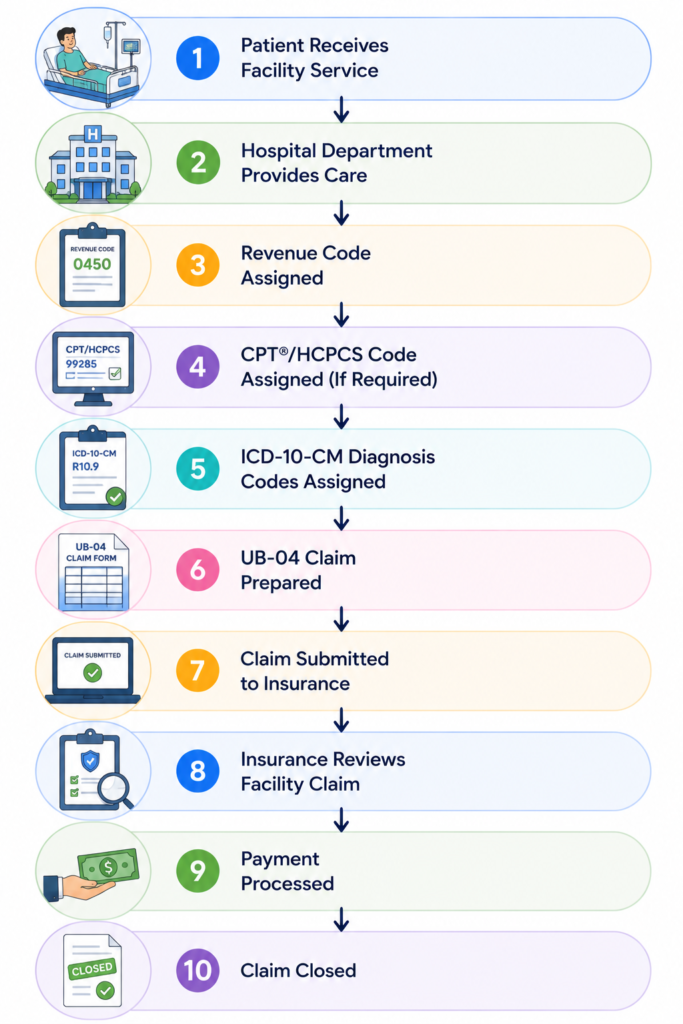
Whenever a patient receives care at a hospital or other healthcare facility, the services provided by different departments generate facility charges. Revenue codes identify the department or service category responsible for each charge, allowing insurance companies to accurately process institutional claims and determine reimbursement.
1. Patient Receives Healthcare Services
2. Hospital Department Provides Care
3. Revenue Code is Assigned
4. CPT®/HCPCS Code is Assigned (If Required)
5. ICD-10-CM Diagnosis Codes are Assigned
6. UB-04 Institutional Claim is Prepared
7. Claim is Submitted to Insurance
8. Insurance Reviews the Facility Claim
9. Facility Reimbursement is Processed
10. Claim is Closed
Keep Learning
Congratulations! You now understand how Revenue Codes are used in institutional medical billing to identify hospital departments and facility services on the UB-04 claim form. Correct revenue code selection improves claim accuracy, reduces billing errors, and supports timely reimbursement. In the next module, you’ll learn about Type of Bill (TOB) Codes, including how TOB codes identify the facility type, bill classification, frequency of the claim, and how they work together with revenue codes to support accurate institutional claim submission.
Questions, answered
Have questions about the US healthcare system? Find clear, beginner-friendly answers to some of the most common questions to strengthen your understanding before moving on to the next module.
What is a revenue code?
A revenue code is a standardized four-digit numeric code used on the UB-04 (CMS-1450) claim form to identify the hospital department, accommodation, or service category responsible for a facility charge.
Where are revenue codes used?
Revenue codes are used only on institutional (UB-04/CMS-1450) claims submitted by hospitals, skilled nursing facilities, home health agencies, ambulatory surgery centers, rehabilitation facilities, and other institutional healthcare providers.
Are revenue codes the same as CPT® codes?
No. Revenue codes identify where a service was provided within a healthcare facility, while CPT®/HCPCS codes describe what medical service or procedure was performed.
Are revenue codes required on professional claims?
No. Professional claims submitted on the CMS-1500 claim form do not use revenue codes. Revenue codes are specific to institutional billing on the UB-04 claim form.
Can incorrect revenue codes cause claim denials?
Yes. Incorrect, missing, or mismatched revenue codes can result in claim rejections, payment delays, underpayments, or denials because the insurance company may be unable to determine the correct facility service category.