What Is CMS?
The Centers for Medicare & Medicaid Services (CMS) is a federal agency within the U.S. Department of Health and Human Services (HHS). It administers Medicare, oversees Medicaid and CHIP, and establishes healthcare policies, billing guidelines, reimbursement rules, and compliance standards. CMS plays a vital role in helping healthcare providers and medical billing professionals submit accurate claims and receive proper reimbursement.
Goals of CMS
CMS works to improve the quality, accessibility, and affordability of healthcare while ensuring that healthcare providers are reimbursed accurately for the services they deliver.
Improve Healthcare Quality
Develop programs and quality standards that encourage safe, effective, and patient-centered healthcare.
Expand Access to Healthcare
Support healthcare coverage through programs such as Medicare, Medicaid, CHIP, and the Health Insurance Marketplace.
Ensure Accurate Reimbursement
Establish payment policies and billing guidelines that help providers receive appropriate reimbursement for covered healthcare services.
Promote Healthcare Innovation
Support new care models, technology, and quality improvement initiatives that improve patient outcomes and healthcare efficiency.
Maintain Program Integrity
Protect federal healthcare programs by promoting compliance, reducing fraud, waste, and abuse, and ensuring responsible use of healthcare resources.
How CMS Works
CMS develops healthcare policies, administers federal healthcare programs, and establishes reimbursement rules that guide the healthcare revenue cycle. Healthcare providers follow these policies when delivering services, submitting claims, and receiving payment through Medicare and other CMS-administered programs.
Patient Receives Healthcare Services
↓
Provider Documents the Visit
↓
Medical Coding (ICD-10-CM, CPT & HCPCS)
↓
Medical Claim Created
↓
Claim Submitted to Medicare or Other Payer
↓
CMS Rules & Coverage Policies Applied
↓
Claim Adjudication
↓
Payment Determination
↓
Provider Receives Reimbursement
↓
Payment Posted
↓
Patient Responsibility (If Applicable)
↓
Account Closed
Healthcare Programs Managed by CMS
CMS administers and oversees several healthcare programs that provide medical coverage to millions of people in the United States. Understanding these programs is essential for anyone working in medical billing or Revenue Cycle Management.
Medicare
Provides health insurance primarily for people aged 65 and older, certain younger individuals with disabilities, and people with End-Stage Renal Disease (ESRD) or ALS.
Medicaid
Provides healthcare coverage for eligible low-income individuals and families. Although Medicaid is jointly funded by the federal and state governments, each state administers its own Medicaid program within federal guidelines.
Children’s Health Insurance Program (CHIP)
Provides low-cost health coverage for eligible children and, in some states, pregnant women whose families earn too much to qualify for Medicaid but cannot afford private insurance.
Health Insurance Marketplace
Allows individuals and families to compare health plans, enroll in health insurance, and determine eligibility for financial assistance through the federal Marketplace.
Medicare Advantage (Part C)
Offers Medicare benefits through private insurance companies approved by CMS. These plans combine Medicare Part A and Part B coverage and often include additional benefits.
Medicare Part D
Provides prescription drug coverage through private insurance companies approved by CMS.
Essential CMS Terms
| Term | Simple Definition |
|---|---|
| CMS | The federal agency that administers Medicare and oversees several national healthcare programs. |
| Medicare | Federal health insurance program for eligible individuals. |
| Medicaid | Joint federal and state healthcare program for eligible low-income individuals and families. |
| CHIP | Children’s Health Insurance Program providing coverage for eligible children. |
| NPI | National Provider Identifier assigned to healthcare providers. |
| HCPCS Level II | Standardized codes for medical supplies, equipment, ambulance services, and certain medications. |
| Fee Schedule | A list of reimbursement amounts established for covered healthcare services. |
| Coverage Determination | A decision about whether a healthcare service is covered under program rules. |
| National Coverage Determination (NCD) | A nationwide CMS policy defining whether Medicare covers a particular service. |
| Local Coverage Determination (LCD) | A coverage policy developed by a Medicare Administrative Contractor (MAC) for its service area. |
CMS in the Healthcare Revenue Cycle
CMS influences every stage of the healthcare revenue cycle by establishing policies that healthcare organizations follow when billing Medicare and other CMS-administered programs. From coding and claim submission to reimbursement and compliance, CMS helps create standardized processes that improve consistency and accountability across the healthcare system.
Patient Journey Through CMS Programs
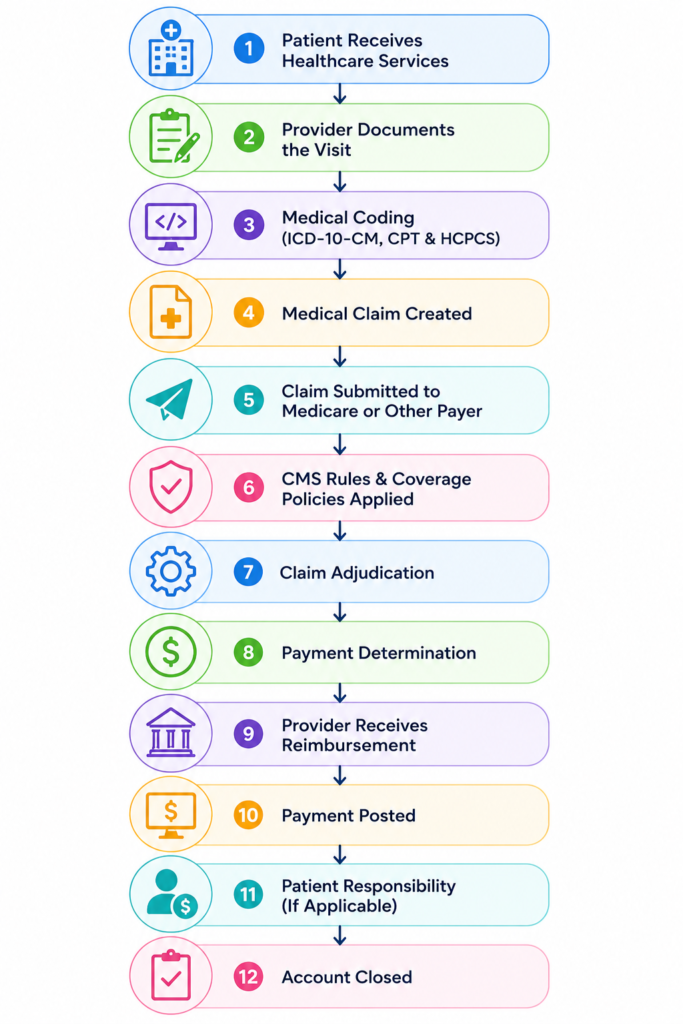
Every patient receiving care under a CMS-administered healthcare program follows a structured process. From receiving medical services to claim processing and reimbursement, CMS helps ensure healthcare services are billed consistently and providers are reimbursed according to established policies.
1. Patient Receives Healthcare Services
2. Provider Documents the Visit
3. Medical Coding (ICD-10-CM, CPT & HCPCS)
4. Medical Claim Created
5. Claim Submitted to Medicare or Other Payer
6. CMS Coverage & Payment Policies Applied
7. Claim Adjudication
8. Payment Determination
9. Provider Receives Reimbursement
10. Payment Posted
11. Patient Pays Remaining Balance (If Applicable)
12. Account Closed
Keep Learning
Excellent! You now understand the role of the Centers for Medicare & Medicaid Services (CMS) and how its policies influence healthcare programs, medical billing, coding, reimbursement, and compliance. In the next module, you’ll learn about the American Medical Association (AMA) and discover how CPT® codes are developed, maintained, and used in medical coding and billing across the US healthcare system.
Questions, answered
Have questions about the US healthcare system? Find clear, beginner-friendly answers to some of the most common questions to strengthen your understanding before moving on to the next module.
What is CMS?
The Centers for Medicare & Medicaid Services (CMS) is a federal agency within the U.S. Department of Health and Human Services (HHS). It administers Medicare and oversees major healthcare programs, reimbursement policies, and healthcare regulations.
What programs are managed by CMS?
CMS administers Medicare, oversees Medicaid and the Children’s Health Insurance Program (CHIP) in partnership with states, and manages the Health Insurance Marketplace at the federal level.
Why is CMS important in Medical Billing?
CMS establishes billing guidelines, reimbursement policies, claim processing standards, and payment rules that healthcare providers and medical billing professionals follow when submitting claims and receiving reimbursement.
Does CMS create CPT codes?
No. CPT® codes are developed and maintained by the American Medical Association (AMA). CMS uses CPT codes for many reimbursement and claims processing purposes and maintains the HCPCS Level II code set.
What is the difference between CMS and Medicare?
CMS is the federal agency that administers Medicare and oversees several other healthcare programs. Medicare is one of the healthcare insurance programs managed by CMS.