What Is CPT®?
CPT® (Current Procedural Terminology) is a standardized coding system that uses five-digit numeric codes to describe medical, surgical, diagnostic, and other healthcare services performed by physicians and other qualified healthcare professionals. It serves as the national standard for reporting professional healthcare services to public and private health insurance programs. The CPT® code set is developed, copyrighted, and updated annually by the American Medical Association (AMA).
Goals of CPT®
CPT® provides a standardized method for reporting healthcare services and procedures, ensuring consistent communication between healthcare providers, insurance companies, and government programs.
Standardize Procedure Reporting
Provide a uniform coding language for reporting medical, surgical, diagnostic, and other healthcare services.
Support Accurate Claim Submission
Ensure healthcare services are reported consistently on professional medical claims.
Improve Insurance Reimbursement
Help insurance companies identify the services performed and determine appropriate payment.
Enhance Communication
Create a common language that allows providers, payers, and healthcare organizations to communicate consistently.
Support Healthcare Data and Quality Reporting
Assist with healthcare analytics, quality measurement, utilization tracking, medical research, and public health reporting.
How CPT® Works
CPT® coding begins after a healthcare provider evaluates the patient and performs a medical service, procedure, or diagnostic test. The provider documents the services performed in the patient’s medical record. A certified medical coder reviews the documentation, assigns the appropriate CPT® code, and links it to the corresponding ICD-10-CM diagnosis code. The medical claim is then submitted to the insurance company, which reviews the reported procedure, medical necessity, and patient benefits before determining reimbursement.
Patient Visits Healthcare Provider
↓
Provider Evaluates Patient
↓
Provider Performs Service or Procedure
↓
Provider Documents the Service
↓
Medical Coder Reviews Documentation
↓
Assign CPT® Procedure Code
↓
Assign ICD-10-CM Diagnosis Code
↓
Submit Medical Claim
↓
Insurance Reviews Claim
↓
Claim Closed
CPT® Code Categories
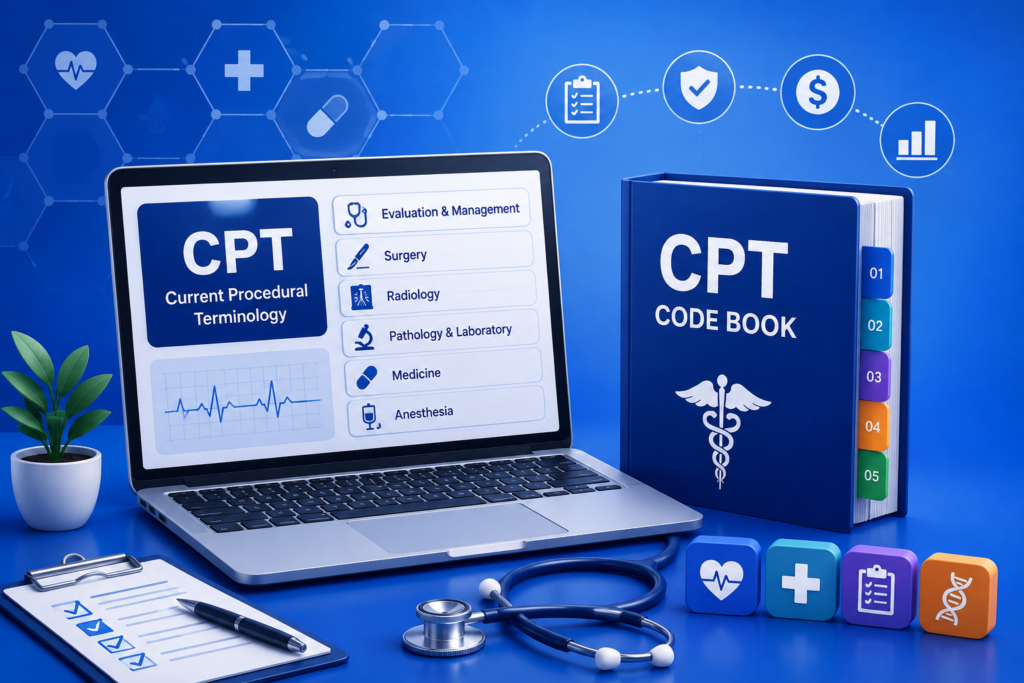
The CPT® code set is divided into three categories, each serving a specific purpose in healthcare reporting and medical billing.
Category I Codes
Category I codes report medical procedures and services that are widely performed and supported by clinical practice. These are the most commonly used CPT® codes for insurance billing.
Six main sections include:
Evaluation and Management (E/M)
Anesthesia
Surgery
Radiology
Pathology and Laboratory
Medicine
Category II Codes
Category II codes are optional tracking codes used to measure healthcare quality and performance. They help collect clinical performance data but are generally not used for reimbursement.
Category III Codes
Category III codes are temporary codes assigned to emerging technologies, new procedures, and innovative medical services. They allow data collection while new procedures are evaluated for future Category I status.
Essential Healthcare Terms
| Term | Simple Definition |
|---|---|
| CPT® | The official procedure coding system used in the United States. |
| Procedure Code | A five-digit numeric code describing a healthcare service or procedure. |
| Category I Code | Standard CPT® codes used for routine medical procedures and services. |
| Category II Code | Optional codes used for quality measurement and performance reporting. |
| Category III Code | Temporary codes used for emerging technologies and new procedures. |
| Modifier | A two-character code added to a CPT® code to provide additional information about a service. |
| Evaluation and Management (E/M) | CPT® codes used to report office visits, hospital visits, and other patient evaluation services. |
| Medical Necessity | Demonstrates why a healthcare service was required based on the patient’s diagnosis. |
| Bundling | Combining related services into one payment according to payer rules or the National Correct Coding Initiative (NCCI). |
| Unbundling | Incorrectly billing separately for services that should be reported together, which may lead to claim denials or compliance issues. |
CPT® Coding Process
Understanding the CPT® coding process helps medical coders and billing professionals accurately report healthcare services, reduce claim denials, and ensure proper reimbursement.
Patient Journey and CPT®
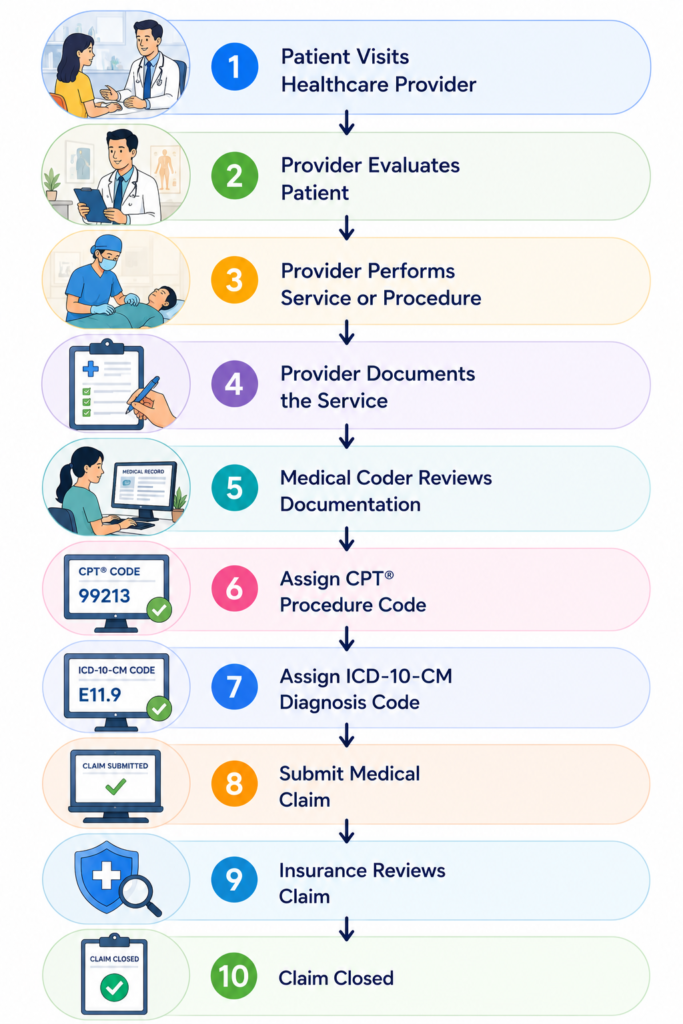
Every patient encounter begins with a healthcare visit where the provider evaluates the patient’s condition and performs the necessary medical service or procedure. The provider documents the services performed, and a certified medical coder assigns the appropriate CPT® procedure code along with the corresponding ICD-10-CM diagnosis code. These codes are submitted on the medical claim, allowing the insurance company to determine coverage, process the claim, and reimburse the healthcare provider.
1. Patient Visits Healthcare Provider
2. Provider Evaluates the Patient
3. Provider Performs the Service or Procedure
4. Provider Documents the Service
5.Medical Coder Reviews the Medical Record
6. CPT® Procedure Code is Assigned
7. ICD-10-CM Diagnosis Code is Assigned
8. Medical Claim is Submitted to Insurance
9. Insurance Reviews the Claim
10. Patient Pays Remaining Balance (if applicable)
Keep Learning
Congratulations! You now understand the fundamentals of CPT® (Current Procedural Terminology), including its purpose, categories, coding process, and role in medical billing. Accurate CPT® coding is essential for reporting healthcare services, supporting reimbursement, and submitting clean claims. In the next module, you’ll learn about HCPCS Level II Codes, including national codes for medical supplies, durable medical equipment (DME), ambulance services, drugs, and other services not covered by CPT® codes.
Questions, answered
Have questions about the US healthcare system? Find clear, beginner-friendly answers to some of the most common questions to strengthen your understanding before moving on to the next module.
What does CPT® stand for?
CPT® stands for Current Procedural Terminology. It is the official procedure coding system used in the United States to report medical, surgical, diagnostic, and other healthcare services.
What are CPT® modifiers?
CPT® modifiers are two-character codes (numeric or alphanumeric) appended to a CPT® code to provide additional information about how a service was performed without changing the definition of the procedure.
Who develops and maintains CPT® codes?
The American Medical Association (AMA) develops, maintains, and updates the CPT® code set annually to reflect advances in medicine and changes in healthcare practices.
How many digits does a CPT® code have?
A standard Category I CPT® code contains five numeric digits that identify a specific healthcare service or procedure.
What is the difference between ICD-10-CM and CPT®?
ICD-10-CM codes describe why a patient received medical care by identifying the diagnosis or medical condition, while CPT® codes describe what medical service or procedure was performed.