
What Is the Patient Registration?
Patient registration is the process of collecting and verifying a patient’s demographic, insurance, and contact information before healthcare services are provided. Accurate patient registration helps create the patient’s medical record, supports insurance verification, ensures accurate claim submission, and reduces billing errors, claim denials, and payment delays.

Goals of Patient Registration
Patient registration ensures that accurate patient and insurance information is collected before medical services are provided. This helps healthcare providers deliver quality care while supporting efficient billing and reimbursement.
Create Accurate Patient Records
Collect complete and accurate demographic information to establish or update the patient’s medical record.
Verify Patient Identity
Confirm the patient’s identity to reduce duplicate records and ensure services are provided to the correct individual.
Collect Insurance Information
Obtain current insurance details required for eligibility verification and claim submission.
Improve Billing Accuracy
Ensure all required registration information is accurate to reduce billing errors and claim rejections.
Support Faster Reimbursement
Provide complete and accurate information that helps insurance claims process smoothly and improves payment turnaround.
How Patient Registration Works
Patient registration is the first operational step in the healthcare revenue cycle. Before a patient receives medical services, the healthcare provider collects and verifies essential information to ensure accurate treatment, insurance verification, claim submission, and reimbursement.
Patient Schedules an Appointment
↓
Patient Arrives at the Healthcare Facility
↓
Collect Demographic Information
↓
Collect Insurance Information
↓
Verify Patient Identity
↓
Verify Insurance Eligibility & Benefits
↓
Obtain Consent & Authorization Forms
↓
Create or Update Patient Medical Record
↓
Patient Receives Medical Services
↓
Information Sent for Medical Billing
Information Collected During Patient Registration
During registration, healthcare providers collect various types of information to identify the patient, verify insurance coverage, and support accurate medical billing.
Patient Demographic Information
Includes the patient’s full name, date of birth, gender, address, phone number, email address, and marital status.
Insurance Information
Includes the insurance company name, member ID, group number, policyholder information, insurance plan, and insurance card details.
Identification Information
A government-issued photo ID or another accepted form of identification used to verify the patient’s identity.
Guarantor Information
Details of the person responsible for paying the patient’s medical bills when the patient is not financially responsible.
Emergency Contact Information
Name, relationship, and contact details of the person to be contacted during an emergency.
Consent and Authorization
Patient signatures for treatment consent, HIPAA acknowledgment, assignment of benefits, financial responsibility, and other required forms.
Visit Information
Reason for the visit, referring provider (if applicable), appointment type, and other details needed before treatment.
Essential Patient Registration Terms
| Term | Simple Definition |
|---|---|
| Patient Demographics | Personal information used to identify the patient. |
| Medical Record Number (MRN) | A unique number assigned to each patient by the healthcare provider. |
| Guarantor | The individual responsible for paying the patient’s medical bills. |
| Policyholder | The person who owns the health insurance policy. |
| Member ID | A unique identification number assigned by the insurance company. |
| Group Number | Identifies the employer or organization providing the insurance plan. |
| Eligibility Verification | Confirms that the patient’s insurance coverage is active and valid. |
| Prior Authorization | Approval required before certain services or procedures are covered. |
| Assignment of Benefits (AOB) | Patient authorization allowing the insurance company to pay the provider directly. |
| Consent for Treatment | Patient permission allowing the provider to deliver medical care. |
Patient Registration Process
Understanding the patient registration process helps medical billing professionals recognize how accurate information collected at the beginning of the visit supports insurance verification, claim submission, reimbursement, and denial prevention.
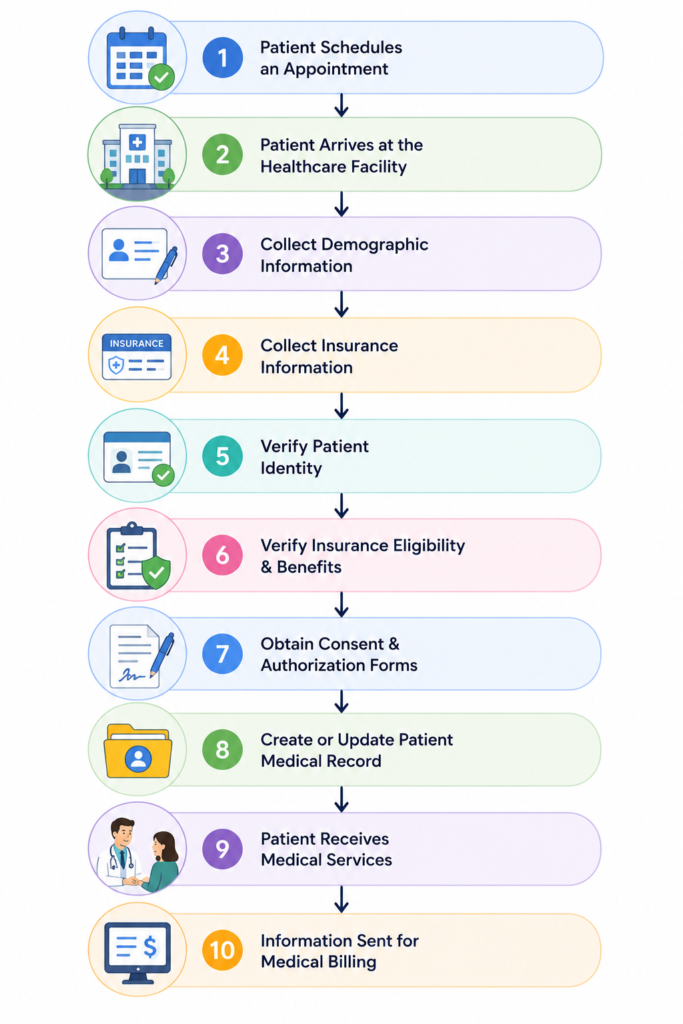
Patient Journey During Registration
Every patient follows a registration process before receiving healthcare services. During this journey, the healthcare provider collects and verifies essential information to ensure accurate treatment, insurance verification, medical billing, and timely reimbursement.
1. Schedule an Appointment
2. Arrive at the Healthcare Facility
3. Complete Registration Forms
4. Provide Demographic Information
5. Present Insurance Card and Photo ID
6. Insurance Eligibility is Verified
7. Sign Required Consent Forms
8. Patient Medical Record is Created or Updated
9. Receive Medical Services
10. Medical Billing Process Begins
Keep Learning
Congratulations! You now understand the Patient Registration process and its role in the healthcare revenue cycle. Accurate registration is the first step toward successful insurance verification, claim submission, reimbursement, and denial prevention. In the next module, you’ll learn about Insurance Verification, where you’ll discover how healthcare providers confirm patient eligibility, benefits, coverage limitations, prior authorization requirements, and financial responsibility before services are provided.
Questions, answered
Have questions about the US healthcare system? Find clear, beginner-friendly answers to some of the most common questions to strengthen your understanding before moving on to the next module.
What is patient registration?
Patient registration is the process of collecting and verifying a patient’s demographic, insurance, and contact information before healthcare services are provided. It establishes the patient’s medical record and supports accurate billing.
Why is patient registration important?
Accurate patient registration helps verify insurance coverage, reduce billing errors, prevent claim denials, and ensure timely reimbursement.
What information is collected during patient registration?
Healthcare providers typically collect demographic information, insurance details, photo identification, emergency contact information, guarantor details, and required consent forms.
What happens if patient registration information is incorrect?
Incorrect registration information can lead to insurance eligibility issues, claim rejections, denied claims, delayed payments, duplicate medical records, and billing errors.
Who performs patient registration?
Patient registration is usually completed by front desk staff, patient access representatives, registration specialists, or admissions staff before the patient receives healthcare services.