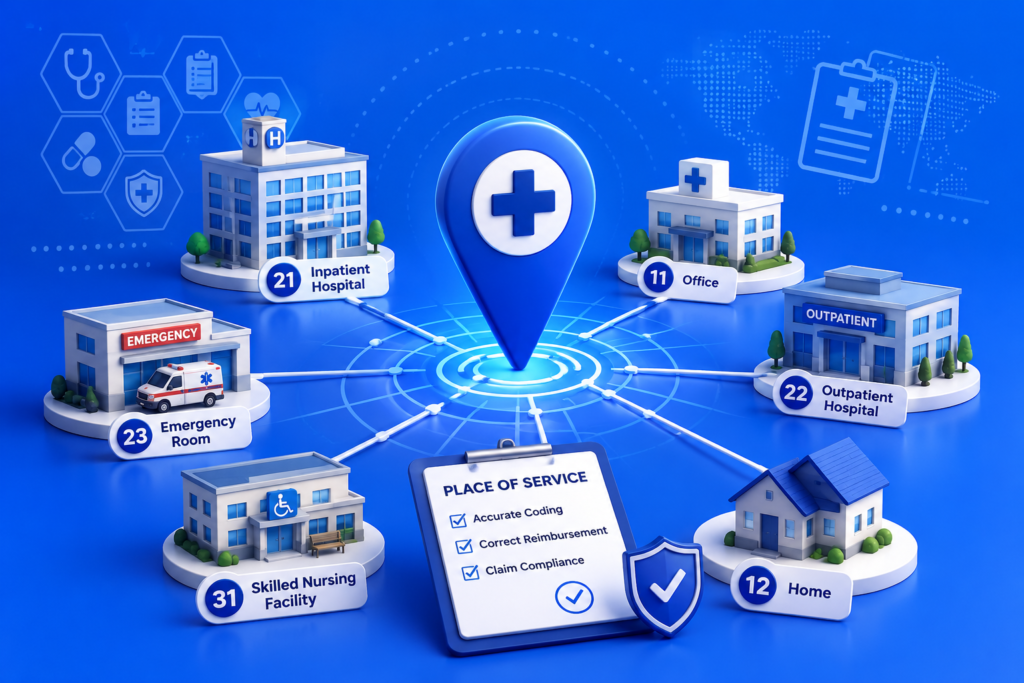
What Is Place of Service (POS)?
Place of Service (POS) is a standardized two-digit code reported on professional healthcare claims to identify the physical or virtual location where medical services were provided. Insurance companies use POS codes to determine the appropriate reimbursement methodology, apply payer-specific billing rules, and verify that the reported services match the location where care was delivered. POS codes are established and maintained by CMS and are recognized by Medicare, Medicaid, and commercial insurance companies.

Goals of Place of Service (POS)
Place of Service (POS) codes provide a standardized method for reporting the location where healthcare services are performed, allowing insurance companies to process claims accurately and reimburse providers correctly.
Identify the Service Location
Clearly indicate where the patient received healthcare services.
Support Accurate Claim Submission
Ensure the correct location of service is reported on professional medical claims.
Improve Insurance Reimbursement
Help insurance companies determine the appropriate payment methodology based on the service location.
Apply Payer-Specific Billing Rules
Allow insurance companies to apply reimbursement policies that vary by care setting, such as office, hospital, telehealth, or home.
Maintain Billing Compliance
Support accurate documentation, reduce billing errors, and ensure compliance with CMS and payer requirements.
How Place of Service (POS) Works
Every time a healthcare provider delivers a medical service, the location where the service is performed must be documented accurately. During the medical billing process, the medical coder or biller selects the appropriate Place of Service (POS) code based on the documented location of care. The POS code is entered on the professional claim along with the CPT®, HCPCS Level II, and ICD-10-CM codes. The insurance company then uses the POS code to apply the correct reimbursement methodology, coverage rules, and payment policies before processing the claim.
Patient Visits Healthcare Provider
↓
Healthcare Service is Performed
↓
Provider Documents Service Location
↓
Medical Coder Reviews Documentation
↓
Select Appropriate POS Code
↓
Assign CPT®, HCPCS & ICD-10-CM Codes
↓
Prepare CMS-1500 Claim
↓
Submit Medical Claim
↓
Insurance Reviews Claim
↓
Claim Closed
Common Place of Service (POS) Codes
Place of Service codes identify the healthcare setting where services are provided. While CMS maintains many POS codes, the following are among the most commonly used in medical billing.
POS 11 – Office
Used when healthcare services are provided in a physician’s private office or clinic.
POS 22 – On-Campus Outpatient Hospital
Used for outpatient services performed in a hospital outpatient department located on the hospital campus.
POS 19 – Off-Campus Outpatient Hospital
Used when outpatient services are performed in a hospital-owned facility located away from the main hospital campus.
POS 23 – Emergency Room – Hospital
Used for emergency medical services provided in a hospital emergency department.
POS 21 – Inpatient Hospital
Used when services are provided to a patient formally admitted to a hospital.
POS 24 – Ambulatory Surgical Center (ASC)
Used when surgical procedures are performed in a licensed ambulatory surgery center.
POS 31 – Skilled Nursing Facility (SNF)
Used when healthcare services are provided to patients residing in a skilled nursing facility.
POS 10 – Telehealth Provided in Patient’s Home
Used when telehealth services are provided while the patient is located in their home.
POS 02 – Telehealth Provided Other than in Patient’s Home
Used when telehealth services are provided while the patient is located somewhere other than their home.
POS 12 – Home
Used when healthcare services are provided in the patient’s residence through an in-person visit.
Essential Place of Service (POS) Terms
| Term | Simple Definition |
|---|---|
| Place of Service (POS) | A two-digit code that identifies where healthcare services were provided. |
| CMS-1500 | The standard professional claim form used to bill physician and non-institutional services. |
| Service Location | The physical or virtual location where the patient received care. |
| POS Code | A standardized two-digit numeric code reported on professional claims. |
| Telehealth | Healthcare services provided remotely using telecommunications technology. |
| Office Visit | Healthcare services performed in a physician’s office, typically reported with POS 11. |
| Outpatient Hospital | Services provided without hospital admission in a hospital outpatient department. |
| Inpatient Hospital | Services provided after a patient has been formally admitted to the hospital. |
| Ambulatory Surgery Center (ASC) | A facility where same-day surgical procedures are performed. |
| Skilled Nursing Facility (SNF) | A licensed facility providing skilled nursing and rehabilitation services. |
Place of Service (POS) Billing Process
Understanding the POS billing process helps medical billers and coders accurately report where healthcare services were provided, reducing claim denials and ensuring proper reimbursement.
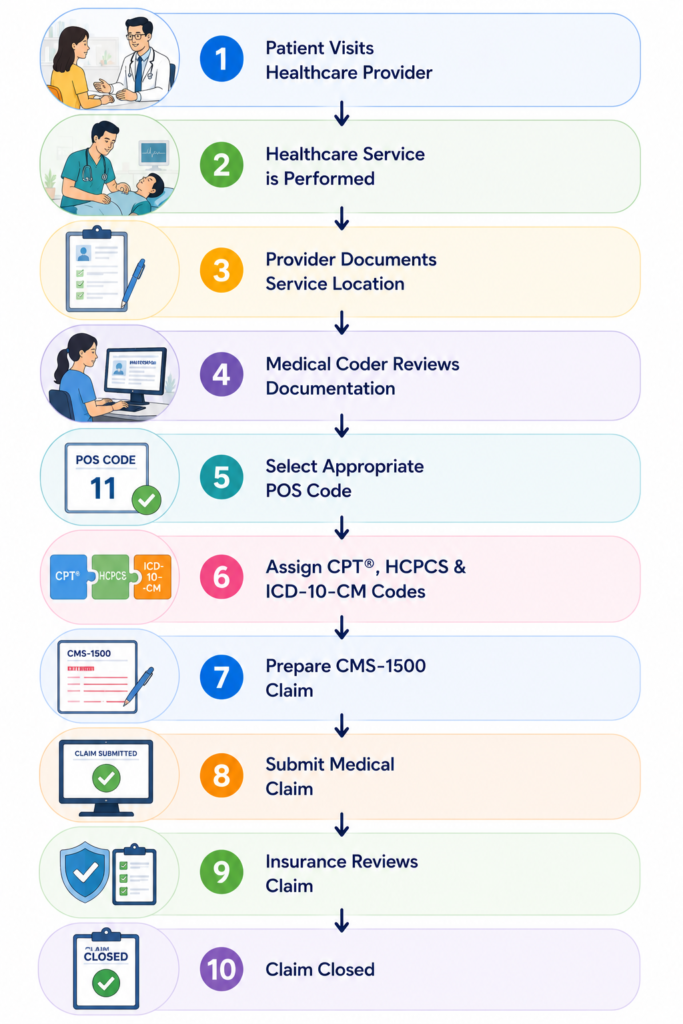
Patient Journey and Place of Service (POS)
Every patient encounter takes place in a specific healthcare setting, such as a physician’s office, hospital, outpatient clinic, skilled nursing facility, or through telehealth. After the healthcare provider performs the service, the location of care is documented in the patient’s medical record. A medical coder or biller then selects the correct Place of Service (POS) code and reports it on the CMS-1500 claim along with the appropriate CPT®, HCPCS Level II, and ICD-10-CM codes. Insurance companies use this information to determine the correct reimbursement and process the claim accurately.
1. Patient Visits Healthcare Provider
2. Healthcare Service is Performed
3. Provider Documents the Service Location
4. Medical Coder Reviews the Medical Record
5. Appropriate POS Code is Selected
6. CPT®, HCPCS Level II, and ICD-10-CM Codes are Assigned
7. CMS-1500 Claim is Prepared
8. Medical Claim is Submitted to Insurance
9. Insurance Reviews the Claim
10. Claim is Closed
Keep Learning
Congratulations! You now understand the fundamentals of Place of Service (POS), including its purpose, common POS codes, billing process, and role in professional medical billing. Correct POS coding is essential for identifying the location of care, ensuring accurate reimbursement, and reducing claim denials.
In the next module, you’ll learn about Type of Bill (TOB) Codes, including how institutional providers use TOB codes on UB-04 claims to identify the type of facility, bill classification, and frequency of services.
Questions, answered
Have questions about the US healthcare system? Find clear, beginner-friendly answers to some of the most common questions to strengthen your understanding before moving on to the next module.
What is a Place of Service (POS) code?
A Place of Service (POS) code is a standardized two-digit numeric code used on professional medical claims to identify the location where healthcare services were provided.
Who maintains POS codes?
The Centers for Medicare & Medicaid Services (CMS) maintains the official Place of Service code set used by Medicare, Medicaid, and many commercial insurance companies.
Where is the POS code reported on the CMS-1500 claim form?
The POS code is reported in Box 24B of the CMS-1500 claim form to identify where the healthcare service was performed.
Can the Place of Service affect reimbursement?
Yes. Insurance companies often use the POS code to determine reimbursement rates, apply payer-specific billing policies, and validate the healthcare setting where services were provided.
What are some commonly used POS codes?
Some of the most frequently used POS codes include:
11 – Office
22 – On-Campus Outpatient Hospital
23 – Emergency Room – Hospital
21 – Inpatient Hospital
24 – Ambulatory Surgical Center (ASC)
31 – Skilled Nursing Facility (SNF)
10 – Telehealth Provided in Patient’s Home
02 – Telehealth Provided Other than in Patient’s Home