
What Is Revenue Cycle Management?
Revenue Cycle Management (RCM) is the complete financial process that manages a patient’s account from appointment scheduling to final payment. It includes patient registration, insurance verification, medical coding, claim submission, payment posting, and follow-up on unpaid or denied claims. By connecting every step of the healthcare revenue process, RCM helps healthcare providers improve cash flow, reduce claim denials, and ensure accurate reimbursement.

Goals of Revenue Cycle Management
Revenue Cycle Management is designed to help healthcare organizations maintain financial stability while ensuring patients receive high-quality care. Every stage of the revenue cycle supports accurate billing, timely reimbursement, and efficient financial operations.
Maximize Revenue
Capture every billable service accurately and ensure healthcare providers receive the reimbursement they have earned.
Reduce Claim Denials
Identify and correct issues before claims are submitted to minimize denials, rework, and payment delays.
Improve Cash Flow
Accelerate claim processing and payment collection to maintain a healthy financial position for the healthcare organization.
Enhance Patient Experience
Provide accurate estimates, transparent billing, and clear communication so patients understand their financial responsibility.
Maintain Compliance
Follow payer requirements, government regulations, and organizational policies to reduce compliance risks and billing errors.
How Revenue Cycle Management Works
Revenue Cycle Management follows a structured workflow that begins before a patient receives care and ends only after all payments have been collected and the account is closed. Every department plays a vital role in ensuring claims are processed accurately, payments are received on time, and billing issues are resolved efficiently.
Appointment Scheduling
↓
Patient Registration
↓
Insurance Verification
↓
Prior Authorization
↓
Patient Visit
↓
Clinical Documentation
↓
Medical Coding
↓
Charge Entry
↓
Claim Submission
↓
Claim Adjudication
↓
Payment Posting
↓
Accounts Receivable Follow-up
↓
Denial Management (If Required)
↓
Patient Billing
↓
Final Payment
↓
Account Closed
Departments Involved in Revenue Cycle Management
Revenue Cycle Management is a collaborative process that involves multiple departments working together. Each department has a specific responsibility, and the success of the revenue cycle depends on how well these teams coordinate with one another.
Patient Access (Front Desk)
The Patient Access team schedules appointments, registers patients, collects demographic and insurance information, and ensures that all required details are accurate before the visit.
Insurance Verification
This team confirms the patient’s insurance eligibility, benefits, deductibles, copayments, coinsurance, and authorization requirements before services are provided.
Prior Authorization
The Prior Authorization team obtains approval from the insurance company for procedures or services that require pre-certification, helping to prevent authorization-related denials.
Clinical Documentation
Healthcare providers document the patient’s medical history, diagnosis, treatment, and procedures performed. Complete documentation supports accurate coding and billing.
Medical Coding
Medical coders review clinical documentation and assign ICD-10-CM, CPT, and HCPCS Level II codes that accurately represent the services provided.
Medical Billing
Medical billers prepare insurance claims, review them for accuracy, and submit them electronically to insurance companies for reimbursement.
Payment Posting
This department records insurance payments, patient payments, contractual adjustments, write-offs, and remittance information into the billing system.
Patient Collections
After insurance processing is complete, any remaining patient responsibility is billed to the patient. The collections team assists patients with payment options and resolves outstanding balances.
Accounts Receivable (AR)
The AR team follows up on unpaid, underpaid, or delayed claims, contacts insurance companies, resolves claim issues, and ensures outstanding balances are collected.
Denial Management
Denial specialists analyze denied claims, identify the root cause, submit corrected claims or appeals, and work to recover lost revenue.
Essential Revenue Cycle Management Terms
| Term | Simple Definition |
|---|---|
| Revenue Cycle | The complete financial process from appointment scheduling to final payment. |
| Clean Claim | A claim submitted correctly without errors or missing information. |
| Charge Capture | Recording all billable services provided to the patient. |
| Claim Adjudication | The insurance company’s process of reviewing and deciding how a claim will be paid. |
| Payment Posting | Recording insurance and patient payments in the billing system. |
| Accounts Receivable (AR) | Money owed to the healthcare provider for services already performed. |
| Denial | A claim that has been processed but not paid by the insurance company. |
| Appeal | A formal request asking the insurance company to review a denied claim again. |
| Adjustment | A reduction or change made to the billed amount based on payer contracts or policies. |
| Patient Responsibility | The amount the patient must pay after insurance has processed the claim. |
Complete Revenue Cycle Process
The Revenue Cycle Management process begins when a patient schedules an appointment and continues through registration, insurance verification, clinical documentation, coding, billing, claim submission, payment processing, and follow-up until the account is fully resolved. Understanding this complete workflow helps beginners see how every department contributes to accurate reimbursement and a healthy revenue cycle.
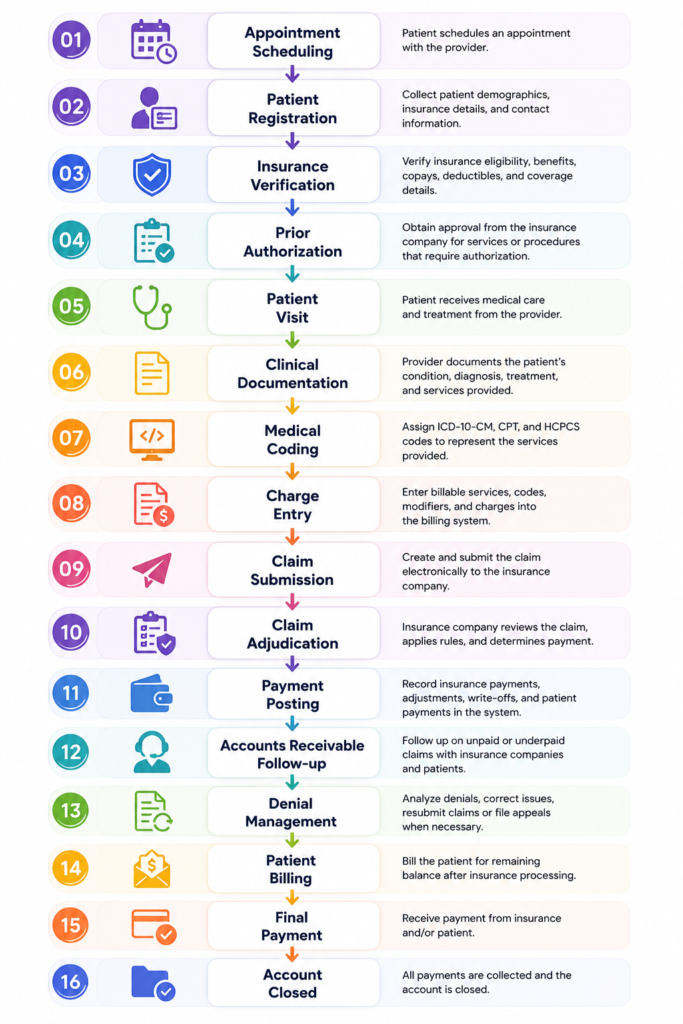
Patient Journey Through Revenue Cycle Management
Every patient visit follows a structured financial journey. From scheduling an appointment to the final payment, each department contributes to ensuring accurate billing, timely reimbursement, and a smooth patient experience. Understanding this workflow helps beginners see how the entire Revenue Cycle Management process works together.
1. Patient Schedules an Appointment
2. Patient Registration
3. Insurance Eligibility Verification
4. Prior Authorization (If Required)
5. Patient Receives Medical Services
6. Provider Documents the Visit
7. Medical Coder Assigns ICD-10-CM, CPT & HCPCS Codes
8. Charge Entry
9. Medical Biller Creates & Submits the Claim
10. Insurance Company Reviews the Claim
11. Claim Approved, Denied, or Pended
12. Payment Posting
13. Accounts Receivable Follow-up (If Needed)
14. Patient Pays Remaining Balance
15. Account Closed
Keep Learning
Congratulations! You now have a solid understanding of Revenue Cycle Management (RCM) and how every department works together to ensure healthcare providers receive accurate and timely reimbursement.
In the next module, you’ll learn HIPAA Basics, where you’ll discover how patient health information is protected, why privacy and security are essential in healthcare, and how HIPAA impacts the daily work of medical billers, coders, AR callers, and other healthcare professionals.
Questions, answered
Have questions about the US healthcare system? Find clear, beginner-friendly answers to some of the most common questions to strengthen your understanding before moving on to the next module.
What is Revenue Cycle Management (RCM)?
Revenue Cycle Management (RCM) is the complete financial process that manages a patient’s account from appointment scheduling through final payment and account closure. It includes registration, insurance verification, coding, billing, payment posting, and follow-up on unpaid claims.
Is Revenue Cycle Management the same as Medical Billing?
No. Medical billing is only one part of Revenue Cycle Management. RCM covers the entire financial lifecycle of a patient account, while medical billing mainly focuses on creating, submitting, and managing insurance claims.
Why is Revenue Cycle Management important?
Revenue Cycle Management helps healthcare organizations receive accurate reimbursement, reduce claim denials, improve cash flow, maintain compliance, and provide a better financial experience for patients.
Which departments are involved in Revenue Cycle Management?
Revenue Cycle Management involves several departments, including Patient Registration, Insurance Verification, Prior Authorization, Clinical Documentation, Medical Coding, Medical Billing, Payment Posting, Accounts Receivable (AR), Denial Management, and Patient Collections.
What happens if one step in the Revenue Cycle is missed?
Since every stage of the revenue cycle is connected, an error in one step—such as incorrect patient information, failed insurance verification, or missing prior authorization—can lead to claim denials, payment delays, increased rework, and lost revenue.