
What Is ICD-10-CM?
ICD-10-CM (International Classification of Diseases, Tenth Revision, Clinical Modification) is the standardized diagnosis coding system used in the United States to report diseases, injuries, symptoms, encounters, and other health conditions. It is maintained by the National Center for Health Statistics (NCHS) under the Centers for Disease Control and Prevention (CDC), while CMS adopts ICD-10-CM for reporting diagnoses on HIPAA-covered healthcare transactions.
Goals of ICD-10-CM
ICD-10-CM provides a standardized way to document patient diagnoses, improve communication among healthcare providers, and support accurate medical billing and reimbursement.
Accurately Describe Patient Conditions
Provide standardized diagnosis codes that clearly represent diseases, injuries, symptoms, and health conditions.
Support Medical Necessity
Link diagnosis codes to healthcare services to demonstrate why treatment, procedures, or tests were medically necessary.
Improve Claim Accuracy
Ensure diagnosis information is reported consistently on medical claims submitted to insurance companies.
Support Insurance Reimbursement
Help insurance companies evaluate medical necessity, process claims, and determine payment.
Improve Healthcare Data
Support disease tracking, public health reporting, quality measurement, medical research, and healthcare planning.
How ICD-10-CM Works
ICD-10-CM coding begins when a healthcare provider evaluates a patient and documents the patient’s condition. Based on the provider’s documentation, a medical coder reviews the medical record, identifies the appropriate diagnosis, and assigns the most specific ICD-10-CM code. The diagnosis code is then reported on the medical claim along with the appropriate CPT®/HCPCS procedure codes. Insurance companies use the diagnosis code to evaluate medical necessity, process the claim, and determine reimbursement.
Patient Visits Healthcare Provider
↓
Provider Evaluates Patient
↓
Provider Documents Diagnosis
↓
Medical Coder Reviews Documentation
↓
Assign ICD-10-CM Diagnosis Code
↓
Assign CPT®/HCPCS Procedure Code
↓
Submit Medical Claim
↓
Insurance Reviews Claim
↓
Payment Processed
↓
Claim Closed
ICD-10-CM Code Structure
Every ICD-10-CM code follows a standardized format that provides detailed information about the patient’s diagnosis. Understanding the code structure helps medical coders assign accurate diagnosis codes and supports proper claim submission.
First Character – Letter
The first character is always an alphabetic letter that identifies the chapter or category of diseases.
Example: E11.9
Second Character – Number
The second character is always a numeric digit and further classifies the disease category.
Example: E11.9
Third Character – Number
The third character completes the basic disease category.
Example: E11
Decimal Point
A decimal is placed after the third character to improve code readability.
Example: E11**.**9
Fourth to Sixth Characters
These characters provide additional details such as the disease type, severity, anatomical site, laterality, or associated complications.
Seventh Character (Extension)
Some injury, poisoning, and external cause codes require a seventh character to identify the type of encounter.
Example:
A – Initial Encounter
Essential ICD-10-CM Terms
| Term | Simple Definition |
|---|---|
| ICD-10-CM | The official diagnosis coding system used in the United States. |
| Diagnosis Code | A code that represents a patient’s disease, injury, symptom, or health condition. |
| Alphabetic Index | The alphabetical section used to locate possible diagnosis codes. |
| Tabular List | The numerical section containing all ICD-10-CM codes and coding instructions. |
| Code Category | The first three characters that identify a disease category. |
| Subcategory | Additional characters that provide greater specificity for a diagnosis. |
| Laterality | Indicates whether the condition affects the right side, left side, or both sides of the body. |
| Medical Necessity | Demonstrates why a healthcare service was required based on the patient’s diagnosis. |
| Coding Guidelines | Official rules for selecting and reporting ICD-10-CM codes correctly. |
| Excludes Notes | Instructions explaining when certain diagnosis codes should or should not be reported together. |
ICD-10-CM Coding Process
Understanding the ICD-10-CM coding process helps medical coders and billing professionals assign accurate diagnosis codes, support medical necessity, reduce claim denials, and ensure proper reimbursement.
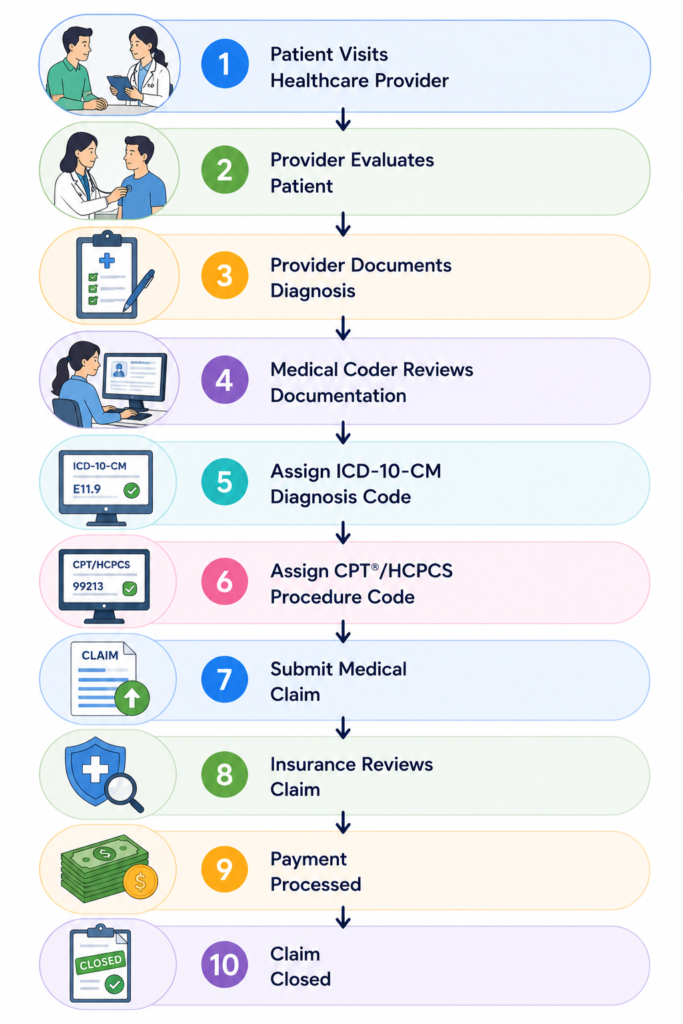
Patient Journey and ICD-10-CM
Every patient encounter begins with a medical evaluation. After examining the patient, the healthcare provider documents the diagnosis, and a certified medical coder assigns the appropriate ICD-10-CM diagnosis code based on the medical record. The diagnosis code explains the patient’s condition and supports medical necessity when the claim is submitted to the insurance company.
1. Patient Visits Healthcare Provider
2. Provider Evaluates the Patient
3. Provider Documents the Diagnosis
4. Medical Coder Reviews the Medical Record
5. ICD-10-CM Diagnosis Code is Assigned
6. CPT®/HCPCS Procedure Code is Assigned
7. Medical Claim is Submitted to Insurance
8. Insurance Reviews the Claim
9. Claim is Processed for Payment
10. Claim is Closed
Keep Learning
Congratulations! You now understand the fundamentals of ICD-10-CM, including its purpose, code structure, coding process, and importance in medical billing. Accurate diagnosis coding is essential for demonstrating medical necessity, reducing claim denials, and ensuring proper reimbursement. In the next module, you’ll learn about CPT® (Current Procedural Terminology), including how procedure codes are structured, how healthcare services are reported, and how CPT® codes work together with ICD-10-CM diagnosis codes to support accurate claim submission.
Questions, answered
Have questions about the US healthcare system? Find clear, beginner-friendly answers to some of the most common questions to strengthen your understanding before moving on to the next module.
What does ICD-10-CM stand for?
ICD-10-CM stands for International Classification of Diseases, Tenth Revision, Clinical Modification. It is the official diagnosis coding system used in the United States.
Who uses ICD-10-CM codes?
Healthcare providers, hospitals, medical coders, medical billers, insurance companies, government programs, and other healthcare organizations use ICD-10-CM diagnosis codes for documentation, billing, reimbursement, and healthcare reporting.
What is the purpose of ICD-10-CM?
ICD-10-CM standardizes the reporting of diseases, injuries, symptoms, and other health conditions. It supports medical necessity, claim processing, reimbursement, public health reporting, and healthcare data analysis.
How many characters can an ICD-10-CM code have?
An ICD-10-CM code can contain 3 to 7 characters. The first character is always a letter, the second character is always a number, and the remaining characters may be letters or numbers depending on the code.
How often is ICD-10-CM updated?
ICD-10-CM is updated annually. New diagnosis codes may be added, existing codes revised, and obsolete codes deleted to reflect advances in medicine and changes in healthcare reporting.