
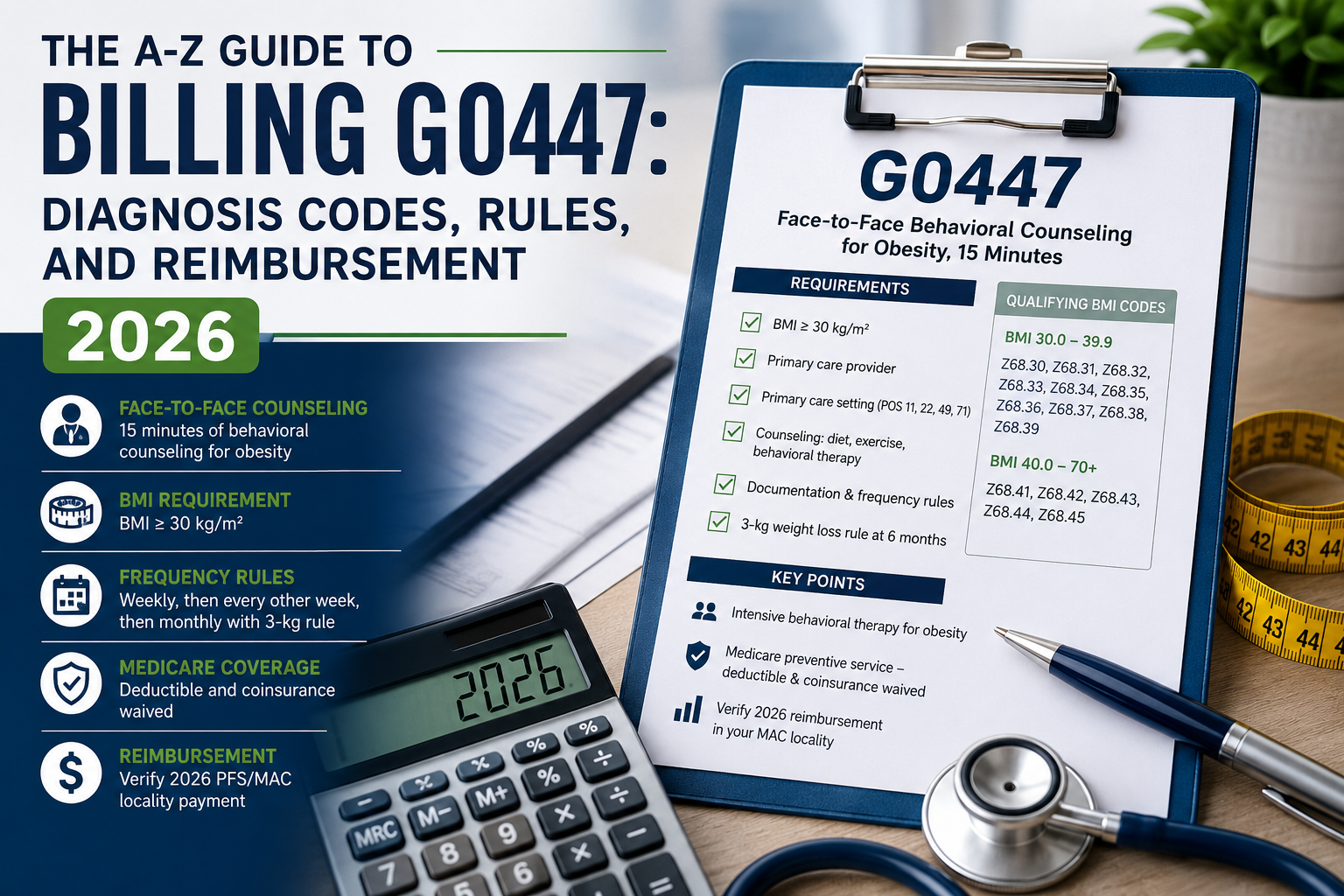
HCPCS code G0447 is an important Medicare preventive-service code for healthcare providers and medical billing teams.
For AR Callers, billers, coders, and RCM professionals, however, knowing the code description is only the beginning. A clean G0447 claim depends on verifying the patient’s eligibility, BMI requirement, provider qualifications, primary-care setting, diagnosis coding, frequency, documentation, and Medicare claim history.
When one of these elements is missing or incorrect, the claim may deny.
This guide explains G0447 billing from A to Z, including Medicare eligibility, BMI requirements, ICD-10-CM coding, provider and setting requirements, the 22-session frequency rule, the 3-kg weight-loss requirement, documentation, common denials, AR workflows, and payer-call strategies.
What Is HCPCS Code G0447?
G0447 is defined as:
Face-to-face behavioral counseling for obesity, 15 minutes.
Medicare covers G0447 as part of its preventive services for eligible beneficiaries with obesity.
The counseling is designed to help the beneficiary achieve and maintain weight loss through behavioral interventions involving areas such as diet, physical activity, and behavior modification.
CMS includes G0447 in its Medicare preventive-services guidance.
What Is Intensive Behavioral Therapy for Obesity?
Intensive Behavioral Therapy (IBT) for obesity is a structured counseling benefit intended to help eligible Medicare beneficiaries with obesity make sustainable behavioral changes.
The service focuses on:
- Weight-loss goals
- Nutrition
- Physical activity
- Behavioral modification
- Risk-factor reduction
- Follow-up
- Progress assessment
The service is not simply a general conversation about weight.
The counseling must meet Medicare’s applicable coverage requirements.
Who Is Eligible for G0447?
Medicare coverage requires specific conditions to be met.
1. BMI of at Least 30
The beneficiary must have a BMI of 30 kg/m² or greater.
CMS specifically identifies obesity with a BMI of at least 30 as a coverage requirement.
For example:
BMI 29.8 → Does not meet the Medicare BMI threshold
BMI 30.0 → Meets the BMI threshold
BMI 35.4 → Meets the BMI threshold
Therefore, the AR team should not assume that an obesity diagnosis alone is enough.
The BMI requirement must also be satisfied.
2. The Beneficiary Must Be Competent and Alert
CMS’s preventive-services guidance specifies that the beneficiary must be competent and alert at the time counseling is provided.
This is important because G0447 is a behavioral counseling service requiring active participation in the counseling encounter.
3. The Service Must Be Furnished in a Primary Care Setting
G0447 is not a general-purpose obesity counseling code that every specialty can automatically bill.
CMS requires the service to be furnished by a qualified primary care physician or other primary care practitioner in a primary care setting.
CMS claims-processing guidance identifies applicable provider specialties and covered places of service.
For professional billing, CMS lists specialties including:
- General Practice
- Family Practice
- Internal Medicine
- Obstetrics/Gynecology
- Pediatric Medicine
- Geriatric Medicine
- Nurse Practitioner
- Certified Clinical Nurse Specialist
- Physician Assistant
CMS also identifies covered POS codes for the service, including:
- POS 11 — Office
- POS 19 — Off-Campus Outpatient Hospital
- POS 22 — On-Campus Outpatient Hospital
- POS 49 — Independent Clinic
- POS 71 — State or Local Public Health Clinic
The specific billing requirements and provider enrollment information must be satisfied.
Important AR Point
Do not use the rule:
“G0447 must always be POS 11.”
That is too broad.
Instead, verify the provider specialty, enrollment record, POS, and applicable Medicare requirements before concluding that the claim is invalid.
G0447 ICD-10-CM BMI Codes
CMS identifies specific BMI diagnosis codes that may be used to establish the required BMI category for this benefit.
The listed BMI codes include:
| ICD-10-CM | BMI |
|---|---|
| Z68.30 | 30.0–30.9 |
| Z68.31 | 31.0–31.9 |
| Z68.32 | 32.0–32.9 |
| Z68.33 | 33.0–33.9 |
| Z68.34 | 34.0–34.9 |
| Z68.35 | 35.0–35.9 |
| Z68.36 | 36.0–36.9 |
| Z68.37 | 37.0–37.9 |
| Z68.38 | 38.0–38.9 |
| Z68.39 | 39.0–39.9 |
| Z68.41 | 40.0–44.9 |
| Z68.42 | 45.0–49.9 |
| Z68.43 | 50.0–59.9 |
| Z68.44 | 60.0–69.9 |
| Z68.45 | 70 or greater |
These are the BMI codes identified by CMS for the G0447 benefit.
Why Is the BMI Code Important?
Suppose the claim contains:
G0447
but the supporting BMI information does not meet the Medicare requirement.
The claim may deny even if the patient has an obesity diagnosis.
Therefore, when working a G0447 denial, the AR Caller should check the BMI documentation and diagnosis coding, not just the obesity diagnosis.
Should an Obesity Diagnosis Also Be Reported?
An obesity diagnosis may be clinically appropriate when supported by the medical record.
Examples can include applicable E66.- obesity codes.
However, do not add a diagnosis simply to make G0447 pay.
Diagnosis coding must accurately represent the patient’s documented condition and follow current ICD-10-CM coding rules.
The BMI code is particularly important because CMS specifically identifies the BMI codes for this preventive benefit.
G0447 Frequency Rules
One of the biggest causes of G0447 denials is frequency.
Medicare allows up to 22 sessions during a 12-month period when the applicable coverage requirements are met.
The schedule is divided into three stages.
Month 1
Up to:
1 face-to-face visit every week
This permits up to four visits during the first month under the established schedule.
Months 2–6
Up to:
1 face-to-face visit every other week
Months 7–12
Up to:
1 face-to-face visit every month
However, the beneficiary must meet the required weight-loss criterion before the additional six months of monthly counseling are covered.
The 3-Kilogram Weight-Loss Requirement
At the six-month point, Medicare requires a reassessment of obesity and the amount of weight loss.
To continue with the additional monthly visits during months 7–12, the beneficiary must have lost at least:
3 kg (6.6 pounds)
during the first six months.
What If the Patient Does Not Lose 3 kg?
The patient does not simply continue receiving the monthly G0447 visits.
CMS states that if the beneficiary does not achieve at least 3 kg of weight loss during the first six months, a reassessment of readiness to change and BMI is appropriate after an additional six-month period.
This distinction is important when working frequency-related denials.
G0447 Frequency Timeline
A simple way to remember the schedule is:
Month 1
Weekly
↓
Months 2–6
Every other week
↓
6-Month Reassessment
Check weight loss
↓
Lost at least 3 kg?
Yes → Monthly sessions may continue through months 7–12
No → Additional reassessment requirements apply
Maximum Number of Sessions
CMS specifies that G0447 and G0473 together are subject to a maximum of 22 sessions in a 12-month period.
Therefore, an AR Caller should consider both individual and group obesity counseling services when reviewing the patient’s Medicare history.
Do not look only at G0447 if the patient has also received G0473.
G0447 vs. G0473
Medicare also recognizes:
G0447 — Face-to-face behavioral counseling for obesity, 15 minutes
G0473 — Face-to-face behavioral counseling for obesity, group, 2–10 people, 30 minutes
The 22-session limitation applies to the applicable combination of these services.
This is important when researching a frequency denial.
Documentation Requirements
Strong documentation is essential for successful G0447 billing.
The medical record should demonstrate that the covered counseling service actually occurred.
Important elements include:
- Patient’s obesity/BMI status
- Weight-related assessment
- Behavioral risk assessment
- Personalized counseling
- Dietary counseling
- Physical activity counseling
- Behavioral-change strategies
- Weight-loss goals
- Patient participation
- Follow-up planning
- Progress toward goals
- Six-month reassessment when applicable
- Weight-loss measurement when applicable
The Five A’s Approach
CMS describes the counseling using the Five A’s approach.
1. Assess
Assess behavioral health risks and factors affecting the patient’s ability to change behavior.
2. Advise
Provide clear, specific, personalized advice about behavior change and health risks.
3. Agree
Work with the patient to establish appropriate goals and treatment methods.
4. Assist
Help the patient develop the skills, confidence, and support needed to make behavioral changes.
5. Arrange
Arrange follow-up contacts and adjust the treatment plan as needed.
CMS includes this approach in its guidance for intensive behavioral therapy for obesity.
Important Documentation Point
Do not treat the Five A’s as five mandatory headings that must literally appear in every note.
What matters is that the documentation supports the covered counseling service and applicable Medicare requirements.
Does G0447 Require 15 Minutes?
Yes.
The HCPCS descriptor identifies G0447 as:
Face-to-face behavioral counseling for obesity, 15 minutes.
The documentation should support the service actually provided.
Do not automatically bill G0447 simply because the patient was discussed for a few minutes during another encounter.
The medical record should demonstrate that the covered counseling service was furnished.
G0447 and Modifier 25
A provider may sometimes report an office/outpatient E/M service on the same date as G0447.
However, the services must be separately reportable under the applicable rules.
If a significant, separately identifiable E/M service is performed in addition to the preventive counseling service, modifier 25 may be appropriate on the E/M service.
For example:
G0447
plus
99214-25
may be appropriate when the documentation supports both services.
Important Warning
Do not add modifier 25 simply because:
“G0447 and 99214 were performed on the same day.”
The E/M service must independently meet the applicable requirements.
The documentation must support the additional work.
Example: G0447 + E/M
A Medicare patient presents for obesity counseling.
During the encounter, the provider also evaluates uncontrolled hypertension, reviews medication effectiveness, assesses the condition, and makes a medically necessary treatment adjustment.
The claim may potentially include:
G0447 — Obesity counseling
99214-25 — Separately identifiable E/M
The exact E/M level and reporting must be supported by the medical record and applicable Medicare rules.
Does G0447 Have Patient Cost-Sharing?
CMS’s Medicare preventive-services guidance states that the coinsurance and Part B deductible are waived for G0447 when the service meets the applicable Medicare preventive-service requirements.
Therefore, a qualifying G0447 service under Original Medicare generally does not result in Medicare Part B deductible or coinsurance for the beneficiary.
However, AR teams should still review the actual remittance and beneficiary coverage because secondary insurance, Medicare Advantage, claim-processing circumstances, and other factors can affect how the account is handled.
G0447 Reimbursement in 2026
Avoid publishing a single nationwide “G0447 pays $34” figure.
Medicare Physician Fee Schedule payments can vary by locality and other applicable payment factors.
CMS’s PFS Look-Up Tool provides Medicare payment information and allows users to search payment amounts by procedure and locality.
CMS also publishes current 2026 national payment files and carrier-specific files.
Best Practice for Your Billing Team
When determining the expected Medicare allowance for G0447:
Check the current 2026 Medicare Physician Fee Schedule → Select the applicable locality → Check the code → Verify the applicable payment amount.
Do not rely on an outdated national-average figure.
Common G0447 Denials
G0447 denials can generally be grouped into several categories.
1. BMI Does Not Meet Requirement
The payer’s records do not support a BMI of at least 30.
2. Missing or Incorrect BMI Diagnosis
The claim does not contain an applicable BMI code or the diagnosis information does not support the service.
3. Frequency Exceeded
The patient has already received the maximum number of eligible sessions or does not meet the applicable frequency schedule.
4. Provider Specialty Issue
The provider’s Medicare enrollment information does not meet the applicable primary-care provider requirements.
5. Place of Service Issue
The service was submitted with a POS that does not meet the applicable Medicare requirements.
6. Documentation Issue
The medical record does not adequately support the counseling service.
7. Weight-Loss Requirement Not Met
The patient did not meet the 3-kg requirement necessary for the additional monthly sessions.
8. Eligibility Issue
The patient did not have applicable Medicare Part B coverage or another required eligibility condition.
AR Workflow: G0447 Frequency Denial
Suppose you receive:
G0447 denied — frequency exceeded
Do not immediately appeal.
Step 1: Pull the Claim
Review:
- Date of service
- G0447
- Diagnosis codes
- Provider
- POS
- Denial code
- RARC, if present
Step 2: Review Medicare Claim History
Search for:
- Previous G0447
- Previous G0473
- Dates of service
- Number of sessions
- First counseling date
Step 3: Calculate the Treatment Timeline
Determine whether the service falls within:
- Month 1
- Months 2–6
- Months 7–12
Step 4: Check the 3-Kg Requirement
If the claim falls into months 7–12, verify whether the required six-month reassessment and 3-kg weight-loss criterion were met.
Step 5: Determine the Root Cause
Ask:
Was the service actually outside the covered frequency?
If yes → denial may be valid.
If no → investigate payer processing.
AR Call Script: Frequency Denial
“I’m calling regarding a G0447 claim for date of service XX/XX/2026. The claim denied for frequency. Could you please confirm the previous G0447 or G0473 services that your system used to determine the frequency limitation?”
Then ask:
“Can you provide the previous dates of service and the number of sessions counted toward the 12-month limit?”
If the claim appears to be incorrectly counted:
“Based on our records, the number of qualifying sessions appears to be different. Can you review the claim history and confirm whether the frequency edit was applied correctly?”
Document:
- Representative name or ID
- Call date
- Reference number
- Previous claims identified
- Frequency calculation
- Required action
AR Workflow: BMI Denial
If G0447 denies because the BMI requirement was not met:
Check:
- BMI documented on the date of service
- BMI diagnosis code
- Obesity diagnosis
- Provider documentation
- Claim diagnosis sequence
- Payer edit
Example
Claim:
G0447
BMI:
29.8
The patient has an obesity diagnosis, but the BMI does not meet the Medicare threshold of 30.
In this situation, the AR Caller should not simply add Z68.30.
The diagnosis must reflect the patient’s actual documented BMI.
AR Workflow: Provider Specialty Denial
If G0447 denies because of provider eligibility:
Check:
- Rendering provider
- Billing provider
- Medicare enrollment
- Provider specialty
- NPI
- Date of service
- POS
- Applicable primary-care requirements
CMS’s claims-processing guidance specifically identifies provider specialty categories for G0447 billing.
If the provider was correctly enrolled but the claim processed incorrectly, document the payer response and follow the appropriate reconsideration process.
AR Workflow: POS Denial
If the claim denies for place of service:
Check the submitted POS.
Do not assume:
“G0447 = POS 11 only.”
CMS identifies multiple applicable POS settings for this service.
Verify:
- POS submitted
- Actual service location
- Provider specialty
- Medicare enrollment
- Institutional vs. professional claim
- Applicable MAC processing requirements
AR Workflow: Documentation Denial
If the payer requests records:
Review whether the documentation demonstrates:
- Face-to-face counseling
- Obesity/BMI status
- Behavioral counseling
- Personalized intervention
- Weight-management goals
- Follow-up
- Appropriate frequency
- Six-month reassessment when applicable
Then submit the documentation through the payer’s specified process.
What Should an AR Caller Ask the Payer?
Instead of saying:
“Why did G0447 deny?”
use specific questions.
Question 1
“Can you provide the exact denial reason and the associated CARC/RARC?”
Question 2
“Is the denial related to BMI, frequency, provider specialty, place of service, documentation, or another coverage edit?”
Question 3
“Which previous G0447 or G0473 claims were counted toward the frequency limitation?”
Question 4
“What documentation or correction is required for reconsideration?”
Question 5
“What is the filing deadline for reconsideration or appeal?”
Question 6
“Can I have the call reference number for this inquiry?”
Corrected Claim vs. Appeal
This is an important AR distinction.
Corrected Claim May Be Appropriate When:
- Wrong diagnosis was submitted
- Incorrect provider information was submitted
- Incorrect POS was submitted
- Other claim data was entered incorrectly
- Payer allows correction for the identified issue
Reconsideration or Appeal May Be Appropriate When:
- The claim was correctly submitted
- The patient meets the coverage requirements
- The provider meets the requirements
- Documentation supports the service
- The payer incorrectly applied the frequency or coverage edit
Always follow the payer’s current instructions.
G0447 Claim Submission Checklist
Before submitting the claim, verify:
Patient
- Medicare Part B eligibility
- Beneficiary information
- Date of service
Clinical
- BMI ≥30
- Obesity documented when applicable
- Counseling provided
- Appropriate behavioral intervention
- Documentation supports service
Provider
- Qualified primary care provider
- Medicare enrollment
- Appropriate provider specialty
Claim
- G0447
- Correct ICD-10-CM codes
- Applicable BMI code
- Correct POS
- Correct billing/rendering provider
- Frequency verified
Documentation
- Counseling documented
- Goals documented
- Follow-up documented
- Six-month reassessment when applicable
- Weight-loss progress documented when applicable
G0447 Denial Prevention Workflow
Use this workflow before claim submission:
Verify Medicare eligibility
↓
Confirm BMI ≥30
↓
Verify applicable BMI diagnosis code
↓
Verify provider specialty/enrollment
↓
Verify primary-care setting/POS
↓
Check previous G0447/G0473 history
↓
Confirm frequency
↓
Review documentation
↓
Submit G0447
This simple workflow can prevent many avoidable denials.
G0447 Quick Reference Table
| Category | Medicare Requirement |
|---|---|
| Code | G0447 |
| Service | Face-to-face behavioral counseling for obesity, 15 minutes |
| BMI | 30 kg/m² or greater |
| Provider | Qualified primary care physician or other primary care practitioner |
| Setting | Primary care setting |
| Frequency | Up to 22 applicable sessions in 12 months |
| Month 1 | Weekly |
| Months 2–6 | Every other week |
| Months 7–12 | Monthly if 3-kg requirement is met |
| 6-month requirement | At least 3 kg weight loss |
| BMI diagnosis | CMS-listed Z68.30–Z68.39 and Z68.41–Z68.45 |
| Patient cost-sharing | Medicare coinsurance and Part B deductible waived when requirements are met |
| Modifier 25 | May apply to a separately identifiable E/M when requirements are met |
CMS remains the primary source for the Medicare coverage and billing requirements.
Frequently Asked Questions
What is G0447?
G0447 is face-to-face behavioral counseling for obesity, 15 minutes, covered by Medicare as a preventive service for eligible beneficiaries.
What BMI is required for G0447?
The Medicare coverage requirement is a BMI of 30 kg/m² or greater.
How many times can G0447 be billed?
G0447 and G0473 are subject to a combined maximum of 22 sessions in a 12-month period, with specific frequency requirements.
How often can G0447 be billed during the first month?
The Medicare schedule permits one face-to-face visit every week during the first month.
How often can G0447 be billed during months 2–6?
The schedule permits one face-to-face visit every other week during months 2–6.
Can G0447 be billed during months 7–12?
Yes, if the beneficiary meets the applicable requirements, including losing at least 3 kg during the first six months. Monthly visits may then continue during months 7–12.
What happens if the patient does not lose 3 kg?
The patient does not automatically qualify for the additional monthly counseling period. CMS provides for reassessment of readiness to change and BMI after an additional six-month period.
Can G0447 be billed with an E/M?
A separately identifiable E/M service may be reportable on the same date when the applicable requirements are met. Modifier 25 may be appropriate on the E/M service.
Do not add modifier 25 automatically.
Does G0447 require POS 11?
No.
CMS’s claims-processing guidance identifies multiple applicable primary-care settings/POS codes, including POS 11, 19, 22, 49, and 71.
Can every physician bill G0447?
No.
Medicare requires the service to be furnished by a qualified primary care physician or other primary care practitioner in a primary care setting, and CMS identifies applicable provider specialty categories.
Does Medicare charge the patient coinsurance for G0447?
CMS states that the Medicare coinsurance and Part B deductible are waived for this preventive service when the applicable coverage requirements are met.
Is there a fixed 2026 national reimbursement amount for G0447?
Do not rely on a single national amount.
Medicare Physician Fee Schedule payment can vary by locality and other payment factors. Use the current CMS PFS Look-Up Tool or applicable fee-schedule files for the specific payment information.
Final Takeaway for AR Callers
G0447 may look like a simple 15-minute counseling code, but Medicare applies several important coverage requirements.
Before billing or working a denial, verify:
BMI → Diagnosis → Provider → Setting → Frequency → Documentation → Claim History
The most important rules to remember are:
G0447 = 15-minute face-to-face obesity counseling
BMI ≥30
Up to 22 applicable sessions in 12 months
Weekly during month 1
Every other week during months 2–6
Monthly during months 7–12 when the 3-kg requirement is met
Qualified primary care provider/practitioner
Primary care setting
Medicare deductible and coinsurance waived when coverage requirements are met
For AR Callers, the key is not simply knowing the code. The real skill is being able to look at a denied G0447 claim, identify the exact root cause, verify the applicable CMS requirement, and determine whether the correct action is a claim correction, reconsideration, appeal, or no further action.
Always verify the current CMS, MAC, and Medicare claim-processing guidance for the date of service before taking final action.
Learn more practical Medicare, medical billing, denial management, coding, and RCM guides at LearnMedicalBilling.in.