
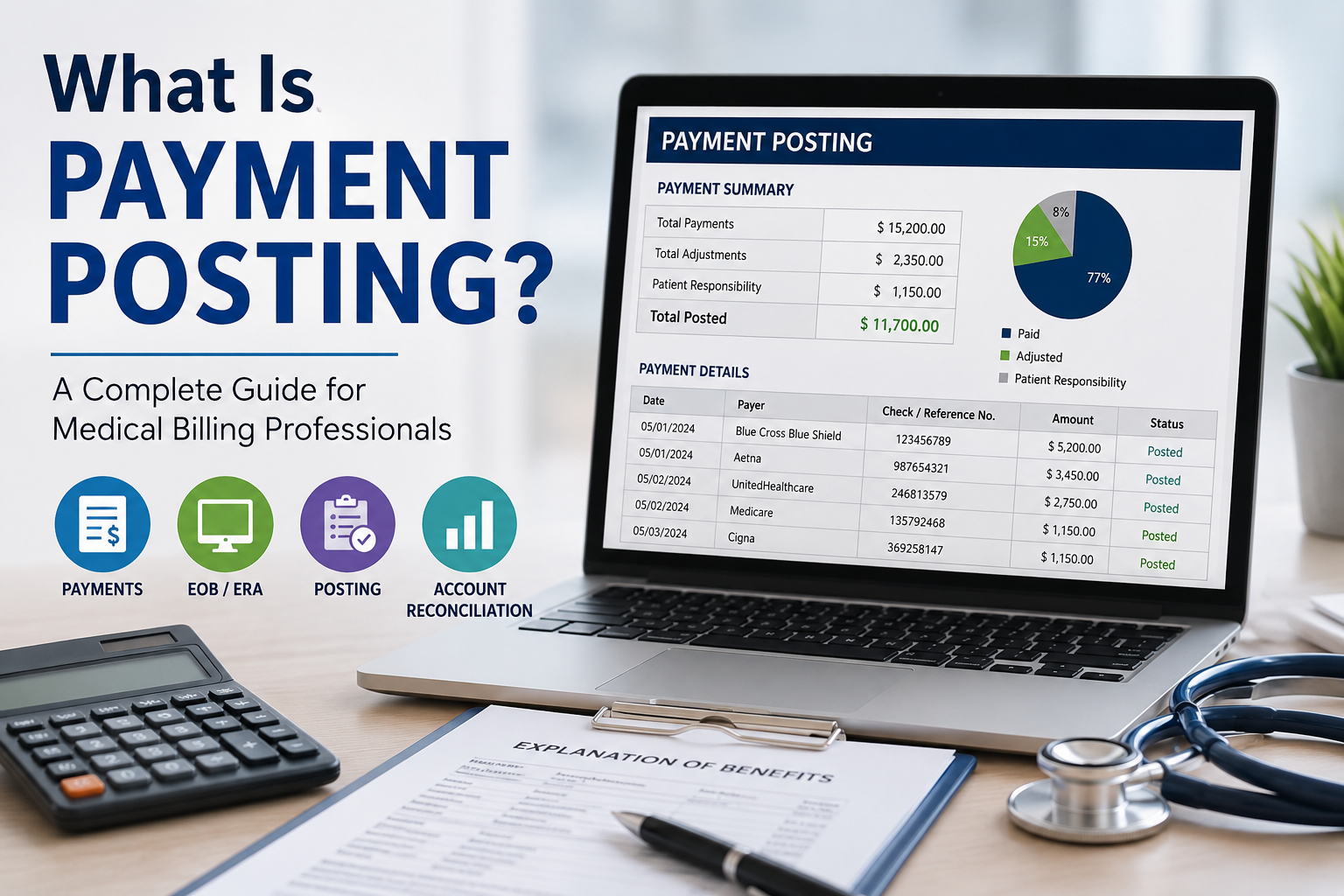
Payment posting is one of the most important steps in the medical billing and Revenue Cycle Management (RCM) process. It is the process of recording payments, adjustments, denials, contractual write-offs, and patient responsibility on a patient’s account after an insurance company or patient makes a payment.
In simple terms, payment posting tells the billing system what happened to a medical claim after it was processed by the payer.
For example, a provider may bill an insurance company $200 for a service. The insurance company may allow $150, pay $120, apply $20 to the patient’s coinsurance, and make a $30 contractual adjustment. The payment poster must accurately record each of these amounts in the patient’s account.
Accurate payment posting is important because it affects the patient’s balance, accounts receivable (AR), financial reporting, denial management, and future collection activity.
According to the Centers for Medicare & Medicaid Services (CMS), an Electronic Remittance Advice (ERA) explains how a health plan adjusted claim charges based on factors such as contractual agreements, benefit coverage, secondary insurance, copayments, and coinsurance. CMS also identifies the X12 835 transaction as the adopted standard for electronic remittance advice.
What Is Payment Posting?
Payment posting is the process of entering and applying healthcare claim payment information to the appropriate patient account and claim.
The payment may come from:
- Medicare
- Medicaid
- Medicare Advantage plans
- Commercial insurance companies
- Workers’ compensation payers
- Automobile insurance
- Secondary insurance
- Patients
Payment posting does not simply mean entering the amount of a check or electronic payment.
A payment poster must determine:
- Which patient account received the payment
- Which claim the payment belongs to
- Which service lines were paid
- The allowed amount
- The paid amount
- Contractual adjustments
- Patient responsibility
- Denied or unpaid amounts
- Other insurance responsibility
- Remaining balance
- Whether the claim requires further AR follow-up
This makes payment posting an important financial and operational control within the revenue cycle.
Why Is Payment Posting Important in Medical Billing?
Payment posting connects the payer’s claim adjudication decision with the provider’s billing system.
When a claim is submitted, the provider initially expects payment. However, the final result is determined by the payer.
The payer may:
- Pay the claim in full
- Pay partially
- Apply contractual adjustments
- Assign a balance to the patient
- Deny a service
- Apply a deductible
- Apply coinsurance
- Apply a copayment
- Process the claim toward secondary insurance
- Request additional information
- Recoup a previous payment
The payment posting team records these results accurately.
Payment Posting Supports the Entire RCM Cycle
A typical revenue cycle can be viewed as:
Patient Registration → Eligibility → Charge Entry → Claim Submission → Claim Adjudication → Payment Posting → AR Follow-Up → Denial Management → Patient Billing → Account Resolution
If payment posting is inaccurate, problems can move into the next stages of the revenue cycle.
For example, if a $50 patient responsibility amount is incorrectly posted as a contractual adjustment, the patient’s balance may become incorrect.
Likewise, if a denied claim is incorrectly posted as fully paid, the AR team may never follow up on the unpaid amount.
Payment Posting vs Cash Posting
The terms payment posting and cash posting are often used interchangeably, but there can be a practical difference depending on the organization’s workflow.
Payment Posting
Payment posting generally refers to applying payment and remittance information to individual patient accounts and claims.
Cash Posting
Cash posting may refer more broadly to recording incoming payments and reconciling them against the organization’s financial records.
In many medical billing departments, however, the same team may be responsible for both activities.
What Are the Main Sources of Payment Posting?
Payment posters usually receive payment information from several sources.
Electronic Remittance Advice
An ERA is an electronic explanation from a health plan describing how a claim was processed and paid.
CMS states that an ERA provides claim payment information and explains adjustments involving items such as contractual agreements, secondary payers, benefit coverage, copayments, and coinsurance.
The standard electronic remittance transaction is the ASC X12 835.
CMS identifies X12 Version 5010 as the adopted standard for ERA transactions.
Explanation of Benefits
An EOB, or Explanation of Benefits, is a document provided by a health plan that explains how a claim was processed.
An EOB may show:
- Billed amount
- Allowed amount
- Insurance payment
- Deductible
- Coinsurance
- Copayment
- Adjustments
- Non-covered amounts
- Patient responsibility
- Denial information
An EOB is not necessarily a bill.
The patient’s actual bill may be generated separately by the provider.
Electronic Funds Transfer
An EFT is the electronic transfer of money from the payer to the provider’s financial institution.
CMS explains that EFT can include information such as the payment amount, payer and payee identification, bank information, routing information, and payment date.
The EFT represents the movement of money.
The ERA explains how the claim was adjudicated.
Paper Checks and Paper Remittance
Some organizations may still receive paper checks and paper remittance information.
The payment poster must manually review the remittance and enter the appropriate information into the billing system.
Electronic posting can reduce manual work because payment and adjustment information can be imported into billing or accounting systems. CMS notes that ERA can allow payment information and adjustments to be automatically posted to accounting or billing applications.
What Is an ERA in Payment Posting?
An Electronic Remittance Advice (ERA) is one of the most important documents used by payment posting teams.
An ERA communicates the payer’s adjudication information for one or more claims.
It can contain information at:
- Claim level
- Service-line level
- Provider level
CMS explains that adjustments may occur at the line, claim, or provider level.
What Is an 835?
The 835 is the electronic healthcare claim payment/remittance transaction.
In practical medical billing terms:
837 = Claim submission
835 = Payment/remittance information
The 837 is sent to request payment.
The 835 is returned by the payer to communicate how the claim was processed.
CMS identifies the ASC X12 835 Version 5010 as the adopted standard for electronic remittance advice.
EFT vs ERA: What Is the Difference?
EFT and ERA are related, but they are not the same thing.
| Feature | EFT | ERA |
|---|---|---|
| Purpose | Transfers money | Explains claim payment |
| Main function | Financial transaction | Remittance information |
| Contains payment amount | Yes | Yes |
| Contains adjustment details | Limited | Yes |
| Contains CARC/RARC information | No | Yes |
| Used for payment reconciliation | Yes | Yes |
| Standard | ACH-related EFT standards | X12 835 |
A simple way to remember this is:
EFT tells you where the money went.
ERA tells you why and how the claim was paid.
CMS recommends providers enroll for both EFT and ERA with participating health plans to improve payment and remittance processing.
What Information Does a Payment Poster Review?
Before posting a payment, the payment poster should review the remittance carefully.
Important information includes:
Patient Information
Verify:
- Patient name
- Patient account number
- Member ID
- Date of birth when applicable
- Insurance information
Claim Information
Review:
- Claim number
- Payer claim control number
- Date of service
- Billing provider
- Rendering provider
- Place of service
- Procedure codes
- Units
- Diagnosis information when necessary
Financial Information
Review:
- Total billed amount
- Allowed amount
- Paid amount
- Deductible
- Coinsurance
- Copayment
- Contractual adjustment
- Other adjustments
- Denied amount
- Patient responsibility
Adjustment Information
Payment posters should review:
- Group codes
- CARCs
- RARCs
CMS explains that standard adjustment information can include a Claim Adjustment Group Code, Claim Adjustment Reason Code (CARC), and Remittance Advice Remark Code (RARC).
Understanding Claim Adjustment Group Codes
Group codes help identify who is financially responsible for an unpaid amount.
Common group codes include:
- CO – Contractual Obligation
- PR – Patient Responsibility
- OA – Other Adjustment
- PI – Payer Initiated Reduction
CO – Contractual Obligation
CO generally identifies amounts that are the provider’s contractual responsibility.
For example:
Billed: $200
Allowed: $150
Paid: $120
Patient responsibility: $30
Contractual adjustment: $50
The $50 contractual adjustment may be posted as a CO adjustment when supported by the payer’s remittance.
PR – Patient Responsibility
PR indicates an amount assigned to the patient.
Examples include:
- Deductible
- Coinsurance
- Copayment
The specific CARC should be reviewed along with the group code rather than relying on the group code alone.
OA – Other Adjustment
OA represents other adjustments that do not fit into the contractual or patient-responsibility categories.
The payment poster should review the accompanying reason code and remittance details before determining the correct posting treatment.
Understanding CARC and RARC Codes
What Is a CARC?
CARC stands for Claim Adjustment Reason Code.
It explains why the amount paid differs from the amount billed or why an adjustment was made.
Examples include reasons related to:
- Deductibles
- Coinsurance
- Duplicate claims
- Timely filing
- Bundling
- Medical necessity
- Non-covered services
- Authorization
- Contractual adjustments
What Is a RARC?
RARC stands for Remittance Advice Remark Code.
A RARC provides additional information about a claim adjustment or payment decision.
Payment posters and AR callers should review CARC and RARC information together when investigating unpaid amounts.
CMS states that HIPAA-covered health plans use standardized CARCs and RARCs to explain claim adjustments rather than using proprietary adjustment codes.
Step-by-Step Payment Posting Workflow
A good payment posting workflow should be systematic.
Step 1: Receive the Payment
The payment may arrive through:
- EFT
- ACH
- Paper check
- Electronic remittance
- Other payer-approved payment methods
Step 2: Retrieve the Remittance
Obtain the corresponding:
- ERA
- EOB
- Paper remittance
- Payment report
Step 3: Match the Payment to the Remittance
Compare the payment amount with the remittance information.
For EFT payments, the payment can be associated with the corresponding ERA using the appropriate trace information.
CMS explains that matching the EFT and ERA using the TRN information is part of the reassociation process.
Step 4: Identify the Patient Account
Confirm that the claim belongs to the correct patient.
Never post a payment simply because the dollar amount looks correct.
Step 5: Locate the Correct Claim
Verify:
- Claim number
- Date of service
- Provider
- Patient
- Payer
Step 6: Review Each Service Line
Do not automatically post the total payment at the claim level.
Review individual service lines when the remittance provides line-level adjudication.
For example:
| CPT | Billed | Allowed | Paid | Patient Responsibility |
|---|---|---|---|---|
| 99213 | $120 | $90 | $70 | $20 |
| 93000 | $80 | $60 | $50 | $10 |
| Total | $200 | $150 | $120 | $30 |
Step 7: Post the Insurance Payment
Enter the actual payer payment against the appropriate claim or service line.
Step 8: Post Contractual Adjustments
Post contractual adjustments according to the payer’s remittance and the provider’s contract and billing-system rules.
Step 9: Post Patient Responsibility
Post amounts assigned to the patient, such as:
- Deductible
- Coinsurance
- Copayment
Step 10: Identify Denied or Unpaid Services
Any remaining balance should be reviewed.
Do not automatically transfer every unpaid amount to the patient.
Determine whether the remaining amount is:
- Patient responsibility
- Denial
- Pending secondary insurance
- Correctable billing issue
- Payer error
- Contractual issue
- Other adjustment
Step 11: Route Denials for Follow-Up
If a service is denied, the account may need to be routed to the denial or AR team.
This is where accurate payment posting becomes extremely important.
Step 12: Reconcile the Payment
The total amount posted should reconcile with the payment received.
If an EFT is $5,000, the corresponding remittance posting should account for the $5,000 according to the organization’s reconciliation process.
Step 13: Close or Transfer the Account
Once all appropriate amounts are posted, the account may:
- Close
- Move to patient billing
- Move to secondary billing
- Move to AR follow-up
- Move to denial management
Payment Posting Example
Let’s take a practical example.
A provider submits a claim for $250.
The payer processes the claim as follows:
Billed amount: $250
Allowed amount: $200
Insurance payment: $160
Patient coinsurance: $40
Contractual adjustment: $50
The payment poster should record:
$160 → Insurance payment
$40 → Patient responsibility
$50 → Contractual adjustment
The account is now financially balanced:
$160 + $40 + $50 = $250
This is the basic concept of payment posting.
Payment Posting Example With a Denial
Consider another claim.
Billed: $300
Allowed: $200
Paid: $150
Patient responsibility: $30
Contractual adjustment: $50
Denied/unresolved amount: $70
The payment poster should not simply write off the $70.
The denial information must be reviewed.
The $70 could require:
- Corrected claim
- Appeal
- Medical records
- Authorization review
- Coding review
- Eligibility investigation
- AR follow-up
This is why payment posting and denial management are closely connected.
What Happens After Payment Posting?
After payment posting, the remaining balance determines the next action.
If the Claim Is Fully Resolved
The account may be closed or marked as paid.
If Patient Responsibility Remains
The balance may move to patient billing according to the provider’s billing policy.
If Secondary Insurance Is Available
The claim may be transferred or submitted to the secondary payer when appropriate.
If a Denial Remains
The account may be assigned to the denial management or AR team.
If the Payer Underpaid
The account may require:
- Contractual review
- Underpayment analysis
- Payer follow-up
- Reconsideration
- Appeal
Payment Posting and AR Management
Payment posting directly affects accounts receivable.
Suppose a payer pays $1,000 but the payment poster applies only $800.
The system may incorrectly show $200 as outstanding.
The AR team may then spend time calling the payer about an amount that has already been paid.
This creates unnecessary work.
On the other hand, if the payment poster applies too much money, the system may show an incorrect balance.
Therefore:
Accurate payment posting = accurate AR
Payment Posting and Denial Management
Payment posting can identify potential denials early.
For example, the remittance may show:
CARC + RARC → Denial/adjustment explanation
The payment poster should recognize that the balance may require further action instead of simply closing the claim.
A strong workflow is:
Payment Posted → Adjustment Reviewed → Denial Identified → Root Cause Determined → Account Routed → Corrective Action → Reprocessed/Appealed → Payment Received
Common Payment Posting Errors
Even experienced teams can make posting errors.
Posting to the Wrong Patient
This can happen when patients have similar names.
Always verify the patient account and claim information.
Posting to the Wrong Claim
A patient may have multiple claims with the same payer.
Verify the claim number and date of service.
Incorrect Contractual Adjustment
Posting the wrong adjustment can distort financial reporting and patient balances.
Incorrect Patient Responsibility
Not every unpaid amount belongs to the patient.
The remittance should be reviewed before transferring a balance to the patient.
Ignoring Denial Codes
A denied service should not automatically be treated as a write-off.
Duplicate Posting
The same ERA or payment may accidentally be posted twice.
This can create an artificial credit balance.
Incorrect Service-Line Posting
When different services receive different payment outcomes, posting the entire payment to one line can create inaccurate balances.
Failure to Reconcile EFT and ERA
The bank payment and remittance should be matched appropriately.
Incorrect Secondary Billing
If primary insurance leaves a balance that should be considered by secondary insurance, the account should be handled according to coordination-of-benefits information and payer requirements.
What Is an Unapplied Payment?
An unapplied payment is money that has been received but has not yet been correctly assigned to a specific patient account, claim, or service.
For example:
A provider receives a $1,000 EFT.
The payment is confirmed in the bank.
However, the billing team cannot determine which claims the payment belongs to.
The $1,000 may temporarily remain unapplied.
Why Should Unapplied Payments Be Resolved Quickly?
Large unapplied balances can cause:
- Incorrect AR
- Delayed claim resolution
- Incorrect patient balances
- Reconciliation problems
- Financial reporting issues
The payment posting team should investigate unapplied payments promptly.
What Is a Credit Balance?
A credit balance occurs when the account shows that more money has been posted than the amount currently owed.
Possible causes include:
- Duplicate payment
- Overpayment
- Incorrect adjustment
- Incorrect patient payment
- Refund due
- Reversal not processed
- Duplicate posting
A credit balance should be investigated rather than automatically refunded or ignored.
Payment Posting Reconciliation
Reconciliation means confirming that the money received matches the amount posted in the billing or accounting system.
A basic reconciliation process can be:
Bank/EFT Amount → Remittance Amount → Posted Amount → Difference Investigation
For example:
EFT received: $25,000
ERA total: $25,000
Amount posted: $25,000
Unreconciled difference: $0
This indicates that the payment batch is balanced.
If the amounts do not match, investigate before closing the batch.
Auto Posting vs Manual Posting
Modern RCM systems can support automated payment posting using ERA files.
Auto Posting
With auto posting:
- ERA is received
- The system reads the 835
- Claim information is matched
- Payments are posted
- Adjustments are posted
- Exceptions are identified
- Staff review exceptions
Manual Posting
With manual posting:
- Staff open the EOB or remittance
- Locate the patient
- Locate the claim
- Review payment information
- Enter payment
- Enter adjustments
- Enter patient responsibility
- Save the transaction
Which Is Better?
Automated posting can reduce repetitive manual work, but it does not eliminate the need for human review.
Exceptions may still require staff intervention.
CMS specifically notes that ERA can support automatic posting of payment and adjustment information into billing or accounting applications.
What Skills Does a Payment Poster Need?
A good payment poster should understand more than data entry.
Important skills include:
Medical Billing Knowledge
Understand:
- Claims
- CPT
- HCPCS
- ICD-10-CM
- Modifiers
- Insurance
- Deductibles
- Coinsurance
- Copayments
- Adjustments
- Denials
EOB and ERA Knowledge
The employee should know how to interpret payment and adjustment information.
Basic Insurance Knowledge
Understand:
- Primary insurance
- Secondary insurance
- Medicare
- Medicaid
- Commercial insurance
- Medicare Advantage
Attention to Detail
Payment posting involves financial transactions.
Small errors can affect many downstream processes.
Analytical Skills
A payment poster should be able to recognize when something does not make sense.
For example:
If the remittance says $500 was paid but the system shows $5,000, the discrepancy should be investigated.
Payment Posting KPIs
Organizations may use different metrics, but common payment posting KPIs include:
Posting Accuracy
Measures how accurately payments and adjustments are entered.
Payment Posting Turnaround Time
Measures how quickly payments are posted after receipt.
Unapplied Cash
Measures payments that remain unassigned.
Reconciliation Rate
Measures how accurately posted transactions reconcile with received funds.
Error Rate
Tracks incorrect postings, duplicate postings, incorrect adjustments, and other errors.
Denial Identification
Measures whether denied claims are correctly identified and routed for follow-up.
Payment Posting Best Practices
Verify Before Posting
Never post based only on the payment amount.
Review the Entire Remittance
Check claim-level and service-line information.
Use Standard Adjustment Codes
Follow the payer remittance and organizational posting rules.
Separate Payment From Adjustment
A payment is not the same thing as a contractual adjustment.
Do Not Automatically Transfer Balances
Confirm whether the balance is truly patient responsibility.
Reconcile Every Batch
Make sure received funds and posted amounts match.
Monitor Unapplied Cash
Do not allow unapplied balances to accumulate unnecessarily.
Identify Denials Early
Route denied services to the appropriate team.
Maintain Audit Trails
Payment transactions should be documented according to organizational procedures.
Protect Patient Information
Payment posting involves protected health information (PHI), so staff should follow applicable privacy and security requirements.
Payment Posting Workflow for an AR Caller
Payment posting is primarily handled by payment posting or cash posting teams, but AR callers should understand the process because it directly affects account follow-up.
A practical AR workflow is:
1. Check claim status
2. Review payer adjudication
3. Review ERA/EOB
4. Confirm payment
5. Review adjustments
6. Identify remaining balance
7. Determine whether the balance is patient, secondary, denial, or underpayment
8. Take the appropriate AR action
For example, if the payer says:
Claim processed and paid $100. Remaining $50 is coinsurance.
The AR caller should not treat the $50 as a payer denial.
It may be legitimate patient responsibility.
However, if the payer says:
Service denied because authorization was required.
That remaining balance may require denial follow-up rather than patient billing.
Sample Payment Posting Call Scenario
An AR caller may contact a payer after reviewing the remittance.
AR Caller
“I’m calling to verify the payment and adjudication details for a claim.”
Insurance Representative
“The claim was processed and paid.”
AR Caller
“Can you confirm the allowed amount, payment amount, patient responsibility, and any adjustment or denial reason?”
Insurance Representative
“The allowed amount is $180. The plan paid $140, and $40 was applied to coinsurance.”
AR Caller
“Thank you. Can you also confirm whether there are any denied lines or remaining payer responsibility?”
This type of questioning helps ensure that the account is posted and worked correctly.
Payment Posting Checklist
Before completing a payment batch, verify:
- Patient account is correct
- Claim number is correct
- Date of service is correct
- Payer is correct
- Payment amount is correct
- Allowed amount is correct when applicable
- Contractual adjustment is correct
- Patient responsibility is correct
- Denial information is reviewed
- Secondary insurance is considered when applicable
- EFT/ERA is reconciled
- Duplicate payment is ruled out
- Unapplied amounts are investigated
- Remaining AR is routed appropriately
Payment Posting vs Denial Management
These functions are connected but different.
| Payment Posting | Denial Management |
|---|---|
| Records payment | Investigates unpaid/denied claims |
| Posts adjustments | Determines denial root cause |
| Posts patient responsibility | Corrects claim issues |
| Reconciles payments | Submits appeals/corrected claims |
| Updates account balance | Follows up with payer |
| Identifies exceptions | Prevents recurring denials |
Payment posting answers:
“What did the payer do with the claim?”
Denial management answers:
“Why wasn’t the claim paid correctly, and what should we do next?”
Payment Posting in the Complete RCM Cycle
Payment posting sits toward the back end of the revenue cycle.
A simplified RCM process is:
Front-End
Patient Registration → Insurance Verification → Eligibility → Authorization → Scheduling
Mid-Cycle
Documentation → Coding → Charge Capture → Claim Creation → Claim Scrubbing
Back-End
Claim Submission → Payer Adjudication → Payment Posting → Denial Management → AR Follow-Up → Patient Collections
This is why payment posting is more than a financial data-entry function.
It helps convert payer adjudication information into actionable account information.
Common Questions About Payment Posting
What is payment posting in simple words?
Payment posting is the process of recording insurance and patient payments, adjustments, and remaining balances on a medical claim.
What is an ERA in medical billing?
ERA stands for Electronic Remittance Advice. It electronically explains how an insurance payer processed a healthcare claim and how payment and adjustments were determined.
What is an 835 in medical billing?
An 835 is the standard electronic healthcare claim payment/remittance transaction used for ERA.
What is the difference between ERA and EOB?
An ERA is electronic remittance information. An EOB is generally a payer-generated explanation of how a claim was processed and what amounts were paid, adjusted, or assigned to the patient.
What is the difference between EFT and ERA?
EFT transfers the money electronically. ERA explains the claim payment and adjustments.
Is payment posting part of RCM?
Yes. Payment posting is an important back-end RCM function because it updates claim and patient account balances after payer adjudication.
Who performs payment posting?
Depending on the organization, payment posting may be performed by a payment poster, cash poster, medical billing specialist, RCM specialist, or other revenue cycle employee.
Why is payment posting important for AR?
Incorrect payment posting can create inaccurate AR balances, unnecessary follow-up, incorrect patient balances, and financial reconciliation problems.
What is unapplied cash?
Unapplied cash is money that has been received but has not yet been correctly assigned to the appropriate patient account or claim.
What is a contractual adjustment?
A contractual adjustment is an amount adjusted from the billed charge based on the applicable payer-provider contractual arrangement and remittance information.
Should every unpaid amount be billed to the patient?
No. The remittance must be reviewed to determine whether the remaining amount is actually patient responsibility, a denial, a secondary insurance balance, a contractual issue, or another type of adjustment.
Final Takeaway
Payment posting is a critical part of medical billing and Revenue Cycle Management.
It is not simply the process of entering an insurance check into a billing system.
A skilled payment poster must understand the relationship between:
Payment + Allowed Amount + Adjustment + Patient Responsibility + Denial + Remaining AR
The payment posting process begins when the provider receives payment and remittance information and continues through accurate account-level and service-line posting, reconciliation, and identification of any remaining action.
Electronic remittance advice has made this process more efficient by allowing standardized payment and adjustment information to move electronically. CMS identifies the X12 835 as the adopted standard for electronic remittance advice and explains how ERA information can support automated posting and reconciliation.
For medical billing professionals, understanding payment posting is especially valuable because it connects claim adjudication with the next stages of AR, denial management, secondary billing, and patient responsibility.
In simple terms:
Claim Submission asks: “Can the payer pay this claim?”
Payer Adjudication answers: “How was the claim processed?”
Payment Posting records: “What did the payer actually do?”
AR Follow-Up determines: “What needs to happen next?”
That connection makes payment posting one of the fundamental skills every medical billing and RCM professional should understand.
Official References
- Centers for Medicare & Medicaid Services (CMS) — Health Care Payment and Remittance Advice.
- Centers for Medicare & Medicaid Services (CMS) — Health Care Payment and Remittance Advice and Electronic Funds Transfer.
- Centers for Medicare & Medicaid Services (CMS) — EFT and Remittance Advice Operating Rules.
- Centers for Medicare & Medicaid Services (CMS) — Adopted Standards and Operating Rules.
- Centers for Medicare & Medicaid Services (CMS) — Medicare Claims Processing Manual, Chapter 22: Remittance Advice.
Frequently Asked Questions
What is payment posting in medical billing?
Payment posting is the process of recording insurance payments, patient payments, contractual adjustments, deductibles, coinsurance, copayments, and other claim adjustments in the patient’s account.
Why is payment posting important?
It ensures that patient balances, insurance balances, AR, financial records, and claim status information are accurate.
What is an ERA?
ERA means Electronic Remittance Advice. It provides electronic information explaining how a payer processed and adjusted a healthcare claim.
What is an 835?
The 835 is the HIPAA-adopted electronic healthcare claim payment and remittance transaction used for ERA.
What is the difference between EFT and ERA?
EFT electronically transfers money to the provider. ERA explains how the payer processed the claim and how the payment was calculated.
What are CARC and RARC codes?
CARCs explain claim adjustment reasons, while RARCs provide additional remittance information. They are used with standardized electronic remittance transactions.
What does CO mean on an EOB or ERA?
CO generally means Contractual Obligation. The exact adjustment should be interpreted using the associated adjustment reason code and payer remittance.
What does PR mean on an EOB or ERA?
PR generally indicates Patient Responsibility. Common examples include deductible, coinsurance, and copayment amounts.
What is unapplied cash?
Unapplied cash is payment received by the provider that has not yet been correctly matched to a patient account or claim.
Can payment posting affect AR?
Yes. Incorrect payment posting can create inaccurate AR balances and lead to unnecessary or incorrect follow-up.
Is payment posting difficult to learn?
The basic concept is simple, but professional payment posting requires knowledge of claims, insurance benefits, EOBs, ERAs, adjustment codes, patient responsibility, secondary insurance, and reconciliation.
What should an AR caller know about payment posting?
An AR caller should understand how to read payment information, distinguish payments from adjustments and denials, identify patient responsibility, recognize remaining payer balances, and determine the appropriate next action.