
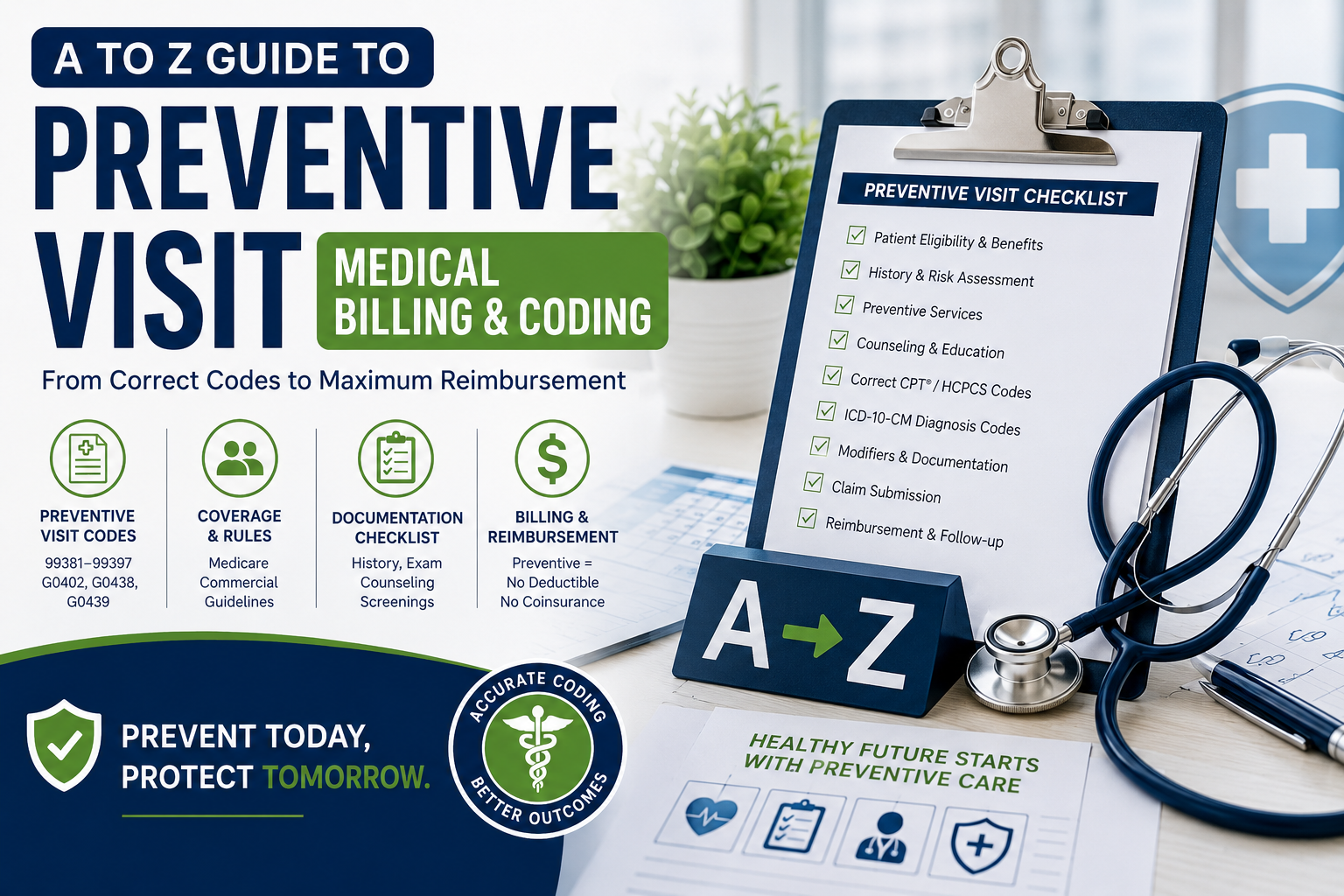
In the complex world of US healthcare revenue cycle management, preventive visit medical billing represents one of the highest-volume service categories—and one of the most frequently denied when billed incorrectly. Whether you are an experienced Accounts Receivable (AR) Caller, a medical billing specialist, or a certified coder, mastering preventive visit medical billing requires understanding the subtle differences between commercial preventive care and Medicare’s wellness-visit benefits.
Preventive visits are an important part of healthcare billing, but they can also create confusion for medical billing teams.
Commercial insurance, Medicaid, and Original Medicare do not necessarily process preventive services in the same way. A claim that is payable under a commercial plan may be handled very differently by Medicare.
For AR Callers and medical billers, understanding the difference between preventive medicine CPT codes, Medicare wellness HCPCS codes, diagnosis coding, modifier 25, frequency limitations, and payer-specific benefits is essential.
A clean preventive claim starts with correct code selection and documentation. When a claim does deny, the AR Caller must determine whether the issue is related to eligibility, frequency, coding, modifier usage, medical necessity, bundling, or the patient’s specific benefit plan.
This guide explains preventive visit medical billing from A to Z, including commercial preventive visits, Medicare IPPE and AWV services, coding, modifier 25, common denials, AR workflows, and prevention strategies.
What Is a Preventive Visit?
A preventive visit is a healthcare encounter focused primarily on prevention, health maintenance, screening, risk assessment, and counseling rather than evaluation and management of a specific acute or chronic problem.
Examples can include:
- Routine preventive examinations
- Well-child visits
- Adult preventive examinations
- Medicare Annual Wellness Visits
- Initial Preventive Physical Examination
- Certain preventive screening services
- Immunization-related preventive services
However, the coding and coverage rules depend heavily on the payer and type of service performed.
Preventive Visit vs. Problem-Oriented E/M
One of the first concepts an AR Caller should understand is the difference between a preventive service and a problem-oriented E/M service.
Preventive Visit
The primary purpose is preventive care, such as:
- Health maintenance
- Screening
- Risk assessment
- Preventive counseling
- Routine examination
- Development or updating of a prevention plan
Problem-Oriented E/M
The visit focuses on evaluating or managing a specific illness, injury, symptom, or chronic condition.
Examples include:
- Hypertension management
- Diabetes management
- Acute respiratory symptoms
- Medication management
- New pain or other complaints
- Evaluation of a worsening chronic condition
A patient can sometimes receive both services on the same date, but the documentation and billing must support both.
Commercial Insurance Preventive Medicine Codes
Commercial insurance plans commonly use the CPT preventive medicine service codes 99381–99397.
These codes are divided between new-patient and established-patient preventive services.
New Patient Preventive Medicine Codes
| Age | CPT Code |
|---|---|
| Infant, under 1 year | 99381 |
| Early childhood, 1–4 years | 99382 |
| Late childhood, 5–11 years | 99383 |
| Adolescent, 12–17 years | 99384 |
| Adult, 18–39 years | 99385 |
| Adult, 40–64 years | 99386 |
| Adult, 65 years and older | 99387 |
Established Patient Preventive Medicine Codes
| Age | CPT Code |
|---|---|
| Infant, under 1 year | 99391 |
| Early childhood, 1–4 years | 99392 |
| Late childhood, 5–11 years | 99393 |
| Adolescent, 12–17 years | 99394 |
| Adult, 18–39 years | 99395 |
| Adult, 40–64 years | 99396 |
| Adult, 65 years and older | 99397 |
New vs. Established Patient
The CPT new-patient concept generally involves whether the patient has received professional services from the physician or another physician/QHP of the same specialty and subspecialty in the same group practice within the previous three years.
For AR purposes, however, do not assume that every payer’s processing logic is identical.
When a commercial payer denies a preventive service because it considers the patient established, verify the payer’s specific policy and claim history before deciding whether a correction or appeal is appropriate.
Medicare Preventive Services Are Different
One of the most important concepts in preventive visit medical billing is understanding that Original Medicare does not cover routine physical examinations in the same way commercial plans may cover preventive physicals.
CMS states that CPT preventive medicine services 99381–99397 are not covered by Medicare. Medicare instead provides specific preventive benefits such as the Initial Preventive Physical Examination (IPPE) and Annual Wellness Visit (AWV).
Therefore, an AR Caller should not automatically treat a Medicare preventive claim the same way as a commercial preventive claim.
Medicare Preventive Visit Coding
The primary Medicare wellness codes are:
- G0402 — Initial Preventive Physical Examination (IPPE)
- G0438 — Initial Annual Wellness Visit
- G0439 — Subsequent Annual Wellness Visit
CMS specifically identifies G0402 as the IPPE and G0438/G0439 as AWV codes.
G0402 — Initial Preventive Physical Examination
The Initial Preventive Physical Examination (IPPE) is commonly called the “Welcome to Medicare” visit.
Code
HCPCS G0402
Timing
Medicare covers one IPPE during the first 12 months after the beneficiary’s Part B coverage begins.
Frequency
Once per lifetime.
Major Components
The IPPE includes required preventive components such as:
- Medical and social history
- Family history
- Medication and supplement review
- Risk factors
- Depression risk assessment
- Functional ability and safety assessment
- Preventive education
- Appropriate screening recommendations
- Other required elements of the IPPE
CMS provides the current required components and billing information on its IPPE guidance.
G0438 — Initial Annual Wellness Visit
Code
HCPCS G0438
G0438 is the initial Annual Wellness Visit and includes development of a personalized prevention plan of service.
CMS describes the AWV as a service designed to develop or update a personalized prevention plan and perform a health risk assessment.
Important Frequency Rule
G0438 is an initial AWV and is generally billed once in a lifetime.
CMS also states that G0438 or G0439 should not be billed within 12 months of G0402 for the same patient.
G0439 — Subsequent Annual Wellness Visit
Code
HCPCS G0439
This is used for subsequent Annual Wellness Visits.
The service updates the patient’s prevention plan and health risk information.
CMS states that G0438 and G0439 can be billed once in a 12-month period, subject to the applicable eligibility and frequency requirements.
Important AR Point
Do not document the rule as simply:
“G0439 is exactly 365 days after the previous AWV.”
Instead, verify the patient’s Medicare history and the applicable CMS/MAC processing rules before determining whether the service is payable.
Medicare Preventive Visit Decision Tree
Use this basic workflow when checking a Medicare preventive visit:
Patient has Medicare Part B
↓
Is the patient within the first 12 months of Part B coverage?
Yes → Check eligibility for G0402
No → Continue
↓
Has the patient already received an IPPE or AWV?
No → Check eligibility for G0438
Yes → Check eligibility for G0439
↓
Verify the 12-month frequency requirement
↓
Check documentation
↓
Submit the appropriate claim
This is a billing workflow, not a substitute for checking the patient’s actual Medicare claims history.
What Is the Difference Between IPPE and AWV?
| Feature | G0402 IPPE | G0438 Initial AWV | G0439 Subsequent AWV |
|---|---|---|---|
| Common name | Welcome to Medicare | Initial AWV | Subsequent AWV |
| Timing | First 12 months of Part B | After initial Part B period and applicable eligibility | Subsequent eligible AWV |
| Frequency | Once per lifetime | Once per lifetime | Once in a 12-month period |
| Main focus | Preventive physical examination and prevention education | Health risk assessment and personalized prevention plan | Update of prevention plan and health risk information |
| Medicare beneficiary cost | Generally no cost-sharing when coverage requirements are met | Generally no cost-sharing when coverage requirements are met | Generally no cost-sharing when coverage requirements are met |
CMS provides the current Medicare wellness coverage and billing rules.
Preventive Services and $0 Cost-Sharing
For commercial insurance, the Affordable Care Act established requirements for many preventive services.
HealthCare.gov states that most health plans must cover specified preventive services without cost-sharing when applicable requirements are met, generally when provided by an in-network provider.
However, $0 cost is not guaranteed in every situation. Coverage can depend on the plan, network status, service, applicable guidelines, and other requirements.
Therefore, an AR Caller should avoid telling a patient:
“All preventive services are always free.”
A better statement is:
“Your plan may provide preventive services without cost-sharing when the applicable coverage requirements are met. We recommend verifying your specific benefits with the payer.”
Modifier 25 With Preventive Visits
One of the most common areas of confusion is billing a preventive service and a problem-oriented E/M service on the same date.
For example:
- Preventive visit: 99396
- Problem-oriented E/M: 99214-25
The key question is whether the problem-oriented E/M was significant, separately identifiable, and medically necessary beyond the preventive service.
CMS confirms that when an AWV is provided with a significant, separately identifiable, medically necessary E/M service, the additional E/M may be reported with modifier 25.
Where Should Modifier 25 Go?
Modifier 25 goes on the problem-oriented E/M code.
Correct example:
99396
99214-25
Not:
99396-25
The modifier identifies the separately identifiable E/M service, not the preventive service.
Example: Preventive Visit + Hypertension Management
A patient comes to the office for a routine preventive examination.
During the encounter, the provider also performs significant additional evaluation and management of uncontrolled hypertension, reviews the patient’s medications, evaluates the condition, and changes the treatment plan.
The claim could potentially include:
99396 — Preventive medicine service
99214-25 — Problem-oriented E/M
The actual reporting depends on the documentation and applicable payer rules.
The important AR question is not:
“Was another problem discussed?”
Instead ask:
“Was a significant, separately identifiable, medically necessary E/M service performed beyond the preventive service?”
Do Different Diagnosis Codes Have to Be Used?
Do not treat different diagnosis codes as the sole test for modifier 25.
The clinical work must support the separately identifiable E/M service.
For example:
Preventive service: Z00.00
Problem-oriented E/M: I10
Using separate diagnoses can accurately describe the services when supported, but merely changing the diagnosis does not create a separately reportable E/M service.
CMS guidance on modifier 25 emphasizes the significance and separate identifiability of the E/M service.
Documentation for Modifier 25
The medical record should support:
- The preventive service
- The additional problem addressed
- Medical necessity
- Evaluation and management work performed
- Assessment
- Plan
- Treatment or medication management when applicable
- The fact that the E/M service was significant and separately identifiable
Do not rely on a checklist that requires a completely separate history and physical section.
The question is whether the record supports the additional E/M service under the applicable coding and payer requirements.
Medicare AWV + Problem-Oriented E/M
CMS specifically allows an additional office/outpatient E/M service when an AWV is performed and a significant, separately identifiable, medically necessary E/M service is provided.
The additional E/M code should be reported with modifier 25.
For example:
G0439
plus
99214-25
when the documentation and Medicare requirements support both services.
2026 Update: G2211 and Preventive Services
This is an important point for 2026 billing teams.
CMS states that beginning January 1, 2025, HCPCS G2211 may be reported with eligible office/outpatient E/M services billed with modifier 25 when performed on the same day as an Annual Wellness Visit, vaccine administration, or certain Medicare Part B preventive services in the office/outpatient setting.
CMS’s current 2026 guidance continues to address this payment rule.
Therefore, if an AR Caller sees a claim containing:
G0439 + 99214-25 + G2211
do not automatically assume G2211 is incorrect.
Check the current CMS/MAC processing rules and the specific services reported on the claim.
ICD-10-CM Diagnosis Coding for Preventive Visits
Diagnosis coding is another important component of preventive visit billing.
For routine examination codes, ICD-10-CM distinguishes between encounters with and without abnormal findings.
Examples include:
Z00.00
Encounter for general adult medical examination without abnormal findings.
Z00.01
Encounter for general adult medical examination with abnormal findings.
When an abnormal finding is identified, the applicable additional code should be assigned to identify the finding.
The FY 2026 ICD-10-CM Official Guidelines explain that when an examination is coded as “with abnormal findings,” additional code(s) should identify the specific abnormal finding.
Pediatric Preventive Codes
Examples include:
Z00.121 — Routine child health examination with abnormal findings
Z00.129 — Routine child health examination without abnormal findings
Gynecological Examination Codes
Examples include:
Z01.411 — Encounter for gynecological examination with abnormal findings
Z01.419 — Encounter for gynecological examination without abnormal findings
Always verify the current ICD-10-CM code set and official guidelines applicable to the date of service.
G0101 and Q0091
Medicare also has specific coverage and billing rules for certain cervical cancer screening services.
Examples include:
G0101 — Cervical or vaginal cancer screening; pelvic and clinical breast examination
Q0091 — Screening Papanicolaou smear; obtaining, preparing, and conveying cervical or vaginal smear to laboratory
These services should not automatically be treated as components of every AWV.
The AR team should verify:
- Eligibility
- Screening frequency
- Risk status
- Previous claim history
- Applicable Medicare coverage requirements
- MAC guidance
Common Preventive Visit Denials
Preventive claims can deny for several reasons.
Common denial categories include:
- Frequency exceeded
- Benefit maximum reached
- Incorrect preventive code
- Incorrect patient status
- Bundled service
- Modifier issue
- Medical necessity
- Diagnosis mismatch
- Eligibility issue
- Non-covered service
- Incorrect provider information
- Incorrect payer
- Duplicate claim
The denial code alone is not enough.
Always review the complete EOB/ERA and payer message.
How an AR Caller Should Work Preventive Visit Denials
Denial 1: Frequency Exceeded
What It Means
The payer’s system indicates that the patient has already received the preventive benefit within the applicable frequency period.
AR Workflow
Step 1: Check the patient’s eligibility and benefits.
Step 2: Review previous preventive claims.
Step 3: Identify the previous date of service.
Step 4: Determine the payer’s frequency rule.
Step 5: Compare the previous claim with the current claim.
Step 6: Determine whether the denial is valid.
Step 7: If the payer processed the claim incorrectly, request reconsideration or correction according to payer procedure.
AR Call Script
“I’m calling regarding a preventive service claim that denied for frequency. Can you please confirm the previous preventive service date used by your system and identify the benefit frequency rule applied to the current claim?”
Then ask:
“Can you confirm whether the frequency is based on the calendar year, plan year, or another benefit limitation?”
Never assume the payer uses a universal “365-day” rule.
Denial 2: Medicare G0438/G0439 Benefit Maximum
What It Means
Medicare’s claim history indicates that the patient does not meet the frequency requirements for the submitted AWV code.
CMS specifically identifies frequency limitations for G0402, G0438, and G0439.
AR Workflow
Check:
- Part B effective date
- Previous G0402
- Previous G0438
- Previous G0439
- Previous date of service
- Current code
- Current date of service
AR Call Script
“Can you confirm the previous IPPE or Annual Wellness Visit date that caused the current claim to deny?”
Then:
“Can you confirm whether the claim was denied because the patient has already received the benefit within the applicable 12-month period?”
Document the response and reference number.
Denial 3: Medicare Denies CPT 99396 or 99397
What It Means
Original Medicare generally does not cover routine preventive medicine CPT codes 99381–99397 as a Medicare preventive benefit.
AR Workflow
First determine what service was actually performed.
Ask:
- Was this a routine physical?
- Was an IPPE performed?
- Was an AWV performed?
- Was the documentation sufficient for G0402, G0438, or G0439?
- Was the patient informed that a routine physical was not a Medicare-covered benefit?
Do not simply replace 99397 with G0439 because the patient is over 65.
The documentation must actually support the Medicare service billed.
Denial 4: E/M Bundled Into Preventive Service
Example
Claim:
99396
99214
Payer denies 99214 as included.
AR Workflow
Step 1: Check whether modifier 25 was submitted.
Step 2: Review the documentation.
Step 3: Determine whether the E/M was significant and separately identifiable.
Step 4: If modifier 25 was incorrectly omitted and the documentation supports it, determine whether a corrected claim is permitted.
Step 5: If modifier 25 was already submitted, review the payer’s processing and applicable policy.
Step 6: If appropriate, submit reconsideration or appeal with supporting documentation.
CMS confirms modifier 25 may be appropriate when the E/M is significant and separately identifiable.
Denial 5: Diagnosis-Related Issue
A preventive claim may deny or process incorrectly because the diagnosis coding does not accurately represent the service.
AR Workflow
Review:
- Primary diagnosis
- Secondary diagnoses
- Preventive diagnosis
- Abnormal finding
- Screening diagnosis
- Payer-specific requirements
Do not add a diagnosis solely to make the claim pay.
The diagnosis must be supported by the medical record.
Denial 6: Eligibility or Benefit Issue
A preventive service can deny even when the CPT code is correct.
Possible causes include:
- Coverage terminated
- Wrong payer
- Out-of-network provider
- Benefit not available under the plan
- Preventive benefit limitation
- Patient enrolled in a different plan
- Service not covered under the patient’s specific benefit structure
AR Workflow
Verify eligibility for the date of service, not just today’s eligibility.
Check:
- Member status
- Effective date
- Termination date
- Product/plan
- Network status
- Preventive benefits
- Frequency
- Applicable exclusions
Corrected Claim vs. Appeal
One of the most important AR decisions is determining whether the claim needs correction or an appeal.
Corrected Claim
Consider a corrected claim when the original claim contains a legitimate billing error, such as:
- Incorrect CPT
- Incorrect modifier
- Incorrect diagnosis
- Incorrect provider
- Incorrect patient information
- Other correctable claim information
Follow the payer’s specific corrected-claim requirements.
Appeal or Reconsideration
Consider an appeal or reconsideration when:
- The original claim was correctly submitted
- The payer applied the wrong policy
- Documentation supports the service
- The claim was incorrectly processed
- The payer failed to consider supporting information
The exact process and deadlines vary by payer.
Preventive Visit AR Call Checklist
Before calling the payer, have:
- Patient name
- Member ID
- DOB when required
- Date of service
- Claim number
- CPT/HCPCS code
- Modifier
- Diagnosis
- Billed amount
- Denial code
- EOB/ERA
- Previous preventive-service history
- Eligibility information
During the call, document:
- Representative name or ID
- Call date
- Call time
- Reference number
- Denial explanation
- Payer policy referenced
- Required correction
- Appeal/reconsideration option
- Filing deadline
- Submission method
- Expected turnaround time
Preventive Visit Denial Prevention
The best denial is the one that never occurs.
Before the Visit
Verify:
- Eligibility
- Benefits
- Network status
- Preventive frequency
- Patient responsibility
- Medicare Part B status
- Previous preventive services
During Coding
Verify:
- CPT/HCPCS
- ICD-10-CM
- Modifier
- Patient status
- Provider information
- Payer-specific requirements
Before Claim Submission
Perform a final review:
Correct patient?
↓
Correct payer?
↓
Correct preventive code?
↓
Correct diagnosis?
↓
Correct modifier?
↓
Frequency verified?
↓
Documentation supports service?
↓
Submit claim
Preventive Billing Quick Reference
| Scenario | Typical Code/Action |
|---|---|
| Commercial preventive visit | CPT 99381–99397 |
| Medicare IPPE | G0402 |
| Medicare initial AWV | G0438 |
| Medicare subsequent AWV | G0439 |
| Preventive + separate problem-oriented E/M | E/M + modifier 25 when supported |
| Medicare routine physical | Generally not covered as a Medicare preventive benefit |
| Frequency denial | Verify prior claims and benefit rules |
| Modifier denial | Review documentation and payer policy |
| Diagnosis issue | Review coding against documentation |
| Eligibility denial | Verify coverage for DOS |
| Bundling denial | Review procedure, modifier, and payer/NCCI rules |
Preventive Visit Billing: AR Decision Tree
Preventive claim denied
↓
Read EOB/ERA
↓
Identify CARC/RARC and payer message
↓
Check eligibility
↓
Check previous preventive claims
↓
Check CPT/HCPCS
↓
Check diagnosis
↓
Check modifier
↓
Review documentation
↓
Check payer policy
↓
Is the claim incorrect?
Yes → Correct claim when permitted
No → Does documentation support the billed service?
Yes → Reconsideration/appeal when appropriate
No → Coding/documentation review
↓
Document payer response
↓
Follow up within the applicable timeframe
Frequently Asked Questions
What CPT codes are used for preventive visits?
Commercial and other non-Medicare plans commonly use CPT 99381–99397 for preventive medicine services, depending on patient age and new/established status.
Medicare uses specific HCPCS codes for the IPPE and AWV, including G0402, G0438, and G0439.
Does Medicare cover CPT 99397?
Original Medicare does not cover CPT 99381–99397 as routine preventive medicine services. Medicare instead provides specific preventive benefits such as the IPPE and AWV.
What is G0402?
G0402 is the Initial Preventive Physical Examination, commonly called the Welcome to Medicare visit.
It is covered once during the first 12 months after the patient’s Part B coverage begins.
What is G0438?
G0438 is the initial Annual Wellness Visit, including a personalized prevention plan of service.
What is G0439?
G0439 is the subsequent Annual Wellness Visit.
CMS states that G0438 and G0439 can be billed once in a 12-month period, subject to the applicable eligibility requirements.
Can an E/M be billed with a preventive visit?
Potentially, yes.
A separate problem-oriented E/M may be reported when the additional service is significant, separately identifiable, medically necessary, and supported by documentation.
Modifier 25 is appended to the problem-oriented E/M when applicable.
Does modifier 25 go on the preventive code?
No.
When appropriate, modifier 25 is appended to the problem-oriented E/M code, not the preventive service code.
Do different diagnosis codes automatically justify modifier 25?
No.
Different diagnoses do not, by themselves, establish that the E/M is separately reportable. The documentation must support the significant, separately identifiable E/M service.
Are preventive services always $0 for commercial insurance?
No.
Many applicable preventive services may be covered without cost-sharing when the plan and service meet the applicable requirements, particularly when provided in-network. However, HealthCare.gov notes that coverage varies and $0 cost is not guaranteed in every situation.
Can G0438 and G0439 be billed every year?
G0438 is the initial AWV and is generally once in a lifetime. G0439 is the subsequent AWV and is subject to the 12-month frequency requirement. Always verify the patient’s Medicare claim history before billing.
Can an AWV and a problem-oriented E/M be billed on the same day?
Yes, when the additional E/M is significant, separately identifiable, medically necessary, and supported by documentation. Modifier 25 is reported with the additional E/M service.
Can G2211 be billed with an AWV in 2026?
CMS guidance allows G2211 with eligible office/outpatient E/M services reported with modifier 25 when performed on the same day as an AWV or certain Medicare Part B preventive services, subject to the applicable requirements.
Final Takeaway for Medical Billing Professionals
Preventive visit billing is not simply about selecting a preventive CPT code.
A successful billing workflow requires the team to understand:
Payer → Benefit → Eligibility → Frequency → CPT/HCPCS → ICD-10-CM → Modifier → Documentation → Claim Submission → Denial Management
For Original Medicare, remember the major distinction:
G0402 = IPPE
G0438 = Initial AWV
G0439 = Subsequent AWV
And for same-day problem-oriented E/M services:
Preventive service + significant, separately identifiable E/M → modifier 25 on the E/M when supported.
For AR Callers, the most important skill is learning to identify the root cause of the denial before taking action.
Do not automatically correct a claim.
Do not automatically appeal.
Do not automatically add modifier 25.
Instead:
Review the claim → verify the benefit → check the patient’s history → review the documentation → verify the current payer rule → determine the correct resolution → document the payer response.
That approach helps reduce preventable denials, improves AR follow-up, and creates a stronger revenue-cycle workflow.
Learn more practical US medical billing, Medicare, denial management, coding, and RCM guides at LearnMedicalBilling.in.