
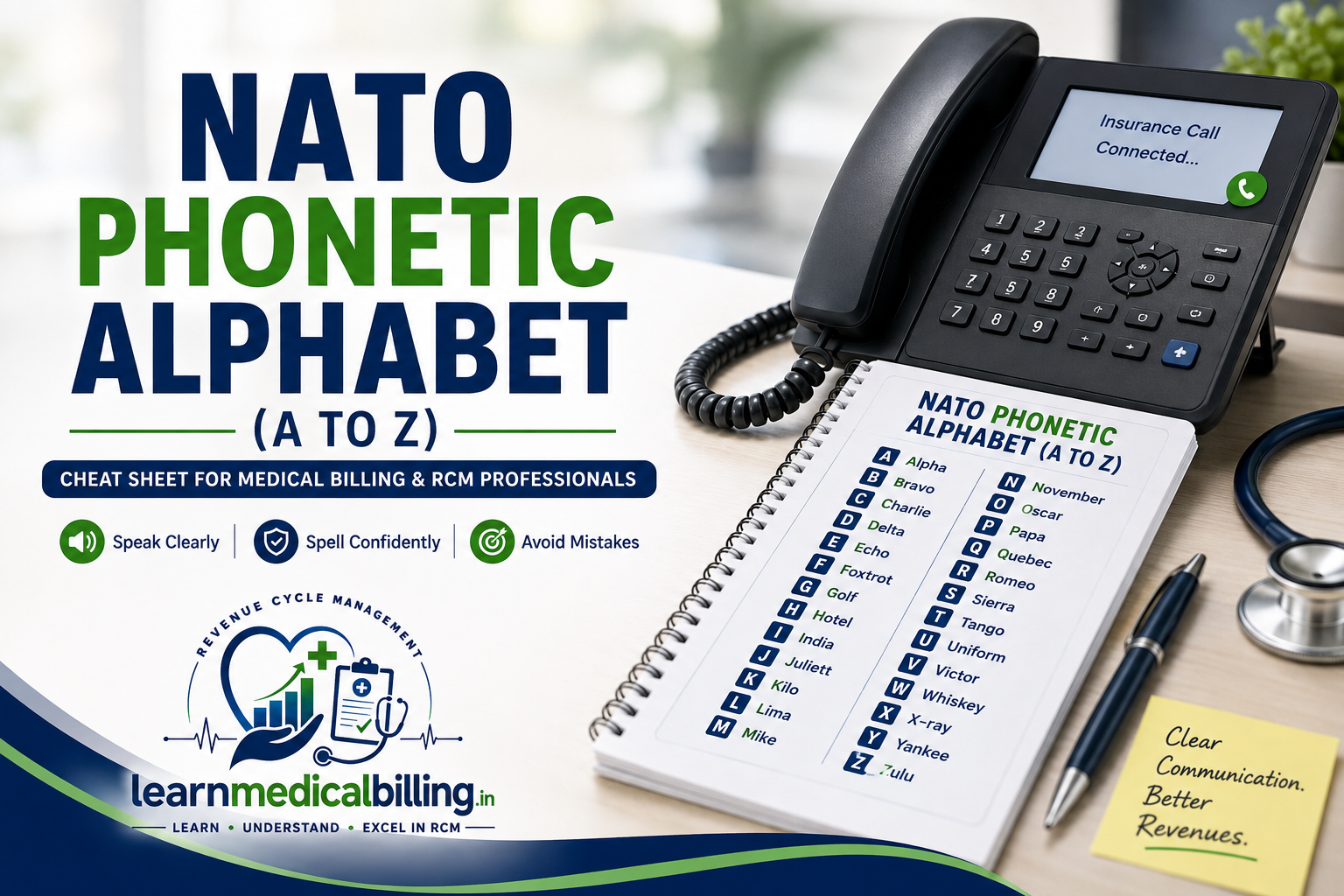
If NATO Phonetic Alphabet for Medical Billing: A-Z Guide for AR Callers
If you’ve ever spoken with a US insurance representative, you’ve probably heard phrases such as:
“Can you confirm the member ID? That’s Alfa, Bravo, Charlie…”
At first, these words may sound unusual. However, they are part of the NATO Phonetic Alphabet, also known as the International Radiotelephony Spelling Alphabet. It assigns a distinctive word to each letter of the English alphabet so that letters can be communicated more clearly over the phone.
In US medical billing, insurance representatives and healthcare revenue cycle professionals communicate by telephone every day. During these calls, an AR Caller may need to verify a member ID, claim number, authorization number, provider information, or payer reference number.
A single misunderstood character can result in incorrect documentation or an unnecessary follow-up call. Therefore, understanding the phonetic alphabet can be a useful communication skill for AR Callers, Medical Billers, Eligibility Specialists, Prior Authorization Specialists, and other RCM professionals.
In this guide, you’ll learn what the phonetic alphabet is, how it works, how medical billing professionals can use it, and practical examples for payer calls.
What Is the NATO Phonetic Alphabet?
The NATO Phonetic Alphabet assigns a standardized spoken word to each letter from A through Z.
For example, instead of simply saying:
B
You can say:
Bravo
Instead of:
D
You can say:
Delta
This makes letters easier to distinguish during telephone conversations, particularly when the connection is unclear or when letters have similar sounds.
The official international spelling alphabet uses terms such as Alfa, Bravo, Charlie, Delta, Echo, Foxtrot, Golf, Hotel, India, Juliett, Kilo, Lima, Mike, November, Oscar, Papa, Quebec, Romeo, Sierra, Tango, Uniform, Victor, Whiskey, X-ray, Yankee, and Zulu.
Why Is the Phonetic Alphabet Useful in Medical Billing?
Medical billing involves frequent communication between providers, billing departments, clearinghouses, patients, and insurance companies.
During an insurance call, an AR Caller may need to communicate information containing a mixture of letters and numbers.
Common examples include:
- Member ID numbers
- Claim numbers
- Authorization numbers
- Reference numbers
- Provider names
- Patient names
- NPI-related information
- Tax identification information
- Payer reference numbers
- Policy numbers
Consider a member ID such as:
BDPT47291
If you simply read the letters aloud, the representative may hear them incorrectly.
Instead, you can say:
Bravo – Delta – Papa – Tango – Four – Seven – Two – Nine – One
This gives the representative a much clearer sequence to document.
How Does It Help an AR Caller?
The primary benefit is clarity.
An AR Caller may spend several minutes researching a claim with an insurance representative. If a claim number or reference number is recorded incorrectly, the information may not be found when the next person follows up.
Using standardized spelling words can help reduce this type of communication error.
Example
Suppose the payer gives you the reference number:
NMCB7821
Instead of repeating:
“N-M-C-B-7821”
you can say:
“November – Mike – Charlie – Bravo – seven – eight – two – one.”
The representative can then confirm the sequence.
This is particularly useful when documenting the reference number in an AR system or claim follow-up note.
Complete NATO Phonetic Alphabet A-Z
| Letter | Phonetic Word | Approximate Pronunciation |
|---|---|---|
| A | Alfa | AL-fah |
| B | Bravo | BRAH-voh |
| C | Charlie | CHAR-lee |
| D | Delta | DELL-tah |
| E | Echo | ECK-oh |
| F | Foxtrot | FOKS-trot |
| G | Golf | Golf |
| H | Hotel | hoh-TELL |
| I | India | IN-dee-ah |
| J | Juliett | JEW-lee-ett |
| K | Kilo | KEY-loh |
| L | Lima | LEE-mah |
| M | Mike | Mike |
| N | November | no-VEM-ber |
| O | Oscar | OSS-cah |
| P | Papa | pah-PAH |
| Q | Quebec | keh-BECK |
| R | Romeo | ROH-me-oh |
| S | Sierra | see-AIR-rah |
| T | Tango | TANG-go |
| U | Uniform | YOU-nee-form |
| V | Victor | VIK-tah |
| W | Whiskey | WISS-key |
| X | X-ray | ECKS-ray |
| Y | Yankee | YANG-key |
| Z | Zulu | ZOO-loo |
The pronunciation shown above is approximate. ICAO notes that pronunciation can vary according to language habits and provides standardized guidance for international radiotelephony communication.
Real Medical Billing Example
Imagine you’re calling an insurance company about a denied claim.
The representative asks:
“Can you provide the member ID?”
The member ID is:
BMQT4927
A simple response would be:
“B-M-Q-T-4-9-2-7.”
A clearer response would be:
“Bravo – Mike – Quebec – Tango – four – nine – two – seven.”
The representative can then repeat the information back to you for confirmation.
Best Practice
After providing an important identifier, ask the representative to confirm it.
For example:
“The member ID is Bravo, Mike, Quebec, Tango, four, nine, two, seven. Can you please confirm that?”
This creates an additional verification step before you continue with the claim inquiry.
Where Can Medical Billing Professionals Use It?
The phonetic alphabet can be useful whenever a telephone conversation involves letters that need to be recorded accurately.
1. Member ID Verification
Insurance member IDs often contain both letters and numbers.
Example:
ABCX73920
You can communicate it as:
Alfa – Bravo – Charlie – X-ray – seven – three – nine – two – zero
2. Claim Follow-Up
During an AR call, the payer may provide a claim or reference number.
If the number contains letters, spelling them phonetically can make documentation easier.
3. Prior Authorization
Authorization numbers and reference numbers may contain letters.
For example:
PAKX48391
You could communicate the letters as:
Papa – Alfa – Kilo – X-ray
followed by the numbers.
4. Eligibility Verification
Eligibility representatives may ask you to confirm subscriber or policy information.
Using phonetic words can help avoid mistakes when the information contains similar-sounding letters.
5. Provider Information
Provider names and other identifiers can sometimes be difficult to understand over a telephone connection.
For unusual spellings, the phonetic alphabet provides a consistent way to clarify individual letters.
Example: Clarifying a Patient’s Name
Suppose a patient’s last name is:
Mendez
If the representative is unsure about the spelling, you could say:
“That’s Mike – Echo – November – Delta – Echo – Zulu.”
This can be especially helpful when the spelling differs from what the representative initially entered.
Phonetic Alphabet vs. Saying “B as in Boy”
Many people use informal expressions such as:
- B as in Boy
- D as in Dog
- M as in Mike
- P as in Peter
These expressions may work in casual conversations. However, the NATO/ICAO spelling alphabet provides a standardized set of words that can be used consistently.
For example:
| Letter | Informal Example | Standard Phonetic Word |
|---|---|---|
| B | Boy | Bravo |
| D | Dog | Delta |
| M | Mother | Mike |
| P | Peter | Papa |
| T | Tom | Tango |
| V | Victor | Victor |
For professional telephone communication, using the standardized words helps maintain consistency.
How to Read a Member ID Correctly
When reading a member ID, claim number, or authorization number, follow a simple process.
Step 1: Read the identifier slowly
Do not rush through the number.
Step 2: Separate letters and numbers
For example:
ABX7291
Break it into:
A – B – X – 7 – 2 – 9 – 1
Step 3: Use phonetic words for letters
Say:
Alfa – Bravo – X-ray – seven – two – nine – one
Step 4: Ask the representative to confirm
You can say:
“Can you please confirm the ID back to me?”
Step 5: Document the confirmed information
Enter the verified information into your appropriate billing or follow-up system.
This simple process can reduce the chance of recording an incorrect identifier.
AR Caller Telephone Script
Here is a practical script you can use during payer calls.
AR Caller:
“I have the member ID as Bravo, Mike, Quebec, Tango, four, nine, two, seven. Could you please confirm that?”
Insurance Representative:
“Yes, that’s correct.”
AR Caller:
“Thank you. I also have the claim reference number as November, Charlie, Delta, five, six, eight, two. Can you confirm that as well?”
This approach is concise, professional, and easy for both parties to follow.
Common Mistakes to Avoid
Mistake 1: Creating Your Own Phonetic Words
Avoid using random words such as:
“B for Boy, D for Dog, Q for Queen.”
Although these may be understandable, they are not the standardized spelling alphabet.
Use:
“Bravo, Delta, Quebec.”
Mistake 2: Speaking Too Quickly
Even when using the correct words, speaking too quickly can cause confusion.
Pause slightly between letters and numbers.
Mistake 3: Not Confirming Important Information
After receiving a claim number, authorization number, or payer reference number, repeat it back when accuracy is important.
Mistake 4: Confusing Similar Letters
Letters such as B/D, M/N, and P/T can sometimes be misunderstood during telephone conversations.
Using phonetic words makes these distinctions clearer.
Tips to Memorize the Alphabet
You don’t have to memorize all 26 words in one sitting.
Practice 5 Letters at a Time
Start with:
A – Alfa
B – Bravo
C – Charlie
D – Delta
E – Echo
Then continue with the next five.
Practice Your Own Name
Spell your first and last name using the phonetic alphabet.
For example:
MANOJ
Mike – Alfa – November – Oscar – Juliett
Practice Common RCM Terms
Try spelling:
CLAIM
Charlie – Lima – Alfa – India – Mike
Then practice:
PAYER
Papa – Alfa – Yankee – Echo – Romeo
Regular practice will make the words easier to recall during real calls.
Quick Reference for AR Callers
| Situation | Recommended Approach |
|---|---|
| Member ID | Spell letters phonetically |
| Claim number | Spell letters and read numbers clearly |
| Authorization number | Use phonetic words for letters |
| Reference number | Repeat and confirm |
| Patient name | Spell unclear letters phonetically |
| Provider name | Clarify unusual spellings |
| Important call documentation | Verify before ending the call |
Is the NATO Phonetic Alphabet Mandatory in Medical Billing?
No. There is no general medical billing requirement that every AR Caller must use the NATO Phonetic Alphabet.
However, it is a useful communication technique for telephone conversations where accurate spelling matters.
Individual insurance companies, healthcare organizations, call centers, and representatives may have their own communication practices.
Therefore, use the standardized alphabet when it improves clarity, while following the specific communication procedures of your employer and the payer.
Do Medicare Representatives Use the NATO Phonetic Alphabet?
The use of the phonetic alphabet can vary by organization and representative.
Medicare-related calls may involve Medicare Administrative Contractors, Medicare Advantage organizations, providers, and other entities, each with its own procedures.
Therefore, it is better to describe the phonetic alphabet as a general telephone communication tool rather than claiming that Medicare universally requires or uses it.
Why Is It Called the NATO Phonetic Alphabet?
The system is commonly called the NATO Phonetic Alphabet, but its formal international use is associated with the International Radiotelephony Spelling Alphabet.
The International Civil Aviation Organization (ICAO) developed and standardized the alphabet for radiotelephony communication. The alphabet was subsequently adopted by NATO and other organizations.
This is why you may hear it described by several names, including:
- NATO Phonetic Alphabet
- NATO Spelling Alphabet
- ICAO Phonetic Alphabet
- International Radiotelephony Spelling Alphabet
- Alpha/Bravo/Charlie Alphabet
Frequently Asked Questions
What is the NATO Phonetic Alphabet?
It is a standardized spelling alphabet that assigns a distinct spoken word to each letter of the alphabet to improve clarity during verbal communication.
What is A in the NATO alphabet?
A is Alfa.
What is B in the NATO alphabet?
B is Bravo.
What is C in the NATO alphabet?
C is Charlie.
What is Q in the NATO alphabet?
Q is Quebec.
What is X in the NATO alphabet?
X is X-ray.
Is Alpha or Alfa correct?
The official ICAO spelling is Alfa. “Alpha” is commonly used in everyday English, but the standardized spelling alphabet uses Alfa.
Is the phonetic alphabet useful for AR Callers?
Yes. It can be particularly useful when communicating member IDs, claim numbers, authorization numbers, reference numbers, patient names, and other information containing letters.
Is the NATO Phonetic Alphabet required by insurance companies?
Not universally. Its use depends on the organization and communication situation.
Final Takeaway
The NATO Phonetic Alphabet is a simple but valuable communication tool for medical billing professionals.
For an AR Caller, accuracy during a payer telephone call can affect everything from claim research to follow-up documentation. Using words such as Alfa, Bravo, Charlie, Delta, and Quebec can make individual letters easier to distinguish.
The best approach is simple:
Spell clearly → use standardized phonetic words → confirm important information → document accurately.
With regular practice, the alphabet becomes second nature and can make payer calls more efficient and professional.
For medical billing professionals, this is a small communication skill that can have a practical impact on everyday AR, eligibility, authorization, and claims follow-up work.
Learn more medical billing and RCM concepts at LearnMedicalBilling.in.