
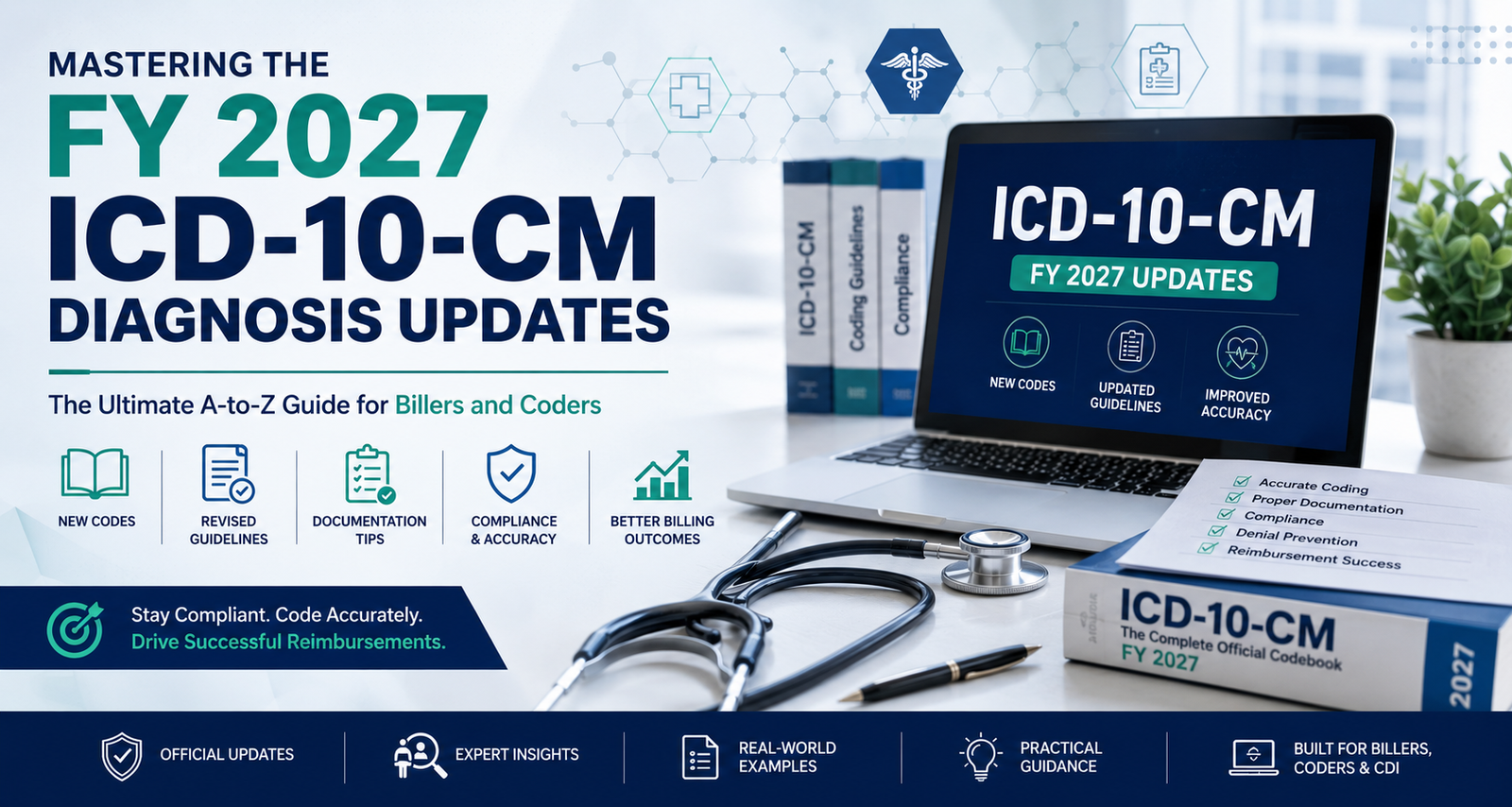
The medical billing and coding landscape in US healthcare is shifting once again. The Centers for Medicare & Medicaid Services (CMS) and the Centers for Disease Control and Prevention (CDC) have officially released the finalized Fiscal Year (FY) 2027 ICD-10-CM diagnosis code files.
For AR callers, medical billers, and certified coders, this isn’t just routine paperwork. These changes are legally locked in and effective for all healthcare encounters and hospital discharges from October 1, 2026, through September 30, 2027.
Using outdated codes after the October 1 deadline means one thing: immediate, systemic claim denials. The new package contains 238 new codes, 4 key revisions, and 21 deletions. If you want to protect your healthcare organization’s cash flow and maintain a clean claim rate, you need to understand exactly what is changing.
This comprehensive guide breaks down the updates from A to Z, ensuring freshers can easily grasp the changes while seasoned revenue cycle management (RCM) experts get the highly detailed clinical mappings they need.
The Core Blueprint: What’s New in FY 2027?
Medical coding systems update annually to map to advancing clinical technologies, precise diagnostic screening methods, and evolving healthcare needs.
When a code is “deleted” in ICD-10-CM, it rarely means the disease disappears from the manual. Instead, CMS typically deletes a broad parent code to split it into highly granular children codes.
The visual workflow below highlights how patient documentation must now flow from a generalized diagnosis into specific coding categories to pass front-end clearinghouse rules:
[Clinical Chart Documentation]
             │
             ▼
 ┌───────────────────────┐
 │   Identify Specialty  │
 └───────────┬───────────┘
             │
             ├───────────────► [Cardiology] ──────► Verify Genetic vs. Specified Etiology (I42.0x)
             ├───────────────► [Orthopedics] ─────► Extract Exact Laterality & Site (M67.A- / M86.8X-)
             └───────────────► [OB-GYN / GI] ─────► Map Complex Complications & Grading (O31.4- / K74.02)
Granular Breakdown: High-Impact Clinical Changes
1. The Cardiology Overhaul: Cardiomyopathy & Inherited Rhythms
Cardiology claims carry high dollar values, making them prime targets for insurance audits. If your practice treats heart failure or implants cardiac devices, pay strict attention to these shifts.
The Dilated Cardiomyopathy Split (I42.0 Deletion)
The legacy catch-all code I42.0 (Dilated cardiomyopathy) is officially invalid for primary or secondary diagnosis reporting. CMS has expanded this category to force providers to document the exact origin of the disease:
- I42.00 (Dilated cardiomyopathy, unspecified): Only map to this code if the chart provides absolutely zero context regarding the cause. Warning: Relying on this code will likely trigger medical necessity denials from commercial payers for advanced heart failure therapies.
- I42.01 (Familial-genetic dilated cardiomyopathy): You must select this when the physician explicitly documents that the cardiomyopathy is linked to genetic tracking, inherited mutations (like TTN or LMNA genes), or a definitive family history.
- I42.09 (Other dilated cardiomyopathy): Used for non-familial, specified secondary dilated cardiomyopathies (e.g., metabolic or toxic forms, assuming primary sequencing guidelines are followed).
Standalone Inherited Arrhythmia Mappings
Historically, complex genetic channelopathies were grouped into vague “Other specified cardiac arrhythmias” codes. FY 2027 introduces highly anticipated standalone tracking codes:
- I49.81 (Brugada syndrome): Captures patients presenting with the classic genetic sodium channelopathy. This code is crucial for establishing medical necessity for Implantable Cardioverter-Defibrillator (ICD) placements.
- I47.22 (Catecholaminergic polymorphic ventricular tachycardia – CPVT): Specifically tracks stress- or exercise-induced bidirectional ventricular tachycardia. This code distinguishes these high-risk patients from standard paroxysmal VT (I47.20), which is critical for capturing exact patient risk adjustment scores.
- I49.82 (Ventricular bigeminy): Moves high-burden ectopy out of general premature depolarization catch-alls.
2. Podiatry & Orthopedics: Plantar Fasciitis & Osteomyelitis
Musculoskeletal billing teams must prepare for immediate adjustments to electronic superbills.
Plantar Fasciitis Gets Labeled
Plantar fasciitis is one of the most common causes of heel pain, yet it has never had its own unique code until now. For FY 2027, it moves out of general fascial disorders (M72.2) and receives its own family under the new M67 subcategory:
- M67.A- (Plantar fasciitis and plantar fascial fibromatosis): You will be required to code down to the final character to specify laterality (Right foot vs. Left foot vs. Unspecified).
Mandatory Laterality for Osteomyelitis
- Under category M86.8X- (Other osteomyelitis), coders are now required to append a 7th character indicating laterality (Right, Left, or Unspecified).
- Revenue Risk: Submitting a truncated 6-character code will trigger an instant front-end rejection at the clearinghouse level before the claim ever reaches the payer.
3. Endocrinology & Gastroenterology: Hypoglycemia & Fibrosis
- Postprocedural Hypoglycemia: Three new codes under the E89.83- subcategory allow providers to track severe low blood sugar complications directly resulting from surgical procedures. This includes E89.830 for post-bariatric hypoglycemia, a critical metric for tracking surgical outcomes.
- Moderate Hepatic Fibrosis (K74.02): A new code has been established for Stage F2 hepatic fibrosis. This bridges a vital gap between mild changes and end-stage cirrhosis, heavily impacting prior authorizations for high-cost specialty gastrointestinal medications.
4. Oncology, OB-GYN, and Rare Genetic Syndromes
- Breast Carcinoma In Situ Coding Note (D05.-): CMS has established strict Excludes1 notes. Starting October 1, billing teams can no longer report a malignant neoplasm of the breast (C50.-) alongside a carcinoma in situ code (D05.-) for the same breast.
- Complex Pregnancy Granularity: New codes for ectopic pregnancies now require documentation of the exact anatomical site of implantation. Additionally, new code O31.4- tracks a continuing pregnancy following vanishing twin syndrome, ensuring OB-GYN practices can capture the true clinical complexity of the patient’s care.
- Isolated Z-Codes & Genetic Syndromes: Rare congenital malformations like Lynch syndrome, Loeys-Dietz syndrome, and Li-Fraumeni syndrome graduate to unique, dedicated codes. On the SDoH and preventive side, a new code tracks a patient’s personal history of Clostridioides difficile (C. diff) infections to aid in facility quality reporting.
Revenue Protection Matrix: Old vs. New Code Conversions
The following table serves as a quick-reference crosswalk for billing teams to identify immediate denial risks:
| Legacy Coding Layout | New FY 2027 Coding Setup | Primary Revenue & Denial Risk |
| I42.0 (Dilated Cardiomyopathy) | I42.00, I42.01, I42.09 | Invalid Parent Code Denials: Inactive 4-character submissions will be dropped by payers. |
| M72.2 (Plantar Fasciitis) | M67.A- family | Medical Necessity Drop: Prior authorizations for heel injections or physical therapy will reject if using old codes. |
| M86.8X (Other Osteomyelitis) | Requires a mandatory 7th character | Truncated Claim Drop: Clearinghouses will flag claims missing laterality extensions as incomplete. |
| K74.0 (General Hepatic Fibrosis) | Includes K74.02 (Stage F2/Moderate) | Prior Auth Denial: Commercial insurance policies require explicit grading for specialty drug approval. |
Action Plan for Revenue Cycle Readiness
Do not wait until October 1 to update your billing platform. Use this countdown sequence to ensure a seamless operational transition:
1.Scrub Inactive Codes from Software:Complete by August 30.
Download the official CMS 2027 Conversion Table files. Upload them into your practice management software, EHR quick-pick menus, and electronic billing scrubbers. Completely remove deleted parent codes like I42.0.
2.Initiate Provider Documentation Training:Complete by September 15.
Host focused training sessions for your clinical staff. Emphasize the critical need for documentation specificity—specifically capturing genetic ties for cardiomyopathy, precise laterality for bone and fascial conditions, and exact anatomical implantation sites for ectopic pregnancies.
3.Execute Clearinghouse Rules Validation:Complete by September 30.
Work closely with your clearinghouse vendor to verify that front-end scrubbing rules are updated. Run test claims utilizing the new 6-character and 7-character extensions to ensure codes do not drop due to formatting errors.
Official CMS & CDC Reference Links
- Official CMS Code Center: You can access and download the raw ZIP archives—including the 2027 Conversion Table, POA Exempt Codes, and the Code Descriptions in Tabular Order—directly from the CMS ICD-10 Coding and Billing Repository.
- Official CDC Diagnosis Index: To review historical releases and check the clinical framework updates managed by the National Center for Health Statistics, check the CDC ICD-10-CM Release Portal.
- AAPC Breakdown: For a localized, chapter-by-chapter editorial review mapping the exact text revisions (such as the Glanzmann thrombasthenia platelet expansions), check the AAPC 2027 ICD-10-CM Update Preview.
For an in-depth visual training session that walks through these diagnostic modifications, you can watch the 2027 ICD-10-CM Code Changes Review Video. This highly detailed video walk-through covers the exact reasons behind the new cardiology splits, Brugada syndrome profiles, and laterality updates to help your revenue cycle team prepare for clean claim submissions well before the hard October deadline.
AR Expert Takeaway: Denials are expensive to work, but simple to prevent. By conducting proactive internal audits of your practice’s most frequently billed codes ahead of October 1, you can confidently protect your cash flow and keep front-end rejection rates near zero.