
What is an NCD?
A National Coverage Determination (NCD) is a nationwide Medicare policy issued by the Centers for Medicare & Medicaid Services (CMS).
An NCD determines whether Medicare will cover a particular item or service for beneficiaries across the entire United States.
Key Features
- Issued by CMS
- Applies nationwide
- Mandatory for all Medicare Administrative Contractors (MACs)
- Uniform Medicare coverage policy
- May include covered diagnoses, documentation requirements, and frequency limits
Example
CMS publishes an NCD for Screening Mammography, specifying Medicare coverage criteria nationwide.
What is an LCD?
A Local Coverage Determination (LCD) is a coverage policy developed by a Medicare Administrative Contractor (MAC) for its own jurisdiction when no applicable NCD exists.
LCDs explain:
- Medical necessity
- Covered diagnosis codes
- Documentation requirements
- Billing instructions
- Frequency limitations
Key Features
- Issued by a MAC
- Applies only within that MAC’s jurisdiction
- May vary between jurisdictions
- Cannot conflict with an existing NCD
Example
A MAC may publish an LCD outlining the medical necessity requirements for Vitamin D testing in its jurisdiction.
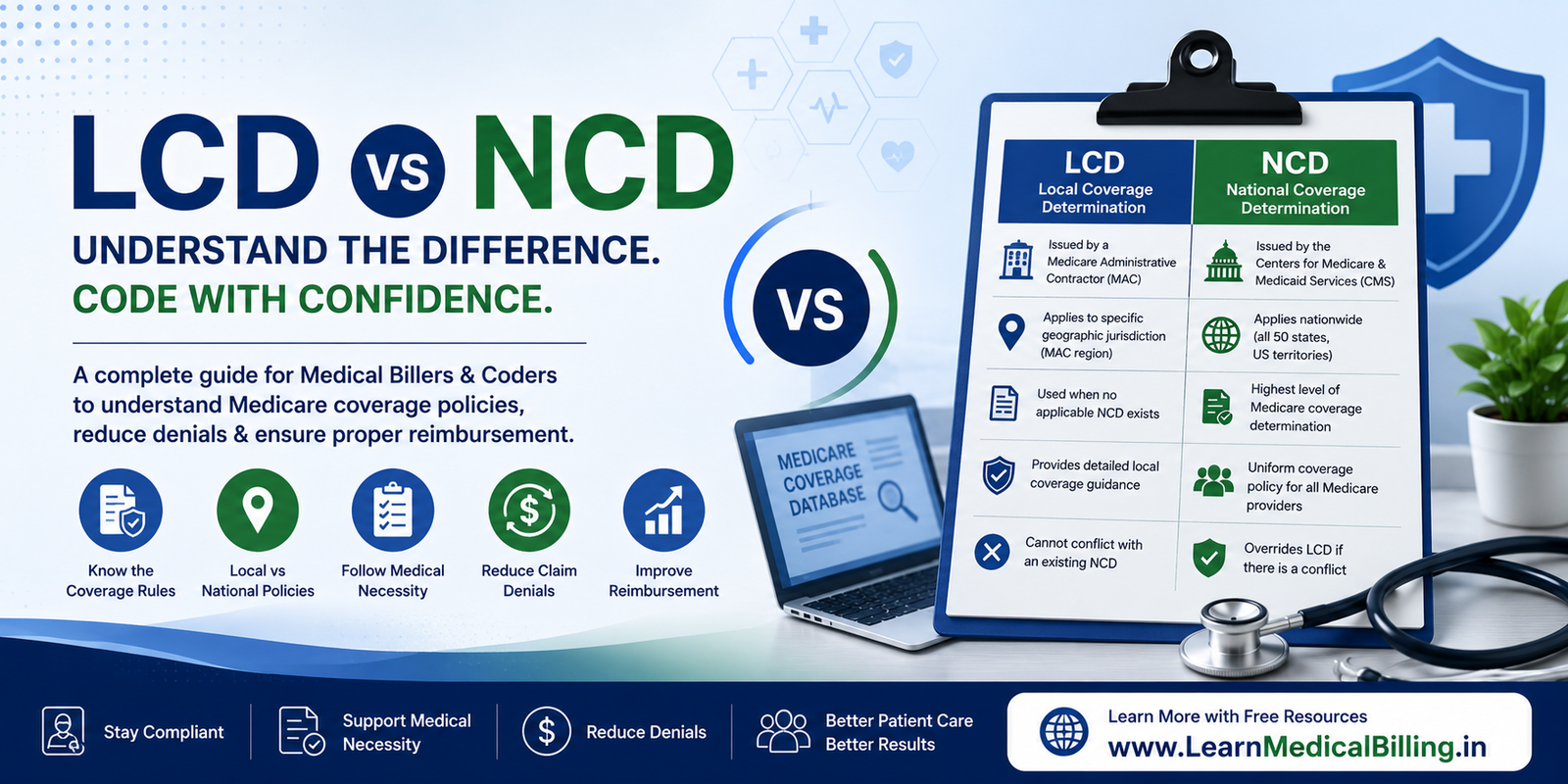
LCD vs NCD
| Feature | LCD | NCD |
|---|---|---|
| Full Form | Local Coverage Determination | National Coverage Determination |
| Issued By | Medicare Administrative Contractor (MAC) | Centers for Medicare & Medicaid Services (CMS) |
| Coverage Area | Specific MAC jurisdiction | Entire United States |
| Applies To | Local providers | All Medicare providers |
| Authority | Local | National |
| Can Vary? | Yes | No |
| Overrides | Cannot override an NCD | Highest Medicare coverage policy |
Why Are LCDs and NCDs Important?
They help determine:
- Whether Medicare covers a service
- Medical necessity
- Required diagnosis codes
- Documentation standards
- Frequency limitations
- Billing requirements
Following these policies can reduce Medicare claim denials.
When Should a Medical Biller Check an LCD?
- Before billing high-cost procedures
- When a service is denied for medical necessity
- When billing laboratory tests
- When billing imaging services
- When billing durable medical equipment (DME)
- When payer guidance is unclear
Common Services with LCDs
- Vitamin D Testing
- Sleep Studies
- Physical Therapy
- Laboratory Testing
- Pain Management
- Wound Care
- Cardiac Testing
- Diagnostic Imaging
Common Services with NCDs
- Screening Mammography
- Colorectal Cancer Screening
- Influenza Vaccines
- Pneumococcal Vaccines
- Diabetes Screening
- Bone Mass Measurement
- Kidney Disease Education
How to Check an LCD or NCD
NCD
Visit the CMS Medicare Coverage Database (MCD) and search for the service or keyword.
LCD
Search the same database and filter results by your Medicare Administrative Contractor (MAC) or jurisdiction.
Common Mistakes
❌ Billing without checking Medicare coverage
❌ Using unsupported diagnosis codes
❌ Missing documentation requirements
❌ Assuming every MAC has the same LCD
❌ Ignoring frequency limitations
Interview Question
Q: What is the difference between an LCD and an NCD?
Answer:
An NCD is a nationwide Medicare coverage policy issued by CMS and applies to all Medicare beneficiaries. An LCD is developed by a Medicare Administrative Contractor (MAC) for its own jurisdiction when there is no applicable NCD. LCDs cannot conflict with existing NCDs.
Key Takeaways
- NCD = National policy issued by CMS
- LCD = Local policy issued by a Medicare Administrative Contractor (MAC)
- NCDs apply nationwide.
- LCDs apply only within the issuing MAC’s jurisdiction.
- LCDs cannot override NCDs.
- Reviewing applicable LCDs and NCDs before billing helps support medical necessity and reduce Medicare claim denials.
Official References
- CMS Medicare Coverage Database (MCD): https://www.cms.gov/medicare-coverage-database
- Centers for Medicare & Medicaid Services (CMS): https://www.cms.gov
Editorial Note
This article is an original educational guide prepared for LearnMedicalBilling.in using publicly available information from official CMS resources. Always verify the latest LCDs and NCDs in the Medicare Coverage Database before submitting Medicare claims, as coverage policies may change over time.