
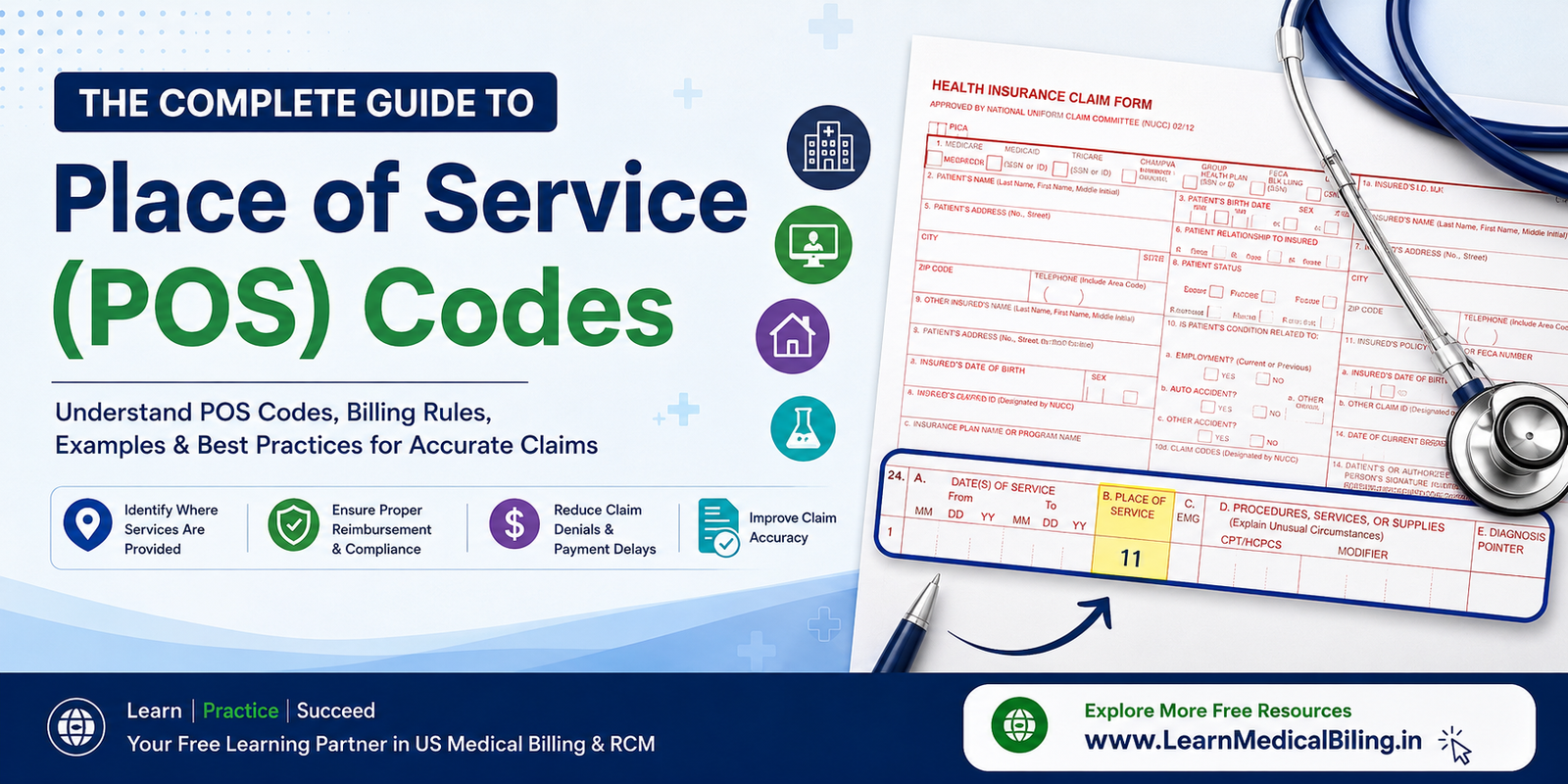
Accurate medical billing depends on more than selecting the correct CPT® and ICD-10-CM codes. One of the most important claim elements is the Place of Service (POS) code, which identifies where a healthcare service was provided.
Using an incorrect POS code can result in claim denials, payment delays, incorrect reimbursement, or requests for additional documentation. That’s why every medical biller, coder, and AR caller should understand how POS codes work.
In this guide, you’ll learn what POS codes are, why they matter, the most commonly used codes, telehealth updates, billing examples, and best practices to help improve claim accuracy.
What Are Place of Service (POS) Codes?
A Place of Service (POS) code is a two-digit code reported on professional claims (CMS-1500 or electronic 837P) to indicate the location where the healthcare service was furnished.
Insurance companies use POS codes to determine:
- Reimbursement rates
- Coverage eligibility
- Medical necessity requirements
- Facility vs. non-facility payment
- Claim processing rules
POS codes are maintained by the Centers for Medicare & Medicaid Services (CMS).
Where Are POS Codes Entered?
On the CMS-1500 Claim Form, the POS code is entered in:
Box 24B – Place of Service
For electronic claims (837P), the POS is transmitted in the corresponding electronic data field.
Why Are POS Codes Important?
The correct POS code helps payers determine:
- Where the patient received care
- Whether the provider qualifies for facility or non-facility reimbursement
- Which billing rules apply
- Whether modifiers or documentation are required
An incorrect POS code may lead to:
- Claim denials
- Incorrect payment
- Claim rejections
- Audit risk
- Delayed reimbursement
Most Common Place of Service Codes
| POS | Description |
|---|---|
| 02 | Telehealth Provided Other than in Patient’s Home |
| 10 | Telehealth Provided in Patient’s Home |
| 11 | Office |
| 12 | Home |
| 19 | Off-Campus Outpatient Hospital |
| 20 | Urgent Care Facility |
| 21 | Inpatient Hospital |
| 22 | On-Campus Outpatient Hospital |
| 23 | Emergency Room – Hospital |
| 24 | Ambulatory Surgical Center (ASC) |
| 31 | Skilled Nursing Facility (SNF) |
| 32 | Nursing Facility |
| 49 | Independent Clinic |
| 50 | Federally Qualified Health Center (FQHC) |
| 72 | Rural Health Clinic (RHC) |
| 81 | Independent Laboratory |
Understanding Telehealth POS Codes
POS 02 – Telehealth (Other Than Patient’s Home)
Use POS 02 when telehealth services are provided and the patient is not located at home during the encounter.
Example:
A patient connects with a physician from a community clinic using telehealth equipment.
POS 10 – Telehealth (Patient’s Home)
Use POS 10 when the patient receives telehealth services while located at home.
Example:
A physician conducts a follow-up visit with a patient connected from home.
Real Billing Example
Patient: John Smith
Provider: Family Medicine Physician
Service: Office Evaluation and Management Visit
CPT Code: 99213
Diagnosis: I10 (Essential Hypertension)
Place of Service: 11 (Office)
Since the service was performed in the physician’s office, POS 11 is reported in Box 24B of the CMS-1500 claim form.
Common POS Billing Mistakes
- Reporting POS 11 instead of POS 22 for hospital outpatient services
- Using POS 02 when the patient actually received telehealth services at home (POS 10)
- Selecting the wrong facility type
- Not verifying payer-specific POS requirements
- Assuming all insurers reimburse the same for each POS code
Tips for Medical Billers
✔ Verify the actual location where services were provided.
✔ Review provider documentation before selecting the POS.
✔ Stay current with CMS telehealth guidance.
✔ Confirm payer-specific billing policies.
✔ Ensure POS codes match documentation and CPT services.
Frequently Asked Questions
Is the POS code required on every CMS-1500 claim?
Yes. Professional claims require a valid POS code to identify where services were performed.
What is the most commonly used POS code?
POS 11 (Office) is one of the most frequently reported Place of Service codes for physician office visits.
What’s the difference between POS 19 and POS 22?
- POS 19: Off-campus outpatient hospital
- POS 22: On-campus outpatient hospital
Selecting the correct code is important because reimbursement and payer rules may differ.
What is the difference between POS 02 and POS 10?
- POS 02: Telehealth when the patient is not at home
- POS 10: Telehealth when the patient is at home
Key Takeaways
- Place of Service (POS) codes identify where healthcare services are provided.
- POS codes are reported in Box 24B of the CMS-1500 claim form.
- Accurate POS reporting helps ensure proper reimbursement and reduces claim denials.
- Telehealth services commonly use POS 02 or POS 10, depending on the patient’s location.
- Always verify payer-specific requirements before claim submission.
Official References
- Centers for Medicare & Medicaid Services (CMS) – Place of Service Code Set: https://www.cms.gov/Medicare/Coding/place-of-service-codes/Place_of_Service_Code_Set
- CMS Medicare Claims Processing Manual
- National Uniform Claim Committee (NUCC) – CMS-1500 Claim Form Guidance: https://www.nucc.org
Editorial Note
This article is an original educational guide created for LearnMedicalBilling.in. It is based on publicly available information from official CMS and NUCC resources and is intended for educational purposes only. Always verify payer-specific billing requirements and the latest CMS guidance before submitting claims.