
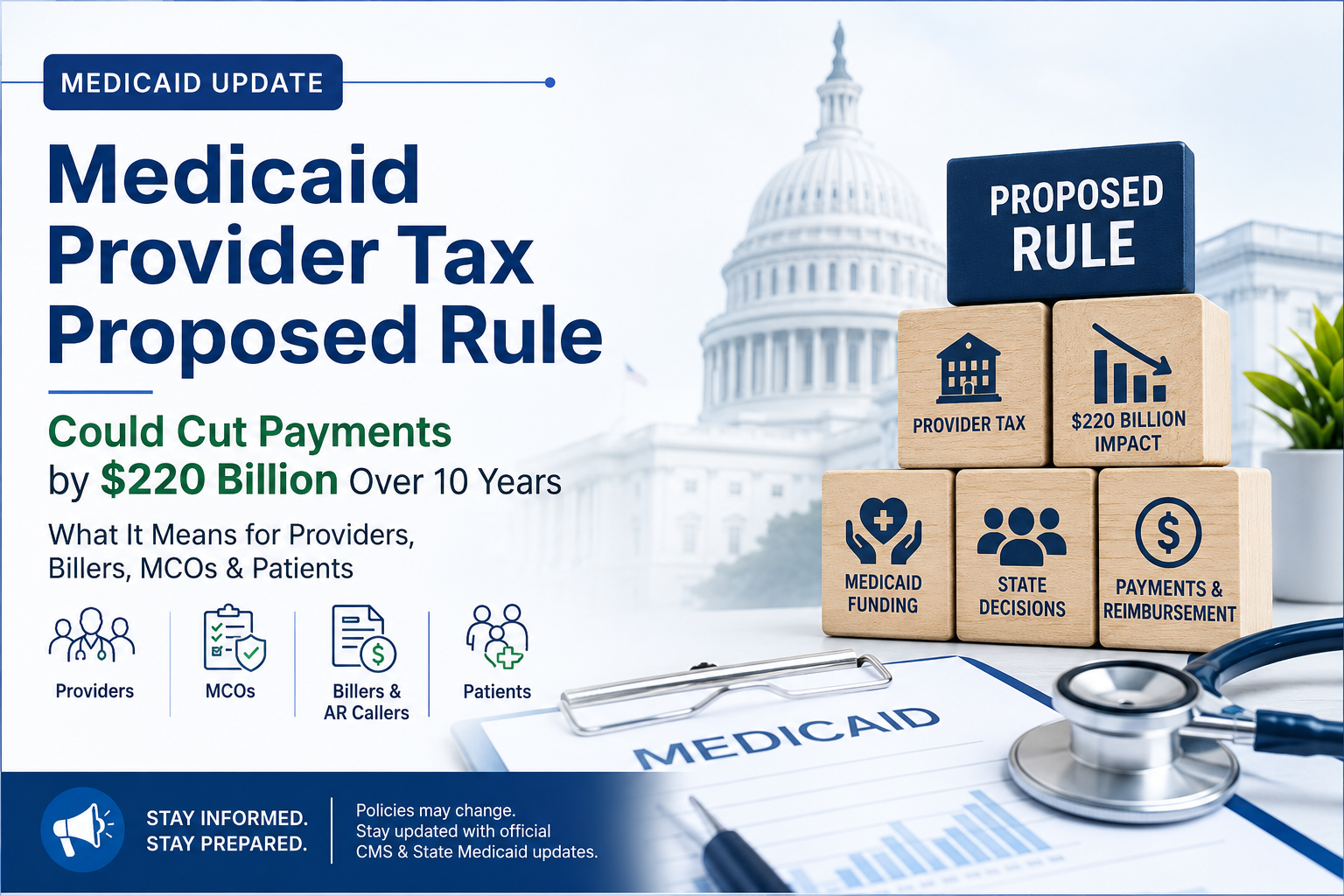
Medicaid provider tax proposed rule is one of the most significant healthcare policy proposals of 2026. The proposal from the Centers for Medicare & Medicaid Services (CMS) has generated widespread attention because it could reduce federal Medicaid spending by approximately $220 billion over the next 10 years. While many headlines suggest Medicaid payments may be cut, the proposal is more complex than it appears. In this article, you’ll learn what the Medicaid provider tax proposed rule is, why CMS introduced it, how it could affect healthcare providers, Medicaid Managed Care Organizations (MCOs), medical billers, AR callers, and patients, and whether Medicaid claim payments will actually decrease.
If you’ve seen headlines saying “Medicaid payments could be cut by $220 billion,” you might wonder:
- Will providers receive less money?
- Will Medicaid claims start paying less?
- Will Medical Billers and AR Callers have more work?
- Will patients lose benefits?
The answer is not immediately. This is currently a proposed rule, not a final regulation.
The sections below explain what it means in simple language.
What Is Medicaid?
Medicaid is a government health insurance program that provides healthcare coverage to millions of low-income individuals and families in the United States.
Unlike Medicare, Medicaid is funded jointly by:
- The Federal Government
- Individual State Governments
Because both governments contribute money, states must follow federal Medicaid rules while managing their own programs.
What Is a Medicaid Provider Tax?
Many states collect a provider tax from healthcare organizations such as:
- Hospitals
- Nursing Homes
- Rehabilitation Facilities
- Other Healthcare Providers
At first, this sounds strange.
Why would hospitals pay a tax to the state?
Here’s the reason.
The tax helps states raise their share of Medicaid funding. Once the state contributes its share, the federal government provides additional matching funds.
The combined money is then used to operate the Medicaid program.
How Medicaid Funding Works
Think of it like this:
Hospital pays Provider Tax
            ↓
State collects the tax
            ↓
Federal Government provides matching funds
            ↓
State Medicaid Program receives more funding
            ↓
Providers receive Medicaid reimbursement
This financing approach has been used by many states for years.
Why Is CMS Proposing This Rule?
CMS believes some provider tax arrangements allow states to receive more federal Medicaid funding than intended.
According to CMS, certain financing structures may effectively allow providers to recover much of the taxes they pay through higher Medicaid reimbursements.
CMS wants to tighten these rules so federal Medicaid funding more closely reflects the intended financing structure.
The goal, according to CMS, is to improve fiscal oversight and reduce unnecessary federal spending.
Why Is Everyone Talking About “$220 Billion”?
According to CMS estimates, the proposal could reduce federal Medicaid spending by approximately $220 billion over the next decade.
However, that does not mean hospitals will suddenly lose $220 billion tomorrow.
Instead, it represents the estimated reduction in future federal Medicaid expenditures if the proposed rule becomes final.
Will Providers Get Less Money?
Right now?
No.
Nothing changes today.
Current:
- urrent Medicaid fee schedules remain unchanged.
- Existing provider contracts are still valid.
- Likewise, MCO agreements continue without modification.
- Claims are processed under today’s reimbursement rules.
Therefore, providers should continue billing as usual.
Could Providers Be Affected Later?
Yes.
If the rule becomes final, some states may receive less federal Medicaid funding.
Each state would then decide how to manage its Medicaid budget.
Possible responses include:
- Finding additional state funding
- Reducing Medicaid reimbursement rates
- Delaying future payment increases
- Adjusting optional Medicaid programs
- Changing reimbursement policies
Every state may respond differently.
Will Medicaid Claims Pay Less?
Not automatically.
Many people assume:
Less Federal Funding = Every Medicaid Claim Pays Less
That is incorrect.
Claim payments only change when:
- A state updates its Medicaid fee schedule.
- A Medicaid Managed Care Organization (MCO) updates provider contracts.
- New reimbursement policies become effective.
Until then, claims continue to pay under current reimbursement rules.
What About Medicaid MCOs?
Many Medicaid patients are enrolled in Managed Care Organizations (MCOs).
Examples include:
- Amerigroup
- Molina Healthcare
- UnitedHealthcare Community Plan
- Aetna Better Health
- Wellcare
- Humana Healthy Horizons
- State-specific Medicaid MCOs
MCOs receive monthly payments from the state.
If states receive less federal funding, future payments to MCOs could also change.
MCOs may respond by:
- Renegotiating provider contracts
- Increasing prior authorization requirements
- Strengthening claim reviews
- Expanding medical necessity reviews
- Improving utilization management
However, existing contracts generally remain in effect until officially changed.
Which Providers Could Be Most Affected?
Organizations with a large Medicaid patient population may experience greater financial pressure.
Examples include:
- Rural Hospitals
- Children’s Hospitals
- Safety-Net Hospitals
- Federally Qualified Health Centers (FQHCs)
- Nursing Homes
- Behavioral Health Centers
- Home Health Agencies
Providers with mostly Commercial Insurance or Medicare patients may experience less direct impact.
What Does This Mean for Medical Billers and AR Callers?
There are no immediate billing changes because of this proposal.
However, if states or MCOs later adjust reimbursement policies, Revenue Cycle Management (RCM) teams may notice:
- Increased denial management
- More medical necessity reviews
- Additional documentation requests
- Greater focus on eligibility verification
- Increased prior authorization requirements
- More aggressive payment audits
- Higher emphasis on first-pass claim accuracy
This makes accurate medical billing even more important.
Example
Imagine a state currently pays ₹8,500 (example amount for illustration only) for a Medicaid-covered service.
If the proposed rule becomes final:
Today
- Provider still receives payment according to the current fee schedule.
Future
- Next, state officials review the Medicaid budget.
Depending on available funding, they may choose to:
- Keep reimbursement unchanged.
- Reduce reimbursement.
- Find alternative funding.
- Reduce spending elsewhere.
There is no automatic reduction to claim payments simply because CMS proposed a rule.
What Should Providers Do?
Providers should continue following current Medicaid billing requirements while staying informed about future developments.
Recommended actions include:
- Monitor announcements from your State Medicaid Agency.
- Review communications from Medicaid MCOs.
- Watch for updated provider manuals and fee schedules.
- Strengthen documentation practices.
- Improve denial prevention strategies.
- Verify eligibility and prior authorizations carefully.
Key Takeaways
✅ At this stage, CMS has issued only a proposed rule—not a final regulation.
✅ Medicaid claims continue to process under existing reimbursement policies.
✅ Providers will not automatically receive lower payments.
✅ Any future reimbursement changes will depend on how each state responds.
✅ Medicaid MCOs may eventually adjust contracts or utilization management if funding changes.
✅ Medical Billers and AR Callers should continue billing normally while monitoring future updates.
Final Thoughts
The proposed Medicaid provider tax rule has generated significant discussion because of its potential long-term impact on Medicaid financing. While headlines focus on the projected reduction in federal spending, it is important to understand that nothing changes for providers overnight.
The real impact—if any—will depend on future decisions made by individual states and Medicaid Managed Care Organizations after the rulemaking process is complete.
For healthcare providers, medical billers, and AR Callers, the best approach is to stay informed, follow current billing guidelines, and prepare for any future policy updates through official Medicaid and CMS communications.
Disclaimer
This article is for educational purposes only and should not be considered legal, financial, or reimbursement advice. Medicaid policies vary by state, and provider reimbursement is governed by state Medicaid agencies, CMS regulations, and payer contracts. Always refer to the latest official CMS guidance, your state Medicaid program, and applicable MCO provider manuals before making billing or operational decisions.