
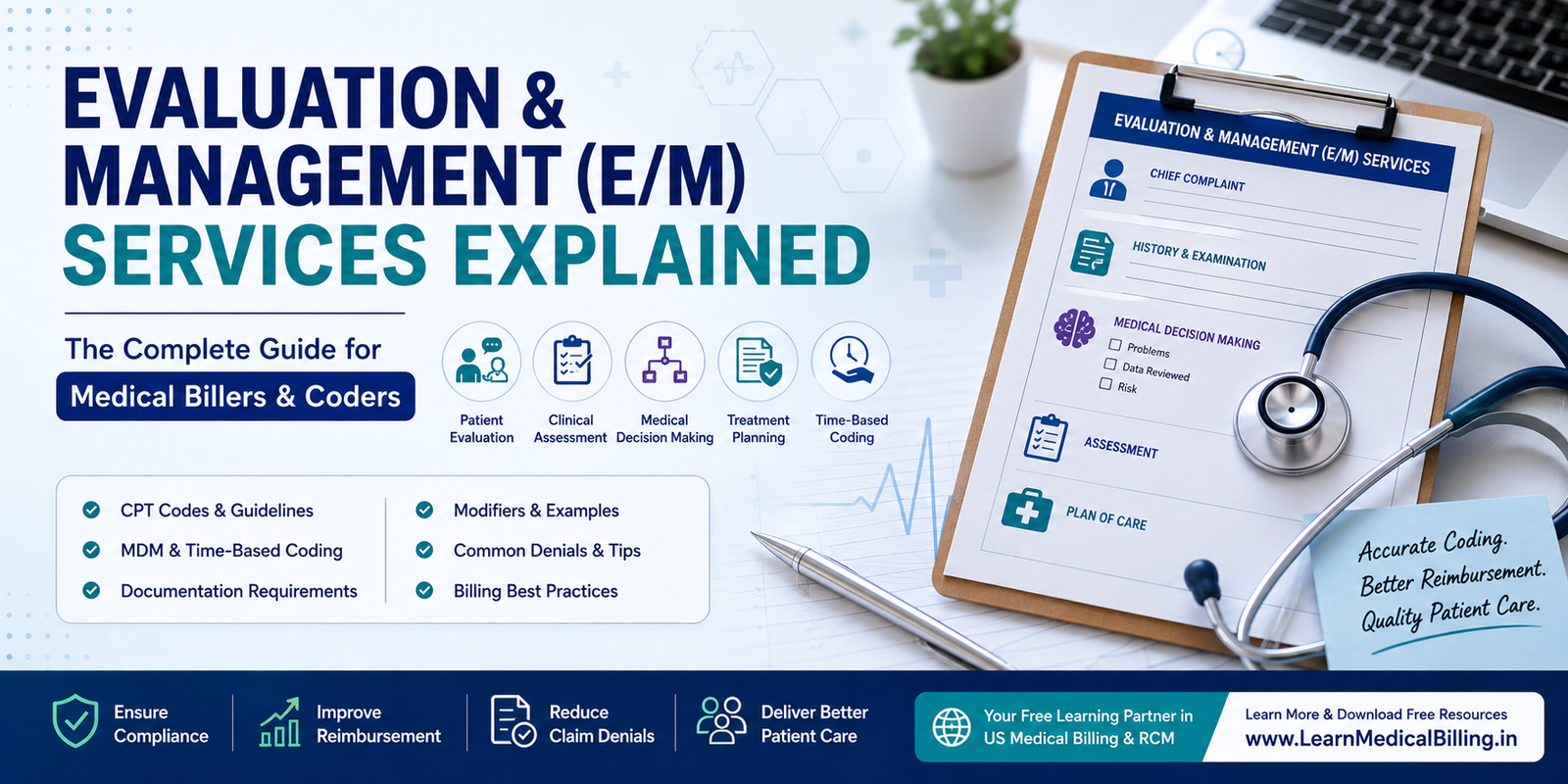
Evaluation and Management (E/M) Services Explained: The Complete Guide
Evaluation and Management (E/M) services are among the most commonly billed services in medical billing. Every day, physicians and other qualified healthcare professionals use E/M codes to report office visits, hospital care, consultations, preventive services, and other patient encounters.
Selecting the correct E/M code is critical because it directly affects reimbursement, compliance, and audit risk. Incorrect coding may result in claim denials, underpayments, overpayments, or payer audits.
This guide explains everything beginners and experienced billers need to know about E/M services.
What Are Evaluation and Management (E/M) Services?
Evaluation and Management (E/M) services are professional medical services that involve:
- Evaluating a patient’s health condition
- Assessing symptoms or medical problems
- Making clinical decisions
- Developing or updating a treatment plan
- Managing ongoing patient care
These services are reported using Current Procedural Terminology (CPT®) codes maintained by the American Medical Association (AMA).
Who Can Bill E/M Services?
E/M services may be reported by qualified healthcare professionals who are permitted to perform and document these services under applicable payer rules and state law. Examples include:
- Physicians (MD/DO)
- Nurse Practitioners (NP)
- Physician Assistants (PA)
- Clinical Nurse Specialists (CNS)
- Certified Nurse Midwives (CNM)
- Other qualified healthcare professionals, when allowed by payer policy
Always verify Medicare, Medicaid, commercial payer, and state-specific requirements.
Common Types of E/M Services
Office or Other Outpatient Visits
- New patient visits
- Established patient visits
Hospital Services
- Initial inpatient visits
- Subsequent inpatient visits
- Discharge management
Observation Services
- Initial observation
- Follow-up observation
- Discharge
Emergency Department Services
Nursing Facility Services
Home and Residence Services
Preventive Medicine Services
Annual Wellness Visits (Medicare)
Transitional Care Management (TCM)
Chronic Care Management (CCM)
Common Office Visit CPT Codes
New Patient
| CPT | Description |
|---|---|
| 99202 | Straightforward medical decision making (MDM) or 15–29 minutes |
| 99203 | Low MDM or 30–44 minutes |
| 99204 | Moderate MDM or 45–59 minutes |
| 99205 | High MDM or 60–74 minutes |
Established Patient
| CPT | Description |
|---|---|
| 99211 | Minimal service |
| 99212 | Straightforward MDM or 10–19 minutes |
| 99213 | Low MDM or 20–29 minutes |
| 99214 | Moderate MDM or 30–39 minutes |
| 99215 | High MDM or 40–54 minutes |
How Are E/M Codes Selected?
For office and other outpatient visits, code selection is generally based on one of two methods:
1. Medical Decision Making (MDM)
or
2. Total Time Spent on the Date of the Encounter
The provider should use the method that best reflects the work performed and meets documentation requirements.
Understanding Medical Decision Making (MDM)
MDM evaluates the complexity of the visit based on three elements:
- Number and complexity of problems addressed
- Amount and complexity of data reviewed or analyzed
- Risk of complications and/or morbidity or mortality related to patient management
The overall MDM level may be:
- Straightforward
- Low
- Moderate
- High
Time-Based Coding
When selecting an E/M code based on time, only qualifying professional time spent on the date of the encounter is counted.
Examples of qualifying activities include:
- Reviewing records
- Examining the patient
- Counseling
- Ordering tests
- Documenting the encounter
- Coordinating care
Time thresholds differ by CPT code.
Documentation Requirements
A complete E/M note generally includes:
- Chief Complaint (CC)
- History of Present Illness (HPI)
- Review of Systems (ROS), when applicable
- Physical Examination, as medically appropriate
- Assessment
- Plan of Care
- Medical Decision Making
- Provider Signature
Documentation should support the level of service billed.
Common E/M Modifiers
Modifier 25
Significant, separately identifiable E/M service performed on the same day as another procedure.
Modifier 24
Unrelated E/M service during the postoperative period.
Modifier 57
Decision for surgery.
Modifier 95
Synchronous telemedicine service when appropriate under payer policy.
Always verify payer-specific modifier requirements.
Real Billing Example
Patient: Established patient with hypertension and diabetes presenting for medication management.
CPT Code: 99214
Diagnosis Codes:
- I10 – Essential hypertension
- E11.9 – Type 2 diabetes mellitus without complications
POS: 11 (Office)
The provider performs a medically appropriate history and examination, reviews laboratory results, adjusts medications, and documents moderate-complexity medical decision making. The encounter supports reporting CPT 99214.
Common E/M Billing Denials
- Insufficient documentation
- Incorrect patient status (new vs. established)
- Wrong modifier
- Duplicate billing
- Incorrect place of service
- Upcoding or downcoding concerns
- Services not medically necessary
- Missing provider credentials
Tips for Medical Billers
✔ Confirm whether the patient is new or established.
✔ Verify documentation supports the billed level.
✔ Check payer-specific E/M policies.
✔ Review modifier usage carefully.
✔ Ensure diagnosis codes support medical necessity.
✔ Verify telehealth billing rules when applicable.
Frequently Asked Questions
What does E/M stand for?
Evaluation and Management.
Who maintains E/M CPT codes?
The American Medical Association (AMA).
Can E/M services be selected based on time?
Yes, when documentation supports the qualifying total time spent on the date of the encounter.
What is the most commonly billed office visit code?
For established patients, 99213 and 99214 are among the most frequently reported E/M codes.
Can an E/M service be billed with a procedure?
Yes, in certain situations. If a significant, separately identifiable E/M service is performed on the same day as another procedure, a modifier such as Modifier 25 may be appropriate, subject to payer rules and documentation requirements.
Key Takeaways
- E/M services describe the professional work involved in evaluating and managing patient care.
- Office visits can generally be selected using Medical Decision Making (MDM) or total time.
- Accurate documentation is essential to support the level of service billed.
- Proper use of modifiers and diagnosis codes helps reduce denials.
- Always follow the latest AMA CPT® guidance and payer-specific billing policies.
Official References
- American Medical Association (AMA) – CPT® Evaluation and Management guidance.
- Centers for Medicare & Medicaid Services (CMS) – Medicare Claims Processing Manual.
- CMS Medicare Learning Network (MLN) – Evaluation and Management Services resources.
- National Correct Coding Initiative (NCCI) policy manuals.
Editorial Note
This article is an original educational guide created for LearnMedicalBilling.in. It is based on publicly available guidance from official sources and industry standards. CPT® is a registered trademark of the American Medical Association (AMA). Always verify current payer policies and official coding guidance before submitting claims.