
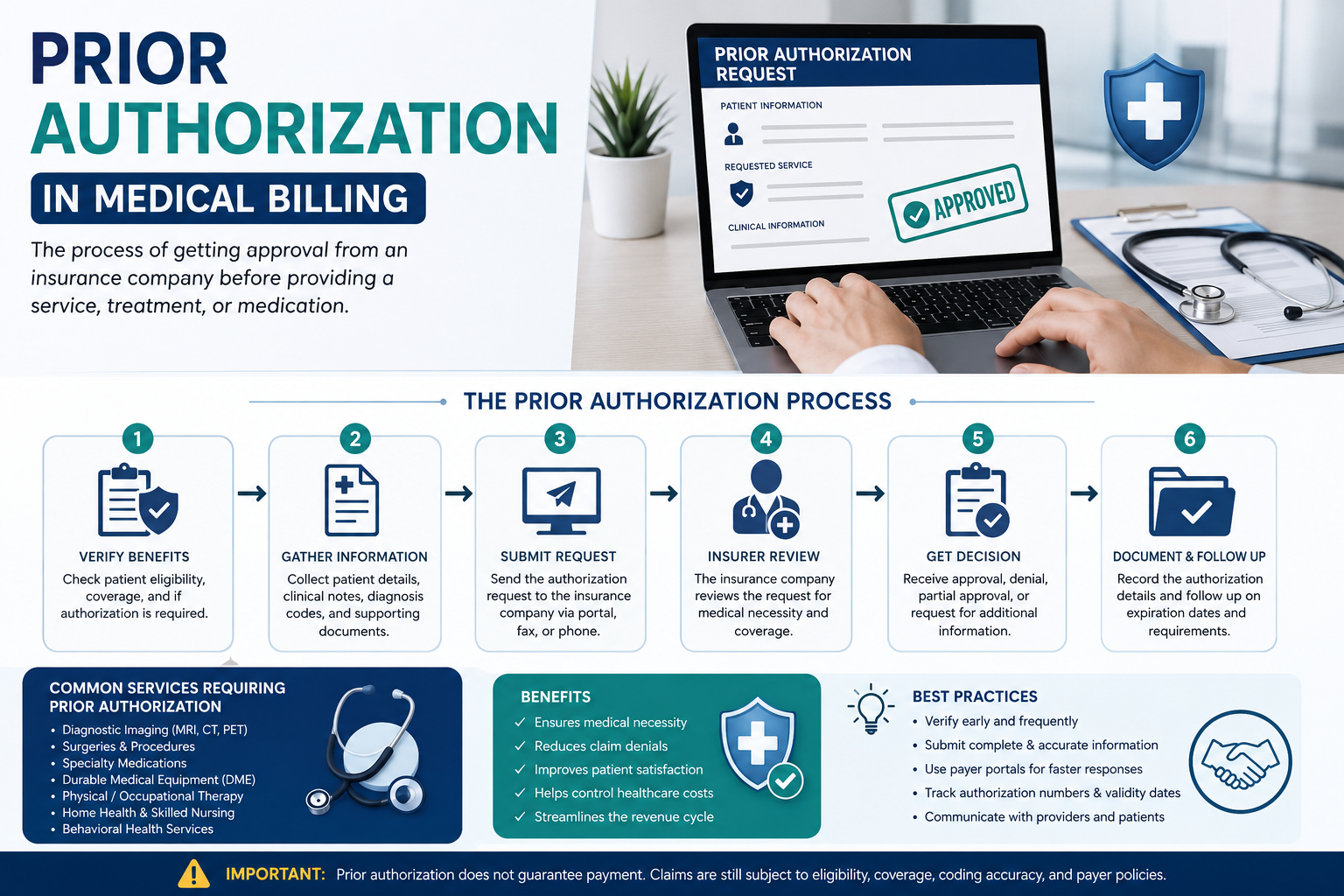
What is Prior Authorization?
Prior Authorization (PA), also called Preauthorization, Precertification, or Predetermination, is a utilization management process used by health insurance companies to determine whether a healthcare service, medication, procedure, or medical equipment is medically necessary before it is provided.
Receiving prior authorization does not guarantee payment. It only indicates that the payer considers the requested service medically necessary based on the information submitted. Final reimbursement still depends on the patient’s eligibility, benefits, coding accuracy, timely filing, and all other payer requirements.
Why Do Insurance Companies Require Prior Authorization?
Insurance companies use prior authorization to:
- Ensure medical necessity
- Reduce unnecessary healthcare costs
- Prevent duplicate services
- Confirm treatment follows clinical guidelines
- Control high-cost medications and procedures
- Improve quality of care
- Prevent fraud, waste, and abuse
Services That Commonly Require Prior Authorization
Many services may require authorization depending on the payer and benefit plan.
Diagnostic Imaging
- MRI
- CT Scan
- PET Scan
- Nuclear Medicine
- Specialized Ultrasound
Surgical Procedures
- Elective surgeries
- Bariatric surgery
- Spine surgery
- Cosmetic procedures (when medically necessary)
- Joint replacement
Specialty Medications
- Injectable drugs
- Biologics
- Chemotherapy drugs
- High-cost specialty medications
Durable Medical Equipment (DME)
- Wheelchairs
- CPAP Machines
- Oxygen Equipment
- Hospital Beds
- Prosthetics
Therapy Services
- Physical Therapy
- Occupational Therapy
- Speech Therapy
- Cardiac Rehabilitation
Behavioral Health
- Inpatient psychiatric admissions
- Intensive outpatient programs
- Substance abuse treatment
- Psychological testing
Home Health Services
- Skilled Nursing
- Home Health Visits
- Hospice Services
- Infusion Therapy
The Prior Authorization Process
Step 1: Verify Insurance Eligibility
Before requesting authorization, verify:
- Active insurance coverage
- Member ID
- Plan benefits
- PCP assignment
- Referral requirements
- Network status
Step 2: Determine Whether Authorization Is Required
Check:
- CPT code
- HCPCS code
- ICD-10 diagnosis
- Place of Service (POS)
- Provider specialty
- Facility type
Each payer maintains a list of services requiring authorization.
Step 3: Gather Clinical Documentation
Collect:
- Office notes
- Physician documentation
- Diagnostic reports
- Laboratory results
- Imaging reports
- Previous treatment history
- Medication history
- Medical necessity documentation
Step 4: Submit Authorization Request
Requests can be submitted through:
- Payer portals
- Electronic Prior Authorization (ePA)
- Fax
- Phone
- Electronic Health Record (EHR) systems
Step 5: Payer Clinical Review
The payer reviews:
- Medical necessity
- Clinical guidelines
- Insurance benefits
- Coverage criteria
- Patient eligibility
- Previous treatments
Step 6: Decision
Possible outcomes include:
Approved
Authorization number is issued.
Pending
Additional information is requested.
Denied
The request does not meet coverage requirements.
Partial Approval
Only part of the requested service is approved.
Information Required for Prior Authorization
Typical requests include:
- Patient demographics
- Insurance information
- Ordering provider
- Rendering provider
- Facility information
- CPT/HCPCS codes
- ICD-10 diagnosis codes
- Date of service
- Clinical notes
- Medical necessity documentation
Common Reasons for Prior Authorization Denials
Missing Clinical Documentation
Incomplete records make it difficult for the payer to determine medical necessity.
Incorrect CPT or Diagnosis Codes
Coding errors frequently lead to denials.
Insufficient Medical Necessity
Documentation does not support the requested service.
Out-of-Network Provider
Some plans require an in-network provider or separate approval for out-of-network care.
Experimental or Investigational Service
Certain procedures may not be covered because they are considered investigational.
Benefit Exclusion
The patient’s plan excludes the requested service.
Duplicate Authorization
A valid authorization already exists for the same service.
Expired Authorization
The service was performed after the authorization validity period ended.
Tips to Reduce Prior Authorization Denials
- Verify insurance before scheduling.
- Check payer authorization requirements for every visit.
- Submit complete clinical documentation.
- Ensure CPT and ICD-10 codes are accurate.
- Request authorization early.
- Track authorization expiration dates.
- Document authorization numbers in the patient account.
- Follow payer-specific policies.
- Respond promptly to requests for additional information.
- Keep copies of all submitted documentation.
Electronic Prior Authorization (ePA)
Many payers now support Electronic Prior Authorization (ePA), which helps providers:
- Submit requests electronically
- Receive faster decisions
- Track request status
- Reduce paperwork
- Minimize phone calls
- Improve workflow efficiency
Does Prior Authorization Guarantee Payment?
No.
Even with an approved authorization, payment may still be denied if:
- Coverage has terminated.
- The patient is ineligible on the date of service.
- The claim is filed late.
- The billed CPT/HCPCS code differs from the approved service.
- Coding or modifier errors occur.
- Documentation does not support the billed service.
- Provider credentialing requirements are not met.
- The service exceeds authorized units or dates.
Best Practices for Medical Billers
Successful prior authorization management requires:
- Maintaining a payer-specific authorization matrix
- Tracking authorization numbers and expiration dates
- Coordinating with clinical staff before scheduling
- Reviewing payer policy updates regularly
- Keeping thorough documentation of all communications
- Auditing denied claims to identify recurring issues
- Educating providers on documentation requirements
Frequently Asked Questions (FAQ)
Is prior authorization the same as a referral?
No. A referral is typically issued by a primary care provider to another healthcare provider, while prior authorization is approval from the insurance company for a specific service or treatment.
How long does prior authorization take?
Timeframes vary by payer and service. Urgent requests are often reviewed faster than routine requests.
Can an approved authorization still result in a denied claim?
Yes. Authorization confirms medical necessity but does not guarantee payment. Eligibility, coverage, coding, timely filing, and other payer rules still apply.
Who is responsible for obtaining prior authorization?
This depends on the payer and provider contract. In many cases, the ordering provider or rendering provider obtains the authorization before the service is performed.
Key Takeaways
Prior authorization is a critical step in the revenue cycle that helps ensure medically necessary services meet payer requirements before care is delivered. Effective eligibility verification, complete documentation, timely submission, and ongoing tracking can significantly reduce denials, improve reimbursement, and create a smoother experience for both providers and patients.
Sources
- Centers for Medicare & Medicaid Services (CMS): https://www.cms.gov
- American Medical Association (AMA): https://www.ama-assn.org
- Council for Affordable Quality Healthcare (CAQH): https://www.caqh.org
- National Committee for Quality Assurance (NCQA): https://www.ncqa.org