
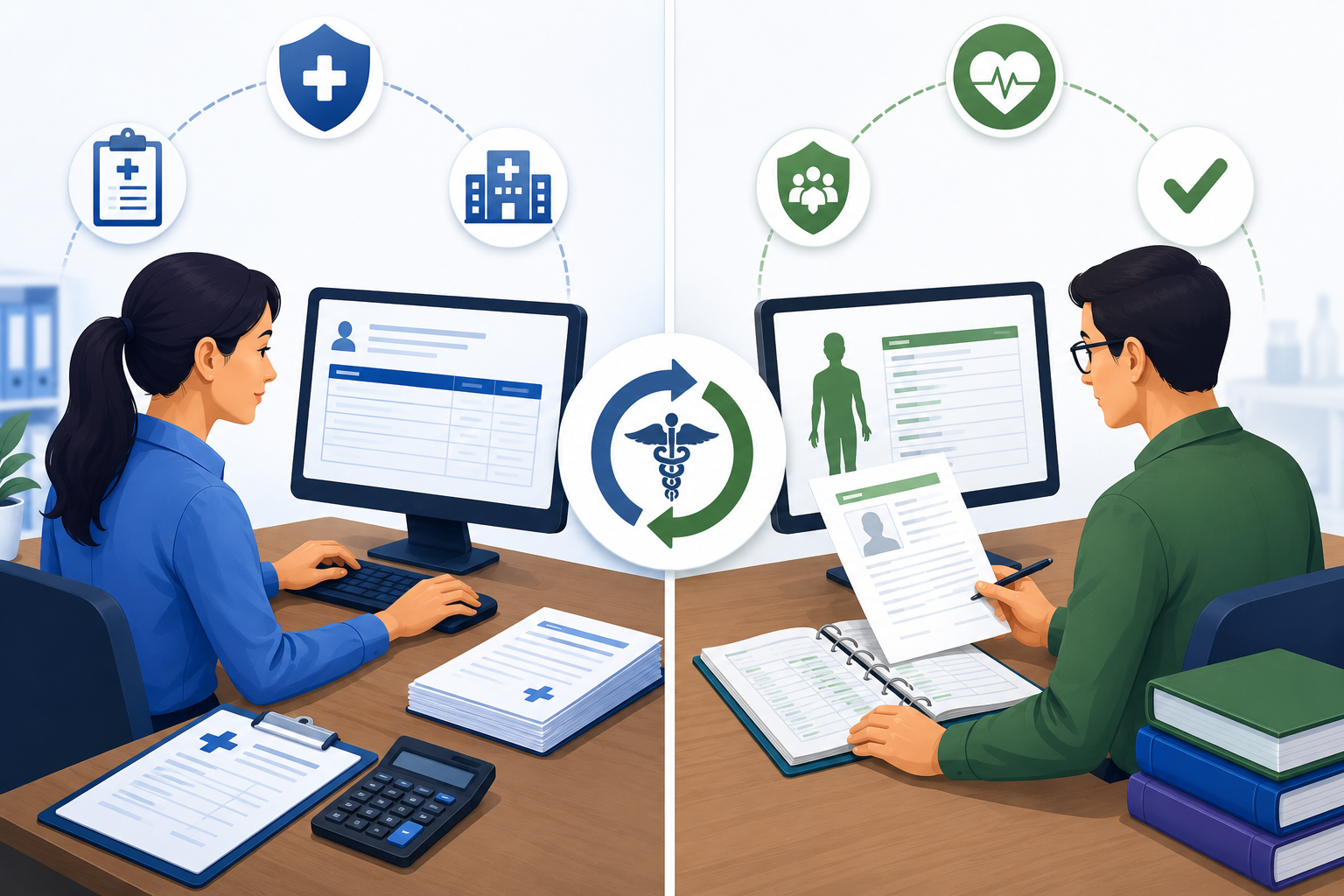
The healthcare industry relies on accurate documentation and timely payments. Two important roles make this possible: medical billing and medical coding.
Although these careers work closely together, they are not the same. Each has different responsibilities, skills, and career paths.
If you’re planning a career in healthcare administration or want to understand how insurance claims work, this guide explains the difference between Medical Billing vs Medical Coding in simple terms.
You’ll learn what each professional does, the skills required, salary expectations, and how both roles support the healthcare revenue cycle.
What Is Medical Billing?
Before comparing the two roles, it’s important to understand what medical billing is.
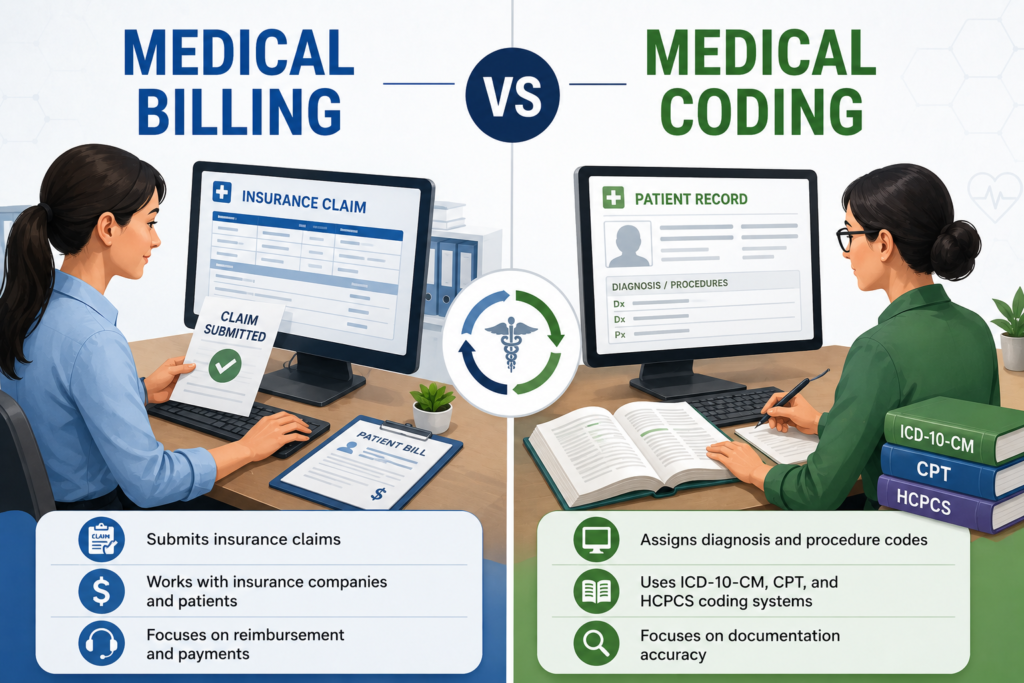
Medical billing is the process of preparing, submitting, and tracking insurance claims so healthcare providers receive payment for the medical services they deliver. Medical billers work with insurance companies, patients, and healthcare providers to ensure claims are processed accurately and payments are received on time.
While medical coding focuses on assigning standardized medical codes, medical billing uses those codes to complete the reimbursement process.
What Is Medical Coding?
Medical coding is the process of converting a patient’s medical information into standardized codes.
After a patient receives treatment, healthcare providers document the diagnosis, procedures, and services. A medical coder reviews these records and assigns the correct codes.
These codes are used for insurance claims, medical records, reporting, and reimbursement.
The three main coding systems used in the United States are:
- ICD-10-CM – Diagnosis codes
- CPT – Procedure and service codes
- HCPCS Level II – Medical supplies, equipment, and certain healthcare services
Accurate coding is essential. Even a small coding error can delay payment or lead to a claim denial.
The Biggest Difference Between Medical Billing and Medical Coding
Think of coding and billing as two connected steps in the healthcare revenue cycle.
Step 1: Medical Coding
Medical coders review patient records and assign standardized diagnosis and procedure codes.
Step 2: Medical Billing
Medical billers use those codes to create insurance claims. They submit the claims to insurance companies and follow up until payment is received.
Simply put:
- Medical coders create the language of the claim.
- Medical billers use that language to get the healthcare provider paid.
Medical Billing vs Medical Coding: Side-by-Side Comparison
| Medical Coding | Medical Billing |
|---|---|
| Assigns diagnosis and procedure codes | Submits insurance claims |
| Reviews clinical documentation | Reviews claim accuracy |
| Uses ICD-10, CPT, and HCPCS codes | Uses billing software and payer portals |
| Focuses on documentation accuracy | Focuses on reimbursement |
| Works mainly with medical records | Works with insurance companies and patients |
| Has little patient interaction | May communicate about claims or balances |
How Medical Billing and Medical Coding Work Together
Understanding Medical Billing vs Medical Coding becomes easier when you follow the workflow.
Step 1: The patient receives medical treatment.
Step 2: The provider documents the visit.
Step 3: The medical coder reviews the documentation and assigns the correct codes.
Step 4: The medical biller prepares and submits the insurance claim.
Step 5: The insurance company reviews the claim and processes payment.
Step 6: The patient receives a bill for any remaining balance.
Both roles are equally important.
If coding is incorrect, the insurance company may deny the claim.
If billing is incorrect, payment may be delayed or rejected.
Medical billing and medical coding are both essential parts of the healthcare revenue cycle. Coders ensure patient records are translated into standardized codes, while billers use those codes to communicate with insurance companies and manage the payment process. Without accurate coding, billing becomes difficult, and without proper billing, healthcare providers may experience delayed or denied reimbursements.
Skills Needed for Medical Coding
Successful medical coders usually have the following skills:
- Knowledge of anatomy and medical terminology
- Understanding of ICD-10-CM, CPT, and HCPCS coding systems
- Strong attention to detail
- Analytical thinking
- Ability to interpret medical documentation accurately
Skills Needed for Medical Billing
Medical billers need a different set of skills.
These include:
- Insurance claim processing
- Knowledge of payer guidelines
- Communication and customer service
- Problem-solving skills
- Experience with billing and revenue cycle management (RCM) software
Common Misconceptions About Medical Billing and Medical Coding
Many people assume medical billing and medical coding are the same job, but they require different skills and responsibilities.
Some common misconceptions include:
- One person always performs both roles.
- Medical coding only involves entering numbers into a system.
- Medical billing is simply sending invoices.
- Certification is mandatory for every entry-level position.
In reality, both professions contribute to the financial success of healthcare organizations, and their responsibilities often vary depending on the size of the medical practice or hospital.
Salary and Job Outlook
Medical billing and medical coding continue to be in high demand. As healthcare services grow, providers need trained professionals to manage documentation and reimbursement.
Medical Coder
- Expected demand in 2026: Strong
- Typical U.S. salary: $45,000–$70,000+
Medical Biller
- Expected demand in 2026: Strong
- Typical U.S. salary: $40,000–$65,000+
Professionals with certifications and experience often earn higher salaries, especially in hospitals, specialty clinics, and revenue cycle management companies.
Which Career Is Easier to Start?
For many beginners, medical billing is easier to learn.
Billing focuses on insurance claims, payment processes, and payer guidelines.
Medical coding requires a deeper understanding of anatomy, medical terminology, and coding rules. Because of this, coding usually involves more training and certification preparation.
Many professionals eventually learn both skills. Employers often prefer candidates who understand both billing and coding.
Can One Person Do Both Jobs?
Yes.
In small clinics and private practices, one employee may handle both coding and billing.
These professionals are often called Medical Billing and Coding Specialists.
In large hospitals and healthcare organizations, the roles are usually separated because of the higher volume and complexity of claims.
Should You Choose Medical Billing or Medical Coding?
Choose Medical Coding if you enjoy:
- Working independently
- Reviewing medical records
- Learning detailed coding guidelines
- Limited patient interaction
Choose Medical Billing if you enjoy:
- Working with insurance companies
- Solving claim and payment issues
- Communicating with patients and payers
- Tracking payments and financial performance
Many professionals begin in medical billing and later expand into coding, auditing, compliance, or revenue cycle management.
Final Thoughts
Medical billing and medical coding are different careers, but they work together every day.
Medical coders convert healthcare services into standardized codes.
Medical billers use those codes to submit insurance claims and collect payment.
Both careers offer excellent job stability, remote work opportunities, and long-term growth in the healthcare industry.
If you’re considering a career in healthcare administration, learning the difference between Medical Billing vs Medical Coding is a great place to begin.
Frequently Asked Questions (FAQs)
Medical coding converts healthcare services into standardized diagnosis and procedure codes, while medical billing uses those codes to prepare insurance claims and collect payment from insurance companies.
Neither is better—they serve different purposes. Medical coding focuses on documentation accuracy, while medical billing focuses on reimbursement and revenue cycle management. The right choice depends on your interests and career goals.
Yes. Smaller clinics often hire professionals who perform both billing and coding, while larger healthcare organizations usually separate the roles.
Generally, yes. Medical coding requires a deeper understanding of anatomy, medical terminology, and coding guidelines.