

Health insurance in the United States is divided into several categories based on who provides the coverage, how it is funded, and how healthcare services are managed. Understanding these insurance plans is essential for Medical Billers, Medical Coders, AR Callers, Eligibility Verification Specialists, Prior Authorization Teams, Healthcare Virtual Assistants, and Revenue Cycle Management (RCM) professionals.
Each insurance plan has its own eligibility requirements, covered benefits, provider network, authorization rules, claim submission process, and reimbursement policies. Knowing these differences helps healthcare professionals submit clean claims, reduce denials, and improve reimbursement.
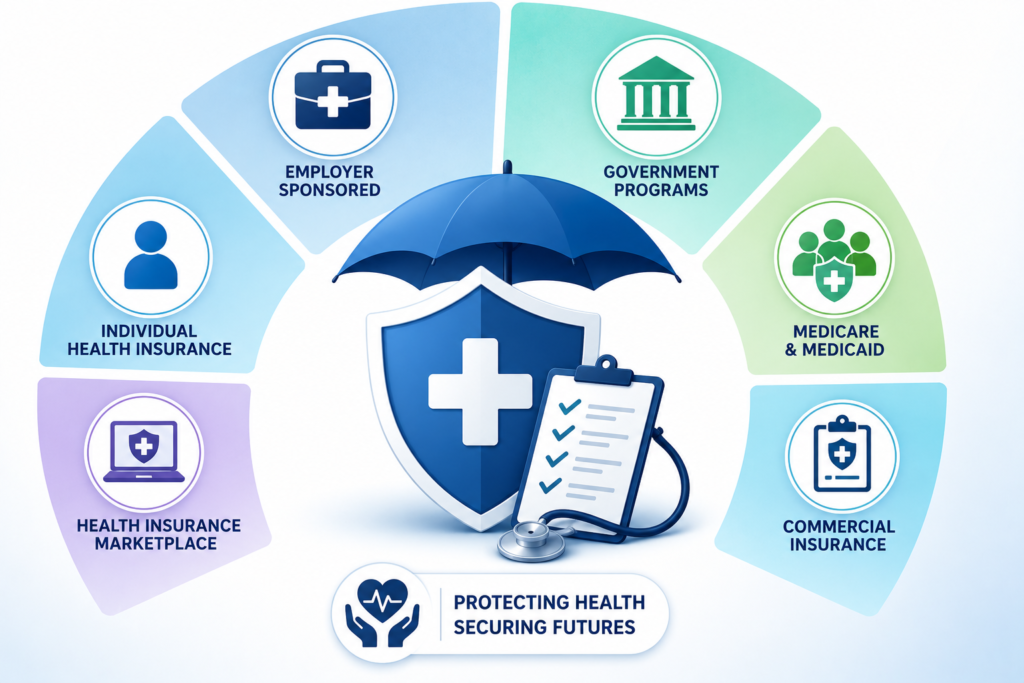
What Are Health Insurance Plans?
Many people search for health insurance plans when learning how healthcare coverage works in the United States. A health insurance plan is an agreement between an individual and an insurance provider that helps cover the cost of eligible medical services according to the plan’s terms and benefits.
Health insurance plans differ in eligibility, provider networks, premiums, deductibles, covered services, referrals, and prior authorization requirements. Understanding these differences is essential for medical billing professionals because every payer follows its own billing guidelines.
Employer-Sponsored Health Insurance
Employer-sponsored health insurance is the most common type of health coverage in the United States. In this arrangement, an employer offers health insurance benefits to eligible employees and often pays a portion of the monthly premium, while the employee pays the remaining amount through payroll deductions.
These plans may also allow employees to enroll eligible dependents such as spouses and children.
How It Works
After joining a company, eligible employees can enroll in one of the health plans offered by their employer. Once enrolled, the employee receives an insurance identification card that is used when visiting healthcare providers.
When medical services are provided, the healthcare provider submits a claim to the insurance company. The insurance company reviews the claim and pays according to the patient’s policy benefits and provider contract.
Example
Maria works for a software company that provides health insurance.
- Monthly Premium: $450
- Employer Pays: $320
- Employee Pays: $130
Maria visits her Primary Care Physician for a routine check-up. After the visit, the physician’s office submits a claim to the insurance company. Based on Maria’s benefits, the insurance company pays the provider, and Maria is responsible only for her required copayment.
Individual Health Insurance
Individual health insurance is purchased directly by an individual rather than through an employer.
People may choose an individual plan if they:
- Are self-employed
- Work as freelancers
- Are unemployed
- Retire before becoming eligible for Medicare
- Do not receive employer-sponsored insurance
Premiums, deductibles, and covered services vary depending on the insurance company and plan selected.
Health Insurance Marketplace Plans
The Health Insurance Marketplace was established under the Affordable Care Act (ACA) to help individuals and families purchase health insurance.
Marketplace plans are available in different coverage levels, commonly referred to as:
- Bronze
- Silver
- Gold
- Platinum
These levels generally differ in how costs are shared between the member and the insurance plan.
Some individuals may qualify for financial assistance based on household income and other eligibility requirements.
Government Health Insurance Programs
Government-sponsored health insurance programs provide healthcare coverage for eligible populations based on age, disability, income, military service, or other qualifying criteria.
The major government programs include:
- Medicare
- Medicaid
- Children’s Health Insurance Program (CHIP)
- TRICARE
- Veterans Health Administration (VA)
Each program follows its own eligibility and billing requirements.
Medicare
Medicare is a federal health insurance program administered by the Centers for Medicare & Medicaid Services (CMS).
It primarily serves:
- Eligible adults aged 65 and older
- Certain younger individuals with qualifying disabilities
- Individuals with End-Stage Renal Disease (ESRD) or Amyotrophic Lateral Sclerosis (ALS), subject to Medicare eligibility rules
Medicare is divided into different parts:
Medicare Part A
Generally helps cover inpatient hospital care, skilled nursing facility care, hospice care, and certain home health services.
Medicare Part B
Generally helps cover physician services, outpatient care, preventive services, and durable medical equipment when covered under Medicare rules.
Medicare Part C (Medicare Advantage)
Medicare Advantage plans are offered by private insurance companies approved by CMS. These plans provide Medicare-covered benefits and may include additional benefits depending on the specific plan.
Medicare Part D
Provides prescription drug coverage through private plans approved by Medicare.
Medical Billers must verify Medicare eligibility, coverage, medical necessity, and applicable billing requirements before claim submission.
Medicaid
Medicaid is a joint federal and state health insurance program that provides healthcare coverage to eligible individuals according to federal guidelines and state-specific eligibility rules.
Because Medicaid programs are administered by individual states, covered services, billing rules, and reimbursement policies may vary.
Healthcare providers should always verify:
- Active eligibility
- Managed care enrollment
- Referral requirements
- Prior authorization requirements
- State-specific billing rules
Children’s Health Insurance Program (CHIP)
CHIP provides healthcare coverage for eligible children in families who meet program requirements but may not qualify for Medicaid.
Covered services often include:
- Preventive care
- Physician visits
- Hospital care
- Immunizations
- Prescription medications
- Dental and vision services (depending on the state program)
Tricare
TRICARE provides healthcare coverage for eligible active-duty service members, National Guard and Reserve members, military retirees, and eligible family members.
Healthcare providers should verify eligibility, referral requirements, and authorization requirements before services are rendered.
Veterans Health Administration (VA)
The Veterans Health Administration provides healthcare services to eligible military veterans through VA medical facilities and authorized community care programs.
Billing requirements depend on the veteran’s eligibility and the type of care received.
Commercial Health Insurance
Commercial insurance refers to private health insurance plans offered by insurance companies.
Coverage may be obtained through:
- Employers
- Individual purchase
- Associations
- Marketplace plans
Common commercial insurance companies include organizations that offer PPO, HMO, EPO, and POS plans.
Commercial plans often have different requirements for:
- Eligibility verification
- Prior authorization
- Referrals
- Claims submission
- Timely filing
- Appeals
- Medical necessity
Medical Billers should review each payer’s provider policies before submitting claims.
Managed Care Organizations (MCOs)
Managed Care Organizations help coordinate healthcare services while managing costs.
Their goals include:
- Improving quality of care
- Encouraging preventive services
- Managing referrals
- Reducing unnecessary healthcare spending
- Coordinating patient care
Many Medicaid and commercial plans operate through managed care organizations.
Why Understanding Insurance Plans Matters in Medical Billing
Every insurance plan has different billing rules.
For example:
- One payer may require prior authorization for an MRI.
- Another payer may require only a referral.
- Medicare may have different documentation requirements than a commercial insurance plan.
- Medicaid billing rules may vary by state.
Medical Billers, AR Callers, and Coders must verify plan-specific requirements before submitting claims to reduce denials and improve reimbursement.
Key Takeaways
- The United States has both government-sponsored and private health insurance plans.
- Employer-sponsored insurance remains one of the most common forms of coverage.
- Medicare and Medicaid have different eligibility requirements and billing rules.
- Commercial insurance plans vary by payer and policy.
- Understanding insurance plans helps improve claim accuracy, reduce denials, and support efficient Revenue Cycle Management.