
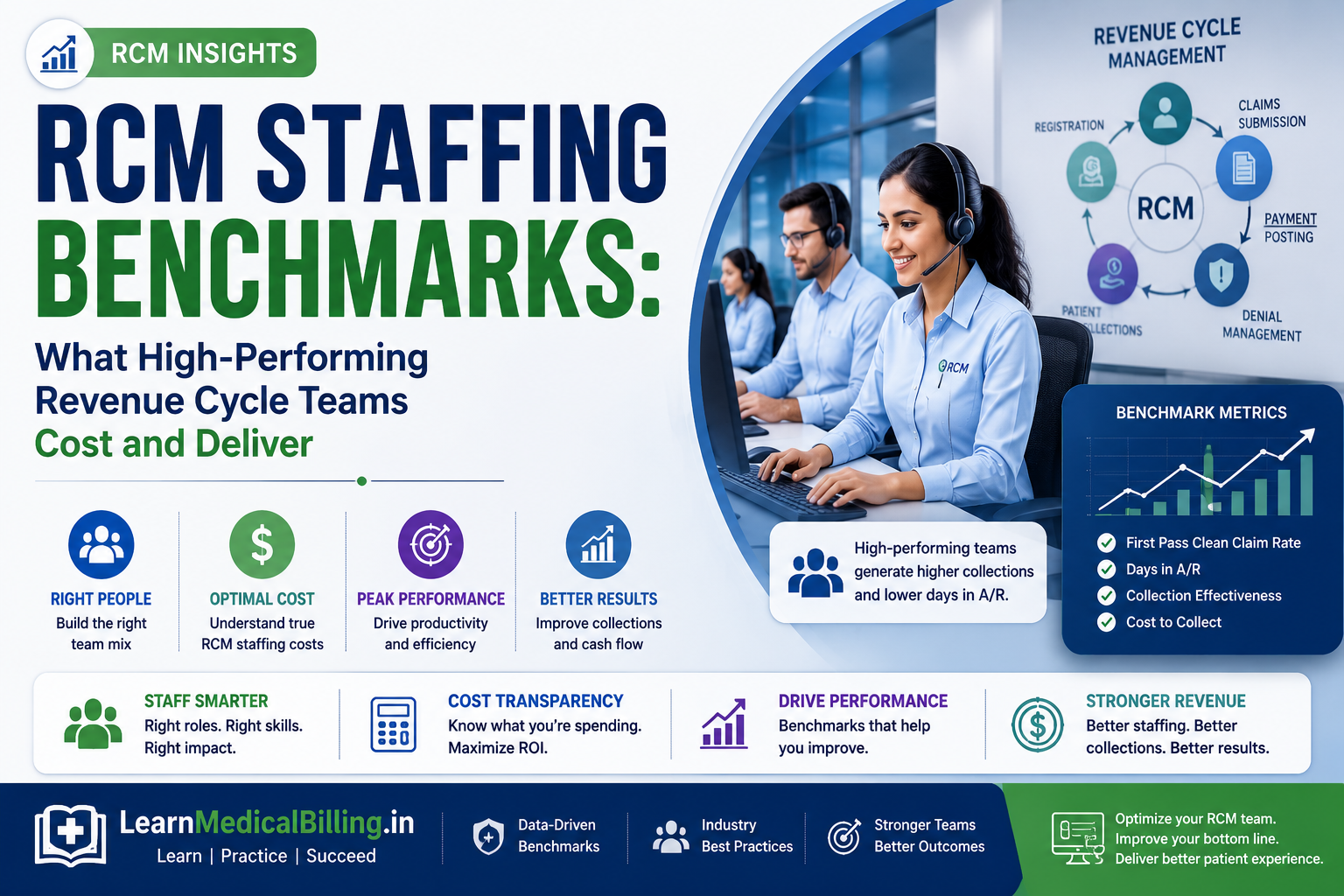
Healthcare organizations are under constant pressure to increase collections, reduce denials, improve cash flow, and control operating expenses. At the same time, recruiting and retaining experienced Revenue Cycle Management (RCM) professionals has become increasingly challenging.
Many organizations focus only on employee salaries when evaluating staffing costs. However, a high-performing revenue cycle team costs more than payroll alone—and when managed effectively, it delivers measurable improvements in financial performance. Recent industry guidance emphasizes evaluating the fully loaded cost of staffing and comparing it with key operational outcomes rather than salary alone. (HFMA)
What Are RCM Staffing Benchmarks?
RCM staffing benchmarks are performance indicators that help healthcare organizations evaluate whether they have:
- The right number of employees
- The right skill mix
- Appropriate staffing costs
- Strong financial performance
- Efficient operational workflows
Benchmarking allows leaders to compare their revenue cycle performance against recognized industry metrics and identify opportunities for improvement. HFMA’s MAP Keys framework is widely used for standardized revenue cycle benchmarking. (HFMA)
Why Staffing Benchmarks Matter
Poor staffing decisions can lead to:
- Increased claim denials
- Longer Days in Accounts Receivable (A/R)
- Higher labor costs
- Increased staff burnout
- Delayed reimbursements
- Lower patient satisfaction
Well-structured teams generally produce:
- Faster claim submission
- Better clean claim rates
- Reduced denial rates
- Improved collections
- Stronger compliance
- Better patient financial experiences
The True Cost of an RCM Employee
The actual cost of an RCM professional extends well beyond base salary.
Typical cost components include:
Direct Costs
- Base salary
- Overtime
- Shift differentials
Employee Benefits
- Health insurance
- Retirement contributions
- Paid leave
- Payroll taxes
Hiring Costs
- Recruitment
- Background checks
- Onboarding
- Training
Technology Costs
- Practice management software
- Clearinghouse fees
- Coding tools
- Denial management systems
- Eligibility verification platforms
Operational Costs
- Office space
- Equipment
- Management oversight
- Continuing education
- Compliance training
HFMA guidance on cost-to-collect recommends including these categories when calculating the full cost of revenue cycle operations. (HFMA)
Core RCM Roles
A balanced RCM team may include:
Front-End Revenue Cycle
- Patient Registration
- Insurance Verification
- Prior Authorization
- Financial Counseling
Mid-Cycle
- Medical Coding
- Charge Entry
- Charge Capture
- Documentation Review
Back-End
- Claim Submission
- Payment Posting
- Denial Management
- Accounts Receivable (AR) Follow-up
- Appeals
- Patient Collections
Key Performance Metrics
High-performing organizations monitor more than staffing counts. Common KPIs include:
Clean Claim Rate
Measures the percentage of claims accepted without edits or rework.
Higher rates reduce delays and administrative costs.
Initial Denial Rate
Tracks claims denied on first submission.
Lower denial rates generally indicate stronger front-end and coding processes.
Days in Accounts Receivable (Days in A/R)
Measures the average number of days required to collect payment.
Lower Days in A/R generally improve cash flow.
Net Collection Rate
Measures how effectively collectible revenue is converted into cash.
Cost to Collect
Shows how much it costs the organization to collect each dollar of revenue.
Prior Authorization Success Rate
Measures authorization approval efficiency.
First-Pass Resolution Rate
Indicates the percentage of claims successfully processed without additional work.
HFMA’s MAP Keys identify standardized definitions for many of these metrics. (HFMA)
Common Staffing Challenges
Healthcare organizations frequently encounter:
- High turnover
- Recruiting difficulties
- Burnout
- Rising labor costs
- Coding shortages
- Denial backlogs
- Increasing payer complexity
These issues can reduce productivity and increase revenue leakage.
Onshore vs Offshore RCM Teams
Many organizations evaluate different staffing models.
Onshore Teams
Advantages
- Strong payer familiarity
- Easier communication
- Local regulatory knowledge
Challenges
- Higher labor costs
- Limited talent availability
Offshore Teams
Advantages
- Lower operating costs
- Expanded staffing capacity
- Extended operational hours
Challenges
- Training requirements
- Time zone coordination
- Quality oversight
- Compliance management
Organizations considering offshore or hybrid models should evaluate both costs and quality outcomes. (HFMA)
Building a High-Performing RCM Team
Successful organizations typically:
- Hire experienced staff
- Invest in ongoing education
- Use automation appropriately
- Track KPIs regularly
- Reduce manual work
- Improve denial prevention
- Standardize workflows
- Conduct routine audits
Technology That Improves Productivity
Modern revenue cycle teams increasingly rely on:
- AI-assisted coding
- Robotic Process Automation (RPA)
- Eligibility verification tools
- Denial management software
- Revenue cycle analytics dashboards
- Automated payment posting
- Claim scrubbing solutions
Technology should complement skilled staff rather than replace them.
Best Practices
✔ Measure productivity monthly
✔ Review staffing annually
✔ Monitor cost-to-collect
✔ Cross-train employees
✔ Reduce turnover
✔ Use standardized KPIs
✔ Monitor denial trends
✔ Invest in continuing education
Common Mistakes
❌ Measuring salary only
❌ Ignoring employee turnover costs
❌ Understaffing AR follow-up
❌ Delaying technology investments
❌ Tracking too few KPIs
❌ Overlooking training expenses
Frequently Asked Questions
What is an RCM staffing benchmark?
It is a measurable standard used to evaluate staffing efficiency, costs, and operational performance within the revenue cycle.
Why shouldn’t organizations look only at salaries?
Because recruitment, training, benefits, software, management, and turnover contribute significantly to the total cost of staffing. (HFMA)
Which KPIs are most important?
Organizations commonly monitor:
- Clean Claim Rate
- Initial Denial Rate
- Days in A/R
- Net Collection Rate
- Cost to Collect
- Prior Authorization Performance
Should every healthcare organization use the same staffing model?
No. Staffing needs vary depending on organization size, specialty, patient volume, payer mix, technology, and operational goals.
Key Takeaways
- High-performing RCM teams balance staffing costs with measurable operational outcomes.
- Evaluate the fully loaded cost of staffing—not just salaries.
- Benchmark performance using standardized KPIs such as Days in A/R, denial rates, clean claim rate, net collection rate, and cost to collect.
- Invest in technology, training, and workflow optimization to improve productivity and financial performance.
- Regular benchmarking helps organizations make informed staffing and investment decisions.
Sources
This article is an original educational summary based on publicly available information from:
- HFMA – RCM Staffing Benchmarks: What High-Performing Revenue Cycle Teams Cost and Deliver
- HFMA MAP Keys – Revenue Cycle Benchmarking KPIs
- HFMA – Healthcare Revenue Cycle Management Overview
- HFMA – Cost-to-Collect Better Practices Guide
Editorial Note: This article is an original educational summary prepared for LearnMedicalBilling.in. It is based on publicly available information and industry guidance and does not reproduce copyrighted material from the referenced sources.